Response prediction and risk stratification of patients with rectal cancer after neoadjuvant therapy through an analysis of circulating tumour DNA
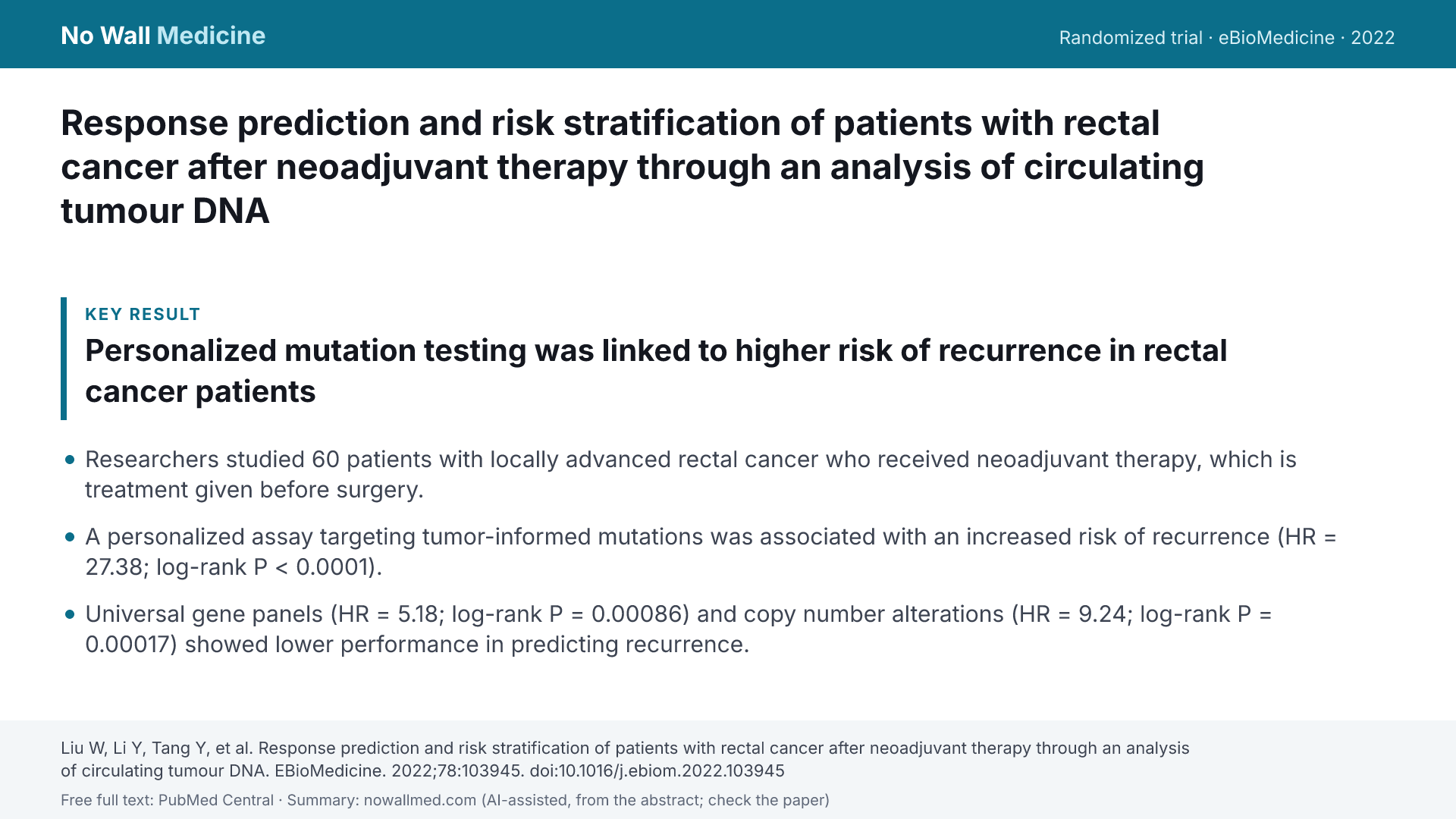
Key result: Personalized mutation testing was linked to higher risk of recurrence in rectal cancer patients
Key points
- Researchers studied 60 patients with locally advanced rectal cancer who received neoadjuvant therapy, which is treatment given before surgery.
- A personalized assay targeting tumor-informed mutations was associated with an increased risk of recurrence (HR = 27.38; log-rank P < 0.0001).
- Universal gene panels (HR = 5.18; log-rank P = 0.00086) and copy number alterations (HR = 9.24; log-rank P = 0.00017) showed lower performance in predicting recurrence.
Why it matters: It is difficult to compare different methods used to detect minimal residual disease, which is the small amount of cancer cells remaining after treatment.
Discussion prompts
- Would these patients look like yours? Who was left out?
- Is the main outcome one that matters to patients?
- Is the difference large enough to change what you do?
Cite: Liu W, Li Y, Tang Y, et al. Response prediction and risk stratification of patients with rectal cancer after neoadjuvant therapy through an analysis of circulating tumour DNA. EBioMedicine. 2022;78:103945. doi:10.1016/j.ebiom.2022.103945
Free full text: PubMed Central · Summary and visual abstract: nowallmed.com/a/response-prediction-and-risk-stratification-of-patients-with-rectal-1vmkezd/ (AI-assisted from the abstract; check the paper before relying on it).