Restrictive fluid management was associated with lower fluid accumulation and shorter hospital stays in shock patients
Restrictive fluid management with early de-escalation versus usual care in critically ill patients (reduce trial): a feasibility randomized controlled trial
Single-center, feasibility, randomized controlled trialBenefit found
Is restrictive fluid management with early de-escalation feasible in critically ill patients?
Who
100
Patients with shock requiring fluid resuscitation in a medical intensive care unit · Single-center medical intensive care unit
Compared
Restrictive fluid strategy: ‒2353 mL
Usual care: 793 mL
Main outcome
Cumulative fluid balance at day 3
Bottom line: Restrictive fluid management is feasible and may reduce fluid accumulation and hospital stay in critically ill patients.
Crit Care · 2025-09-25Download image
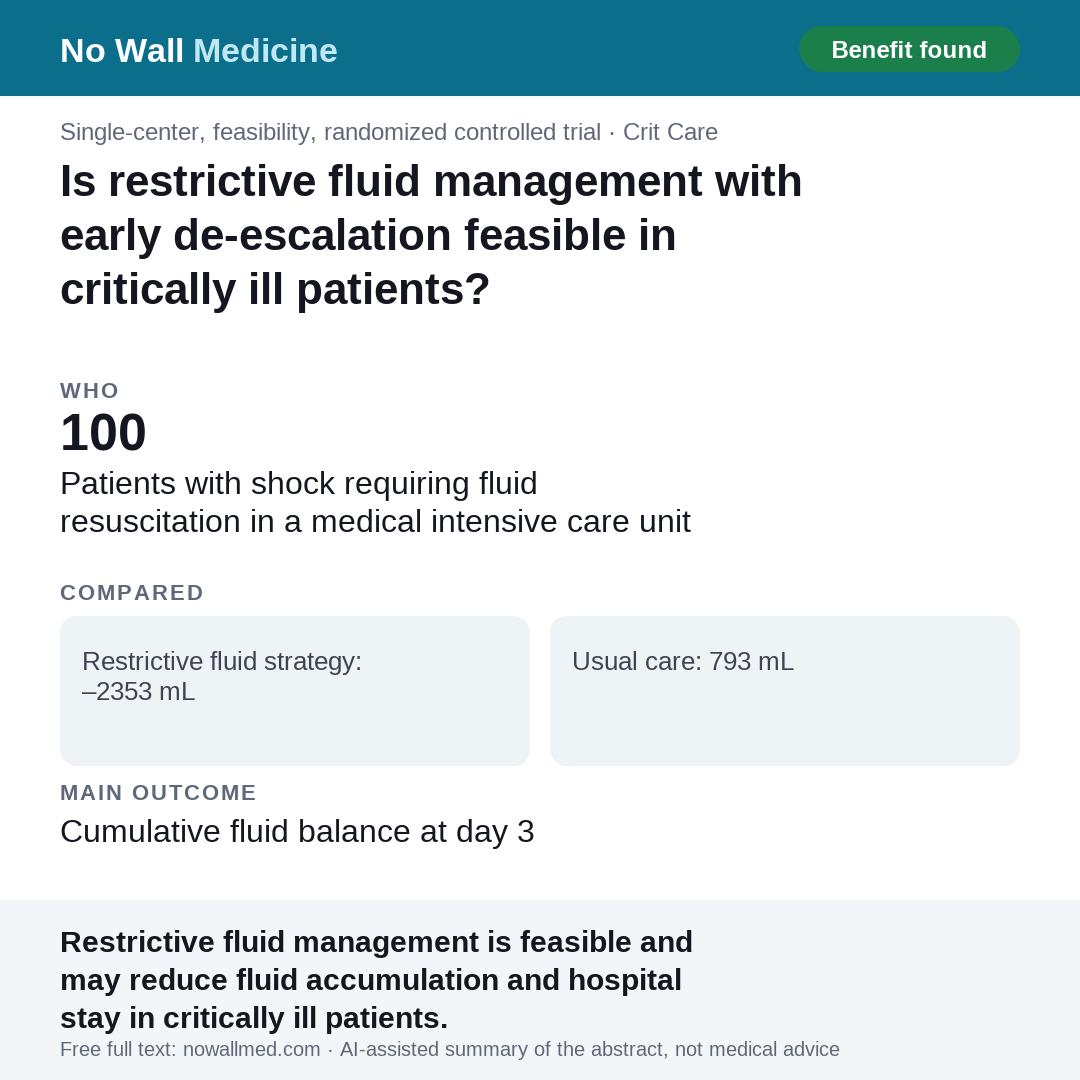
Clinical question: Is restrictive fluid management with early de-escalation feasible in critically ill patients?
Why it matters: Optimal fluid management strategies for patients in circulatory shock vary across different phases of care.
Key points
- Researchers conducted a single-center feasibility trial with 100 patients in a medical intensive care unit who required fluid resuscitation for circulatory shock.
- The restrictive group had a lower cumulative fluid balance at day 3 compared to usual care, with -2353 mL versus 793 mL (p < 0.001).
- Patients in the restrictive group had shorter intensive care unit stays of 7 days versus 10 days and shorter hospital stays of 16 days versus 22 days.
Limitation the authors note: The study was a single-center feasibility randomized controlled trial.
Headline and key points written with AI from the paper’s abstract, with every number checked against it. Read the paper before relying on them.
Topics
Cite this article
Naorungroj T, Prajantasen U, Sanla-Ead T, Viarasilpa T, Tongyoo S. Restrictive fluid management with early de-escalation versus usual care in critically ill patients (reduce trial): a feasibility randomized controlled trial. Crit Care. 2025. doi:10.1186/s13054-025-05624-z
Spotted a mistake? Suggest a correction
Top studies every Monday
The week’s key trials and guidelines in your specialties, by email. Free.
Get the weekly digest