Restrictive versus conventional ward fluid therapy in non-cardiac surgery patients and the effect on postoperative complications: a meta-analysis
Meta-analysis of seven recordsBenefit found
Does restrictive versus conventional ward fluid therapy affect postoperative complications?
Who
883
Adult human patients after non-cardiac surgery
Compared
Restrictive fluid regimen
Conventional fluid regimen
Main outcome
Overall complication rate
Result: risk ratio 0.46 (95% CI 0.23 to 0.95) in randomized controlled trials
Bottom line: Restrictive fluid therapy may reduce postoperative complication rates in randomized controlled trials for non-cardiac surgery patients.
Limitation: Small sample size, moderate to low quality of evidence, and inclusion of non-randomized studies.
Perioper Med · 2023-09-21Download image
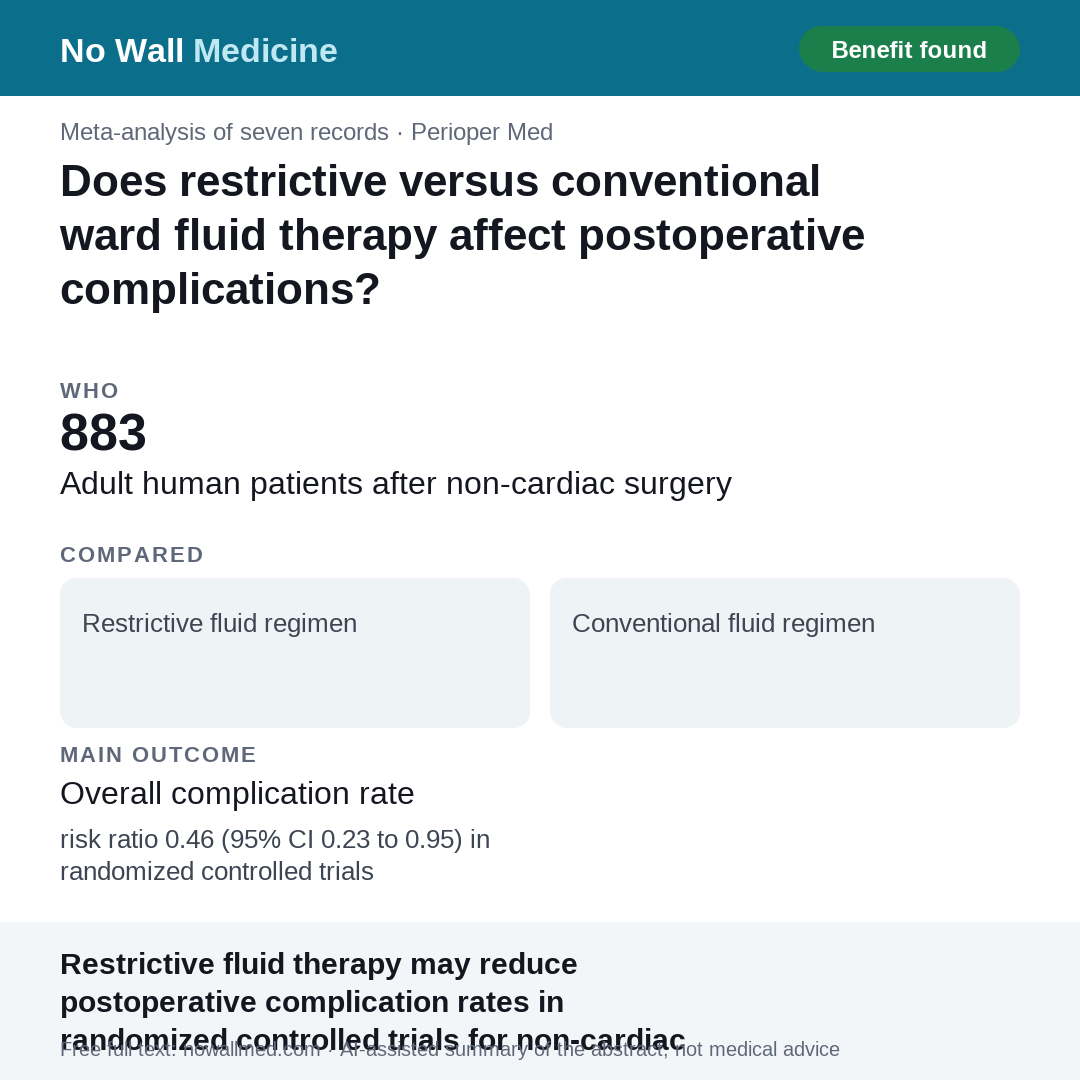
Clinical question: Does restrictive versus conventional ward fluid therapy affect postoperative complications?
Abstract
Background
Diligent fluid management is an instrumental part of Enhanced Recovery After Surgery. However, the effect of a ward regimen to limit intravenous fluid administration on outcome remains unclear. We performed a meta-analysis investigating the effect of a restrictive versus a conventional fluid regimen on complications in patients after non-cardiac surgery in the postoperative period on the clinical ward. Study design
We performed a systematic search in MEDLINE, Embase, Cochrane Library, and CINAHL databases, from the start of indexing until June 2022, with constraints for English language and adult human study participants. Data were combined using classic methods of meta-analyses and were expressed as weighted pooled risk ratio (RR) or odds ratio (OR) with 95% confidence interval (CI). Quality assessment and risk of bias analyses was performed according to PRISMA guidelines. Results
Seven records, three randomized controlled trials, and four non-randomized studies were included with a total of 883 patients. A restrictive fluid regimen was associated with a reduction in overall complication rate in the RCTs (RR 0.46, 95% CI 0.23 to 0.95; P < .03; I2 = 35%). This reduction in overall complication rate was not consistent in the non-randomized studies (RR 0.74, 95% CI 0.53 to 1.03; P 0.07; I2 = 45%). No significant association was found for mortality using a restrictive fluid regimen (RCTs OR 0.51, 95% CI 0.05 to 4.90; P = 0.56; I2 = 0%, non-randomized studies OR 0.30, 95% CI 0.06 to 1.46; P = 0.14; I2 = 0%). A restrictive fluid regimen is significantly associated with a reduction in postoperative length of stay in the non-randomized studies (MD - 1.81 days, 95% CI - 3.27 to - 0.35; P = 0.01; I2 = 0%) but not in the RCTs (MD 0.60 days, 95% CI - 0.75 to 1.95; P = 0.38). Risk of bias was moderate to high. Methodological quality was very low to moderate. Conclusion
This meta-analysis suggests restrictive fluid therapy on the ward may be associated with an effect on postoperative complication rate. However, the quality of evidence was moderate to low, the sample size was small, and the data came from both RCTs and non-randomized studies.
Cite this article
Bosboom JJ, Wijnberge M, Geerts BF, Kerstens M, Mythen MG, Vlaar APJ. Restrictive versus conventional ward fluid therapy in non-cardiac surgery patients and the effect on postoperative complications: a meta-analysis. Perioper Med. 2023. doi:10.1186/s13741-023-00337-9
Spotted a mistake? Suggest a correction
Top studies every Monday
The week’s key trials and guidelines in your specialties, plus any topics you follow. By email, free.
Get the weekly digest