Decision support software for fluid management resulted in lower lactate levels during major liver surgery
Restrictive versus Decision Support Guided Fluid Therapy during Major Hepatic Resection Surgery: A Randomized Controlled Trial
Prospective, randomized controlled, assessor- and patient-blinded superiority studyBenefit found
Does decision support guided fluid therapy decrease arterial lactate during major hepatic resection?
Who
90
Patients undergoing major liver surgery with an arterial catheter
Compared
Decision support group: 2.5 [1.9 to 3.7] mmol · l-1
Restrictive fluid group: 4.6 [3.1 to 5.4] mmol · l-1
Main outcome
Arterial lactate level upon completion of surgery
Result: median difference, -2.1; 95% CI, -2.7 to -1.2
Bottom line: Decision support guided fluid therapy resulted in lower arterial lactate levels compared to a restrictive fluid strategy during major hepatic resection.
Limitation: Future trials are necessary to make conclusive recommendations that will change clinical practice.
Anesthesiology · 2024-07-26Download image
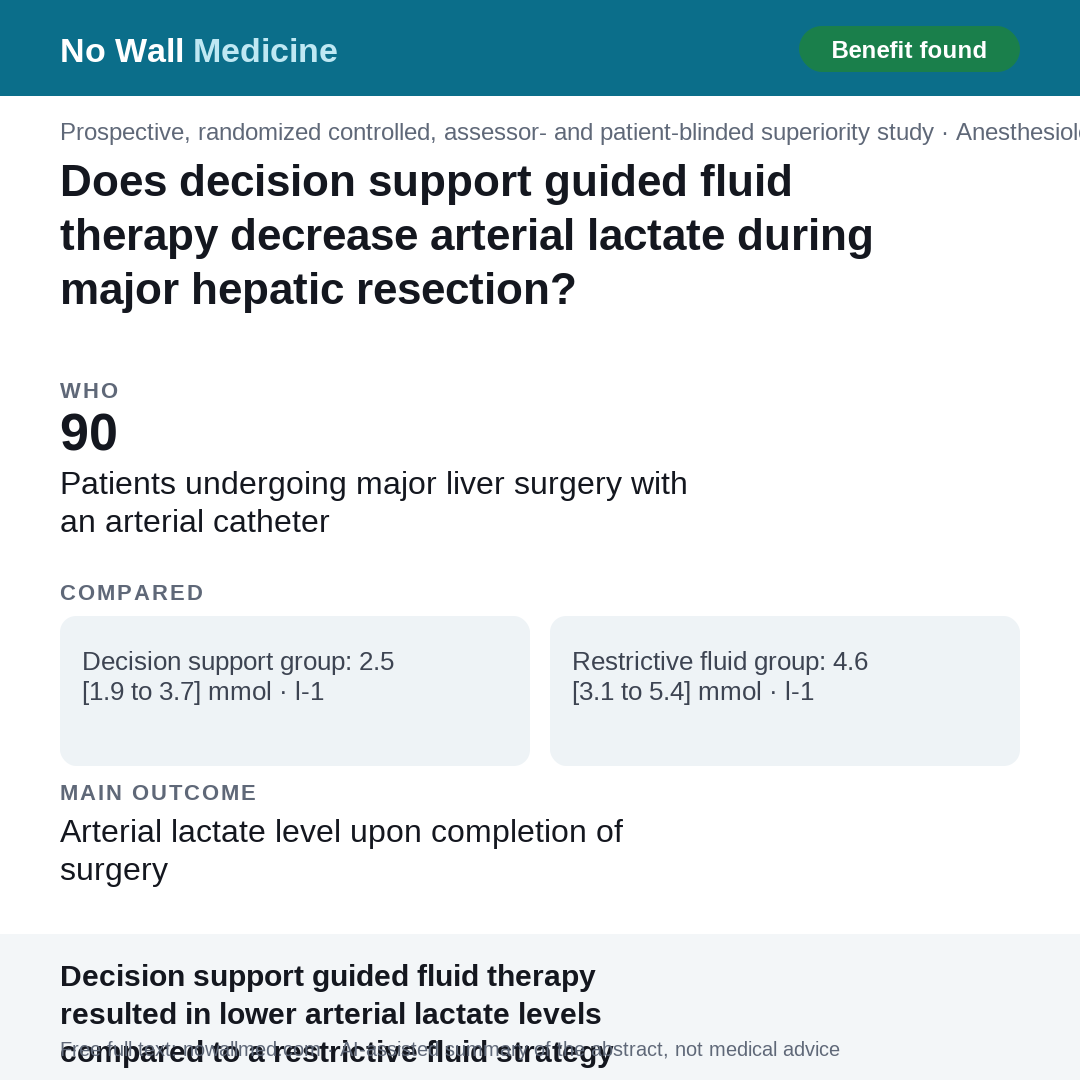
Clinical question: Does decision support guided fluid therapy decrease arterial lactate during major hepatic resection?
Why it matters: It is unknown whether using decision support software to guide fluid administration can prevent high lactate levels caused by restrictive fluid strategies during major liver surgery.
Key points
- Researchers conducted a randomized trial with 90 patients undergoing major liver resection to compare software-guided fluid therapy against a restrictive fluid strategy.
- The decision support group had a lower median arterial lactate level at skin closure than the restrictive group, with 2.5 [1.9 to 3.7] mmol · l-1 versus 4.6 [3.1 to 5.4] mmol · l-1.
- There was no difference in blood loss between the groups, though central venous pressure was higher in the decision support group at 7.7 ± 2.0 mmHg versus 6.6 ± 1.1 mmHg.
Headline and key points written with AI from the paper’s abstract, with every number checked against it. Read the paper before relying on them.
Topics
Cite this article
Coeckelenbergh S, Soucy-Proulx M, Van der Linden P, Roullet S, Moussa M, Kato H. Restrictive versus Decision Support Guided Fluid Therapy during Major Hepatic Resection Surgery: A Randomized Controlled Trial. Anesthesiology. 2024. doi:10.1097/ALN.0000000000005175
Spotted a mistake? Suggest a correction
Top studies every Monday
The week’s key trials and guidelines in your specialties, plus any topics you follow. By email, free.
Get the weekly digest