Liberal blood transfusion strategy may lower death or heart attack risk after myocardial infarction
Restrictive vs Liberal Transfusion Strategy After Myocardial Infarction: A Post Hoc Analysis of the MINT Randomized Clinical Trial
Post hoc analysis of a randomized clinical trialBenefit found
Is a liberal versus restrictive transfusion strategy better for myocardial infarction and anemia?
Who
3504
Adults hospitalized with myocardial infarction and anemia · 144 sites in 6 countries
Compared
Liberal transfusion strategy: 1.4% to 2.4% lower risk of 30-day death or MI
Restrictive transfusion strategy
Main outcome
30-day death or myocardial infarction and heart failure
Result: risk difference 1.4% (95% credible interval, -0.8% to 3.5%) to 2.4% (95% credible interval, 0.3%-4.6%) lower
Bottom line: A liberal transfusion strategy was associated with lower 30-day death or myocardial infarction risk, outweighing increased heart failure risk.
JAMA Netw Open · 2026-07-01Download image
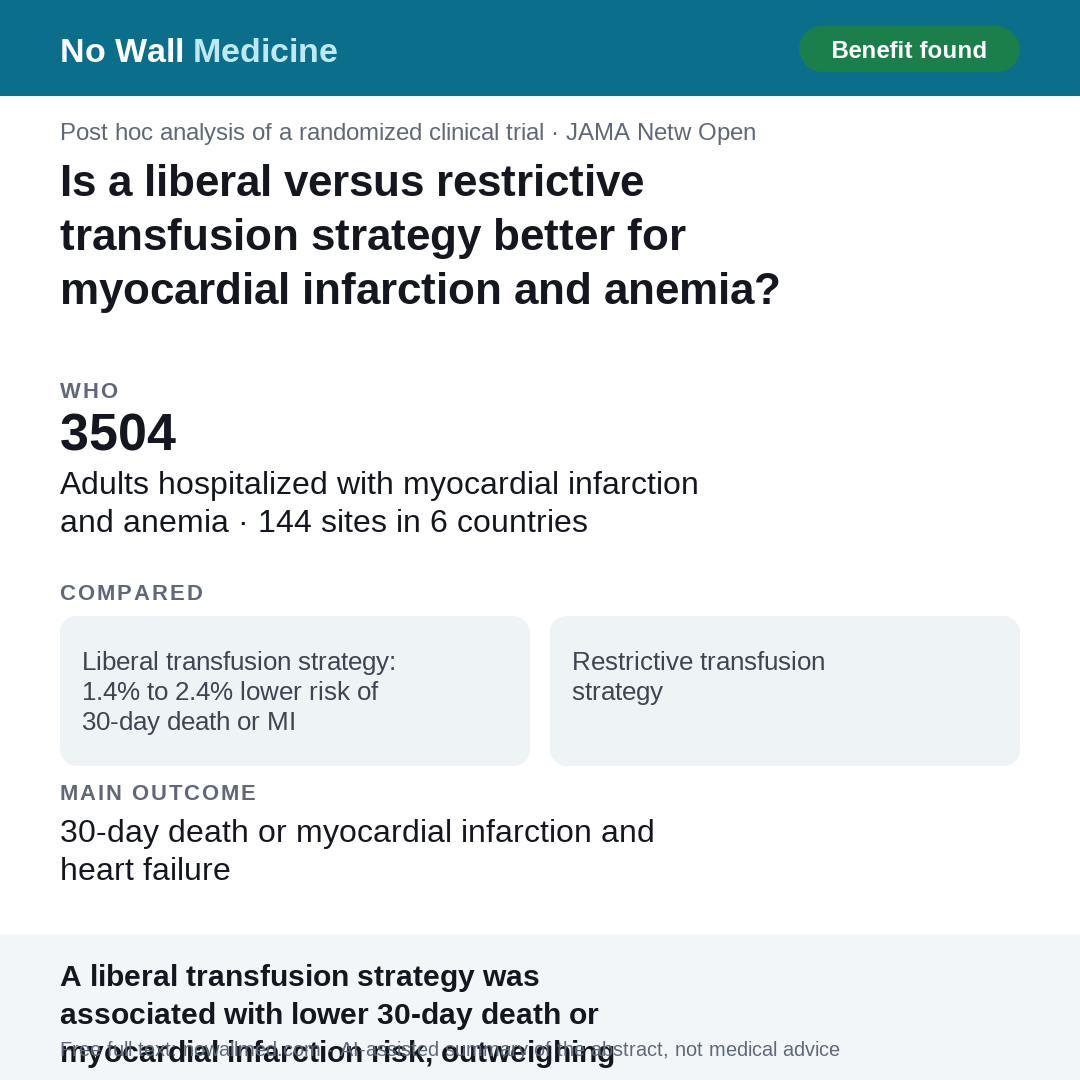
Clinical question: Is a liberal versus restrictive transfusion strategy better for myocardial infarction and anemia?
Key points
- Researchers analyzed 3504 hospitalized adults with myocardial infarction and anemia across 144 sites in 6 countries.
- A liberal transfusion strategy was associated with a 1.4% to 2.4% lower risk of death or myocardial infarction within 30 days compared to a restrictive strategy.
- The risk of heart failure with a liberal strategy was 0.2% to 0.6% higher than with a restrictive strategy depending on prior beliefs.
Headline and key points written with AI from the paper’s abstract, with every number checked against it. Read the paper before relying on them.
Topics
Spotted a mistake? Suggest a correction
More in Cardiology
Clonal hematopoiesis mutations linked to higher atrial fibrillation risk in cancer populations
Association of Clonal Hematopoiesis Mutations With Incident Atrial Fibrillation: A Systematic Review and Meta-Analysis
Deep learning model detects aortic stenosis from finger-cuff pressure waveforms accurately
Aortic Valve Stenosis Screening Using Deep Learning on Noninvasive Arterial Pressure Waveforms
Spontaneous coronary artery dissection affects younger women more often than expected
Spontaneous coronary artery dissection: implications for women's health, clinical care, and future research
Early lipid-lowering strategies may reduce atherosclerotic cardiovascular disease risk
Lipid-Lowering Strategies in the Era of Early Atherosclerosis Detection: 2026 ACC Scientific Statement: A Report of the American College of Cardiology