Pharmacist use of a medication safety dashboard was associated with fewer emergency visits and hospitalizations
Results of a multicenter cluster-randomized controlled clinical trial testing the effectiveness of a bioinformatics-enabled pharmacist intervention in transplant recipients
Prospective, cluster-randomized, controlled multicenter studyBenefit found
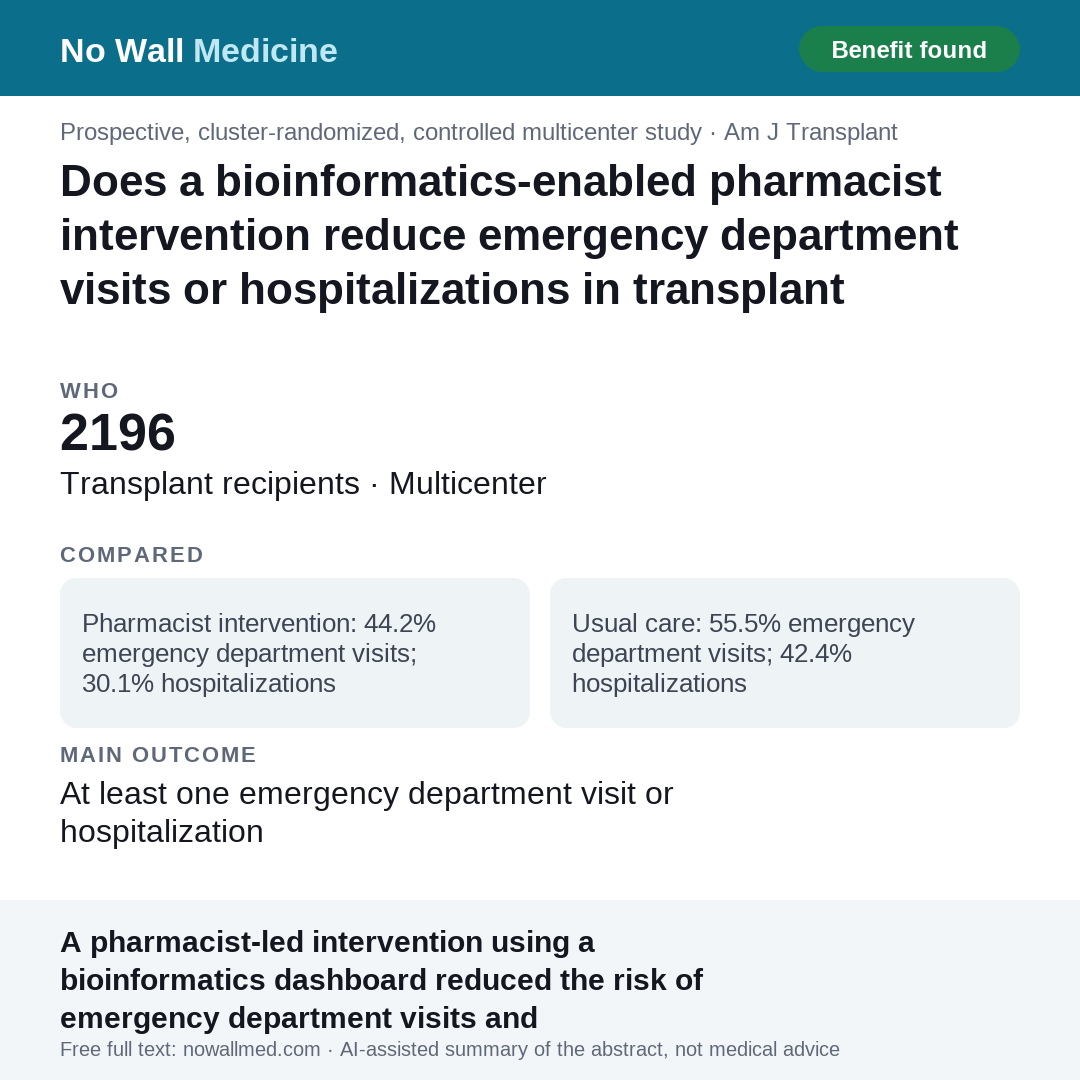
Does a bioinformatics-enabled pharmacist intervention reduce emergency department visits or hospitalizations in transplant recipients?
Who
2196
Transplant recipients · Multicenter
Compared
Pharmacist intervention: 44.2% emergency department visits; 30.1% hospitalizations
Usual care: 55.5% emergency department visits; 42.4% hospitalizations
Main outcome
At least one emergency department visit or hospitalization
Result: absolute risk reduction 11.3% (95% confidence interval, 7.1%-15.5%) for emergency department visits
Bottom line: A pharmacist-led intervention using a bioinformatics dashboard reduced the risk of emergency department visits and hospitalizations.
Am J Transplant · 2023-08-09Download image
Clinical question: Does a bioinformatics-enabled pharmacist intervention reduce emergency department visits or hospitalizations in transplant recipients?
Why it matters: It was unknown if a pharmacist-led intervention using a bioinformatics-enabled medication safety dashboard could reduce emergency department visits or hospitalizations in transplant recipients.
In absolute numbers
Pharmacist intervention: 44.2% · Usual care: 55.5% → a difference of 11.3 percentage points, so about 9 people would need the treatment for 1 more to benefit (number needed to treat) over the trial’s follow-up.
Worked out by us from the two group results above, not reported by the authors. Check the paper for the exact outcome and timing.
Key points
- Researchers conducted a 2-year multicenter study involving 2196 transplant events, comparing pharmacist use of a medication safety dashboard to usual care.
- The intervention group had a 11.3% absolute risk reduction in having ≥1 emergency department visit (44.2% vs 55.5%) and a 12.3% absolute risk reduction in having ≥1 hospitalization (30.1% vs 42.4%).
- Among those who had at least one event, the median emergency department visit rate and hospitalization rate were similar between the two groups.
Headline and key points written with AI from the paper’s abstract, with every number checked against it. Read the paper before relying on them.
Was this summary helpful?
Subject terms
Cite this article
Taber DJ, Ward RC, Buchanan CH, Axon RN, Milfred-LaForest S, Rife K. Results of a multicenter cluster-randomized controlled clinical trial testing the effectiveness of a bioinformatics-enabled pharmacist intervention in transplant recipients. Am J Transplant. 2023. doi:10.1016/j.ajt.2023.08.004
Spotted a mistake? Suggest a correction
Top studies every Monday
The week’s key trials and guidelines in your specialties, plus any topics you follow. By email, free.
Get the weekly digest