Blood eosinophil levels measured before treatment predict response to inhaled corticosteroids in COPD patients
Rethinking Blood Eosinophils for Assessing Inhaled Corticosteroids Response in COPD: A Post Hoc Analysis From the FLAME Trial
Post hoc analysis of a randomized controlled trialMixed results
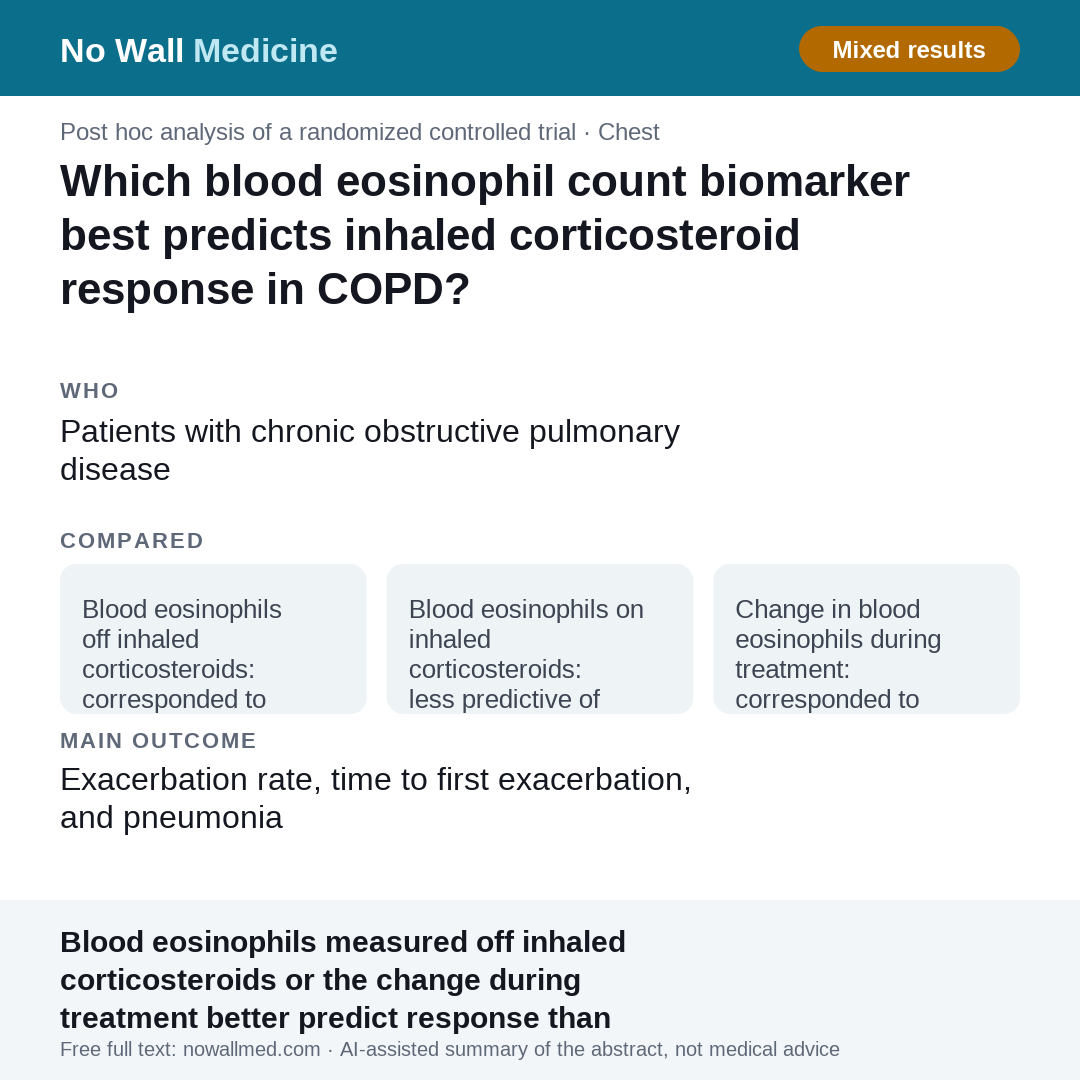
Which blood eosinophil count biomarker best predicts inhaled corticosteroid response in COPD?
Who
Patients with chronic obstructive pulmonary disease
Compared
Blood eosinophils off inhaled corticosteroids: corresponded to superior response to LABA/ICS
Blood eosinophils on inhaled corticosteroids: less predictive of treatment response
Change in blood eosinophils during treatment: corresponded to superior response to LABA/ICS
Main outcome
Exacerbation rate, time to first exacerbation, and pneumonia
Bottom line: Blood eosinophils measured off inhaled corticosteroids or the change during treatment better predict response than counts measured on treatment.
Limitation: This was an exploratory post hoc analysis.
Chest · 2024-07-09Download image
Clinical question: Which blood eosinophil count biomarker best predicts inhaled corticosteroid response in COPD?
Why it matters: It is unknown whether blood eosinophil counts measured during treatment, before treatment, or the change in those counts best predict how patients with COPD respond to inhaled corticosteroids.
Key points
- Researchers analyzed data from the FLAME trial, a 52-week randomized controlled trial comparing long-acting beta-2 agonists/long-acting muscarinic antagonists to long-acting beta-2 agonists/inhaled corticosteroids.
- Higher blood eosinophil counts measured off inhaled corticosteroids, higher counts measured on treatment, and significant suppression of these cells during treatment were associated with better responses to inhaled corticosteroids.
- In a subgroup representing 9% of participants where blood eosinophil counts changed by ≥ 200 cells/μL, blood eosinophil counts measured while on treatment did not predict response.
Headline and key points written with AI from the paper’s abstract, with every number checked against it. Read the paper before relying on them.
Was this summary helpful?
Subject terms
Cite this article
Mathioudakis AG, Bate S, Sivapalan P, Jensen JS, Singh D, Vestbo J. Rethinking Blood Eosinophils for Assessing Inhaled Corticosteroids Response in COPD: A Post Hoc Analysis From the FLAME Trial. Chest. 2024. doi:10.1016/j.chest.2024.06.3790
Spotted a mistake? Suggest a correction
Top studies every Monday
The week’s key trials and guidelines in your specialties, plus any topics you follow. By email, free.
Get the weekly digest