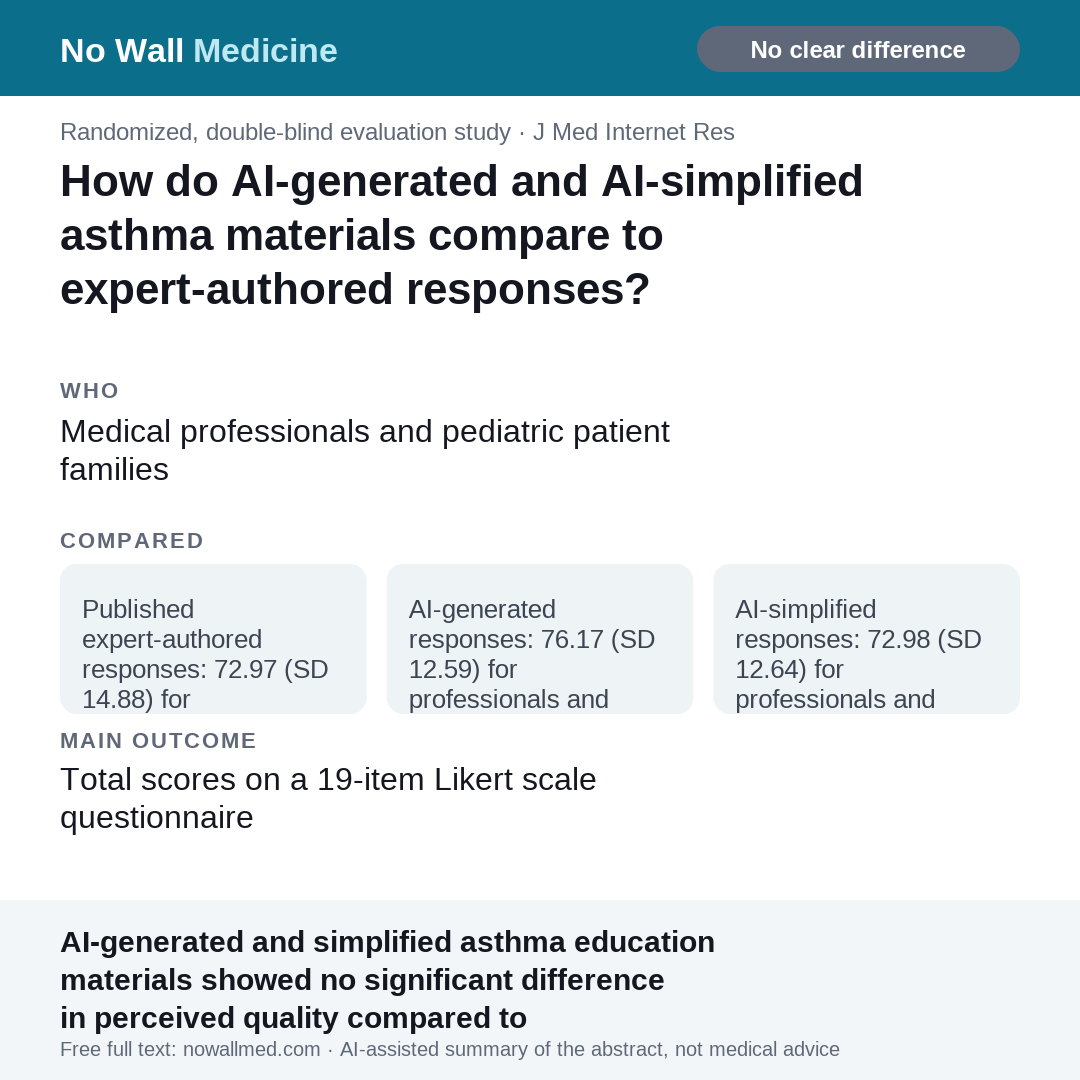
How do AI-generated and AI-simplified asthma materials compare to expert-authored responses?
Who
Medical professionals and pediatric patient families
Compared
Published expert-authored responses: 72.97 (SD 14.88) for professionals and 64.18 (SD 15.76) for families
AI-generated responses: 76.17 (SD 12.59) for professionals and 68.77 (SD 16.47) for families
AI-simplified responses: 72.98 (SD 12.64) for professionals and 65.47 (SD 16.52) for families
Main outcome
Total scores on a 19-item Likert scale questionnaire
Bottom line: AI-generated and simplified asthma education materials showed no significant difference in perceived quality compared to expert-authored responses.
Clinical question: How do AI-generated and AI-simplified asthma materials compare to expert-authored responses?
Why it matters: Questions remain about whether content generated by large language models can balance professional accuracy with public accessibility for health education.
Key points
Medical professionals and patient families evaluated expert-authored responses, artificial intelligence-generated responses, and artificial intelligence-simplified responses for pediatric asthma education.
There were no statistically significant differences in total scores between the artificial intelligence-generated responses and expert-authored responses for either medical professionals or families.
Participants showed a strong tendency to attribute the materials to human authors, highlighting a need for source transparency.
Headline and key points written with AI from the paper’s abstract, with every number checked against it. Read the paper before relying on them.
ClinicalAge, a framework for modelling ageing trajectories from longitudinal electronic health records in the UK: a model development and validation study
A prognostic model for use at labour onset to estimate the risk of severe fetal compromise at birth: a retrospective, model development and validation study