Artificial intelligence risk score outperformed standard systems for predicting skin cancer outcomes
Retrieval Augmented Generation-Enabled Large Language Model for Risk Stratification of Cutaneous Squamous Cell Carcinoma
Diagnostic studyBenefit found
Can a retrieval augmented generation large language model outperform current risk stratification systems for cutaneous squamous cell carcinoma?
Who
2379
Patients with primary cutaneous squamous cell carcinoma tumors
Compared
Artificial intelligence-derived risk score: LR 0.69; NM 0.81; DM 0.85; DSD 0.80
BWH and AJCC8 systems
Main outcome
Locoregional recurrence, nodal metastasis, distant metastasis, and disease-specific death
Bottom line: The artificial intelligence-derived risk score outperforms existing BWH and AJCC8 systems in predicting poor cutaneous squamous cell carcinoma outcomes.
JAMA Dermatol · 2025-06-11Download image
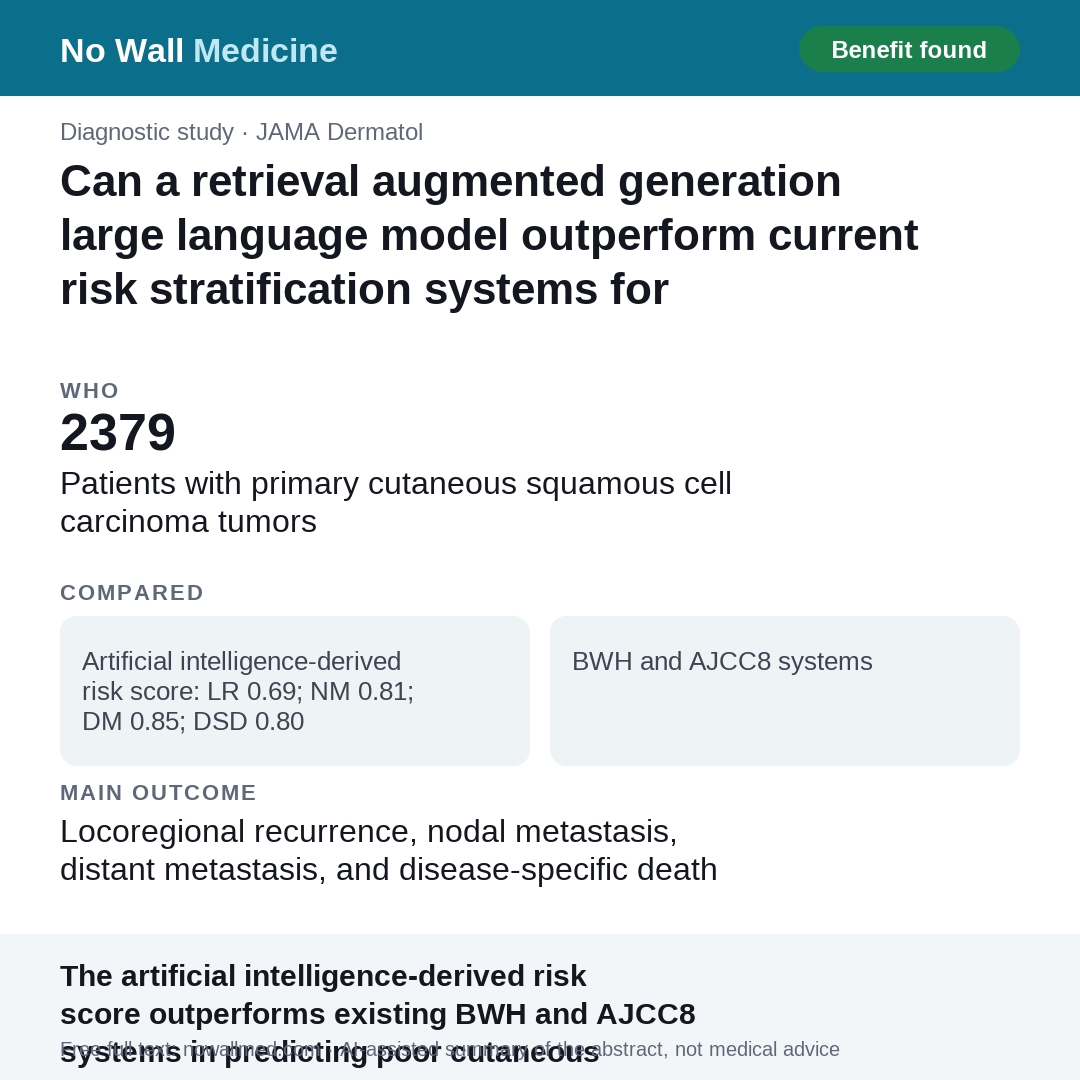
Clinical question: Can a retrieval augmented generation large language model outperform current risk stratification systems for cutaneous squamous cell carcinoma?
Why it matters: There is significant variation in outcomes among patients with cutaneous squamous cell carcinoma based on their tumor stage.
Key points
- Researchers compared a new artificial intelligence-derived risk score to existing staging systems using 2379 primary cutaneous squamous cell carcinoma tumors.
- The artificial intelligence system showed higher sensitivity for locoregional recurrence, nodal metastasis, distant metastasis, and disease-specific death than current standards.
- The artificial intelligence system achieved the highest area under the receiver operating characteristic curve values for locoregional recurrence (0.69), nodal metastasis (0.81), distant metastasis (0.85), and disease-specific death (0.80).
Headline and key points written with AI from the paper’s abstract, with every number checked against it. Read the paper before relying on them.
Topics
Cite this article
Jairath NK, Pahalyants V, Cheraghlou S, Maas D, Lee N, Criscito MC. Retrieval Augmented Generation-Enabled Large Language Model for Risk Stratification of Cutaneous Squamous Cell Carcinoma. JAMA Dermatol. 2025. doi:10.1001/jamadermatol.2025.1614
Spotted a mistake? Suggest a correction
Top studies every Monday
The week’s key trials and guidelines in your specialties, plus any topics you follow. By email, free.
Get the weekly digest