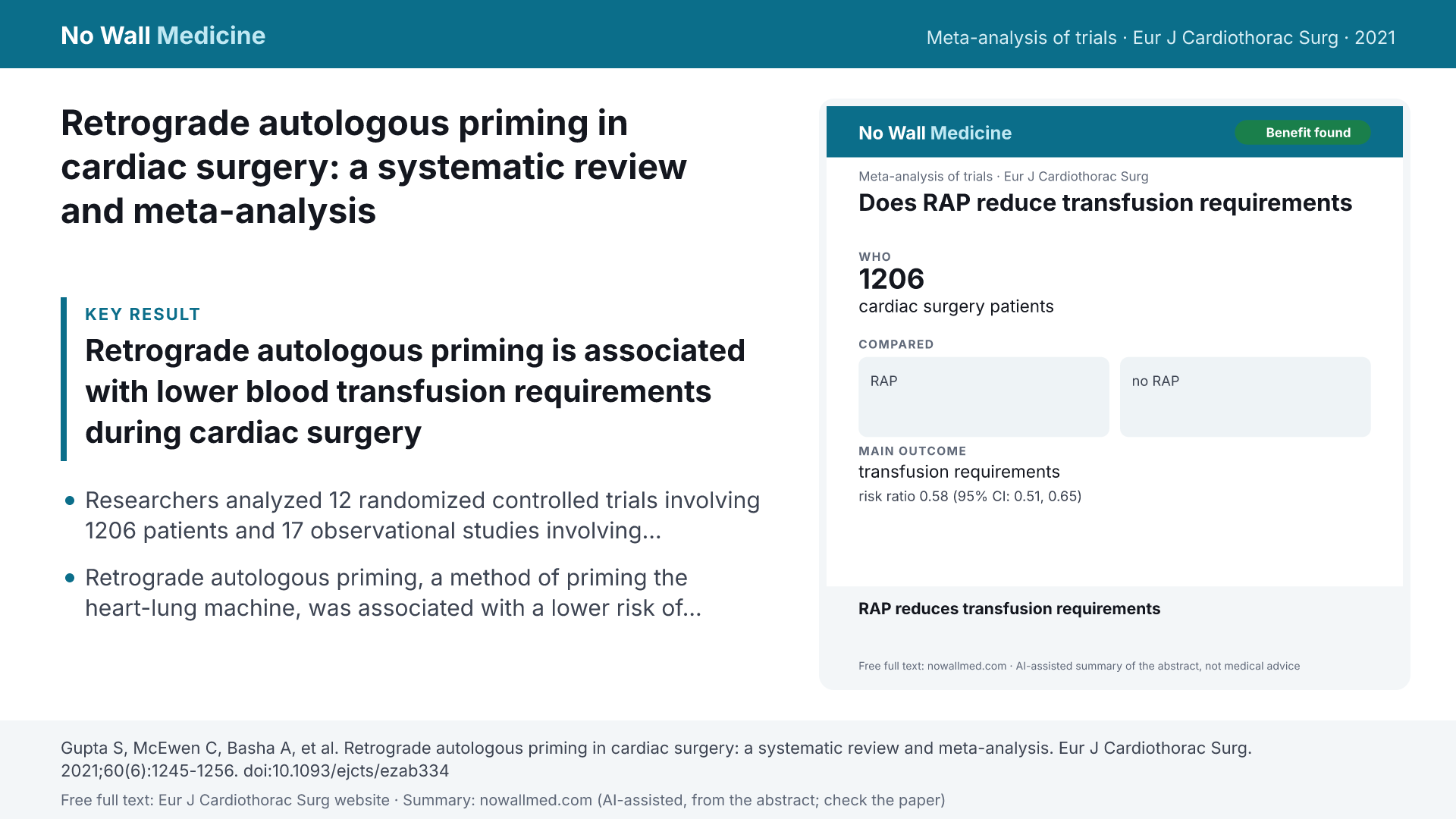
Retrograde autologous priming is associated with lower blood transfusion requirements during cardiac surgery
Retrograde autologous priming in cardiac surgery: a systematic review and meta-analysis
Meta-analysis of trialsBenefit found
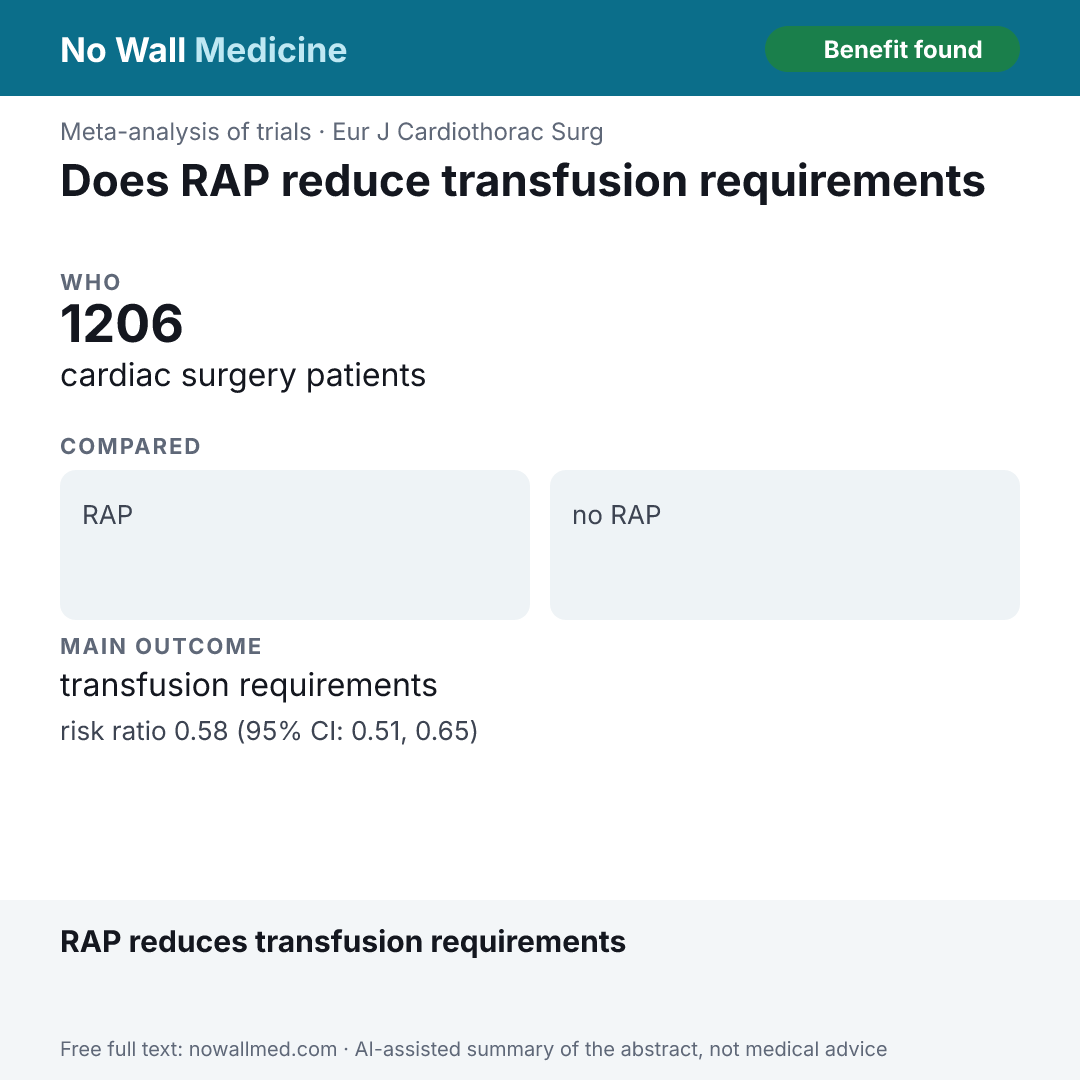
Does RAP reduce transfusion requirements
Who
1206
cardiac surgery patients
Compared
RAP
no RAP
Main outcome
transfusion requirements
Result: risk ratio 0.58 (95% CI: 0.51, 0.65)
Bottom line: RAP reduces transfusion requirements
Eur J Cardiothorac Surg · 2021-08-22 · Save PNG
Why it matters: The efficacy and safety of using retrograde autologous priming to prime the cardiopulmonary bypass circuit are not well-established.
Key points
- Researchers analyzed 12 randomized controlled trials involving 1206 patients and 17 observational studies involving 3565 patients comparing retrograde autologous priming to no priming.
- Retrograde autologous priming, a method of priming the heart-lung machine, was associated with a lower risk of blood transfusions (risk ratio 0.58 in randomized trials).
- The number of blood units transfused per patient was lower with priming in randomized trials (mean difference -0.38 unit) and observational studies (mean difference -1.03 unit).
Headline and key points written with AI from the paper’s abstract, with every number checked against it. Read the paper before relying on them.
Was this summary helpful?
Subject terms
Headline, design, result, key points, caveat and citation as plain text.
Cite this article
Gupta S, McEwen C, Basha A, et al. Retrograde autologous priming in cardiac surgery: a systematic review and meta-analysis. Eur J Cardiothorac Surg. 2021;60(6):1245-1256. doi:10.1093/ejcts/ezab334
Spotted a mistake? Suggest a correction