Suction-assisted kidney stone surgery shows similar stone clearance rates to mini-percutaneous nephrolithotomy
Retrograde intrarenal surgery with flexible and navigable suction access sheaths vs mini-percutaneous nephrolithotomy for large upper urinary tract stones: a systematic review and meta-analysis
Meta-analysis of 10 studiesBenefit found
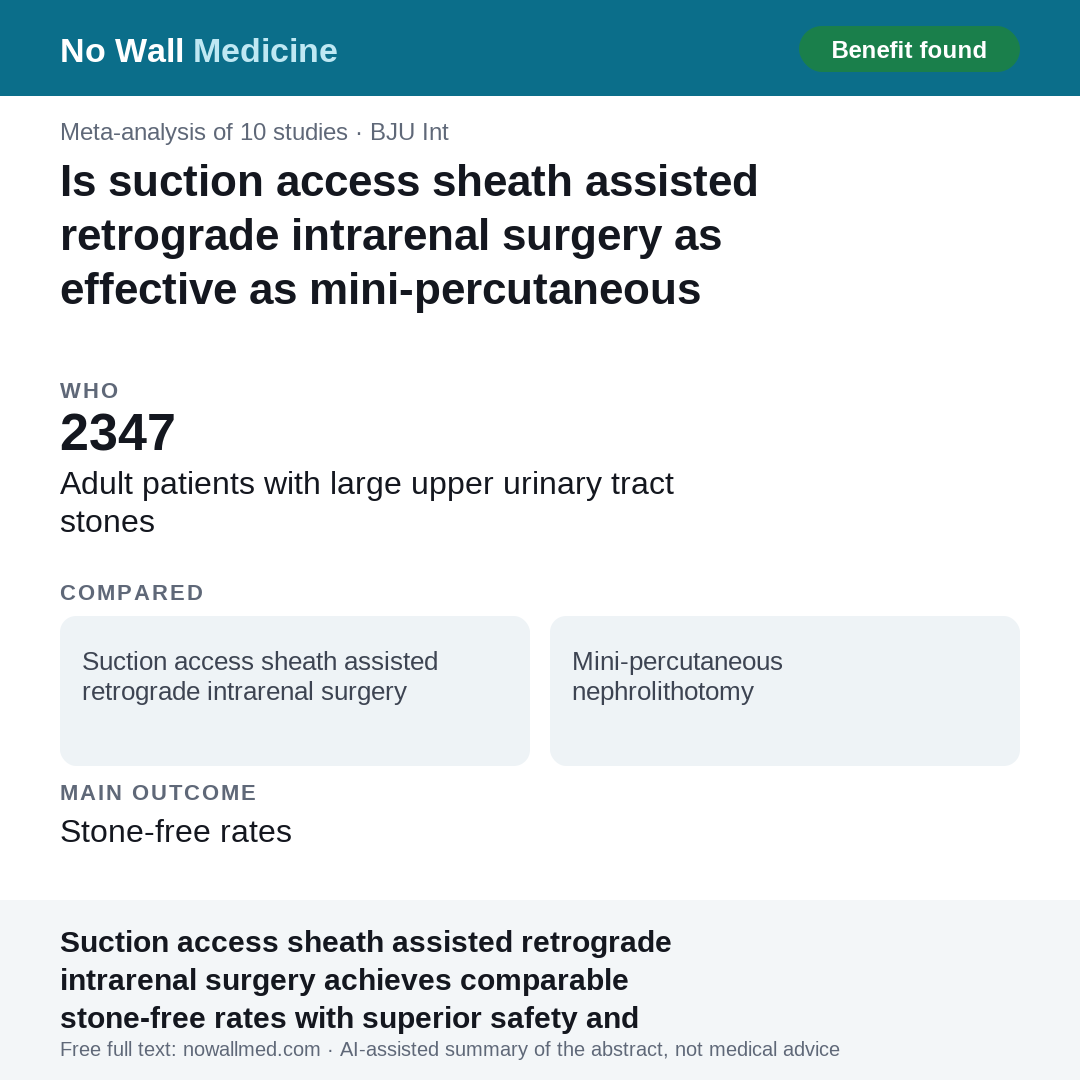
Is suction access sheath assisted retrograde intrarenal surgery as effective as mini-percutaneous nephrolithotomy?
Who
2347
Adult patients with large upper urinary tract stones
Compared
Suction access sheath assisted retrograde intrarenal surgery
Mini-percutaneous nephrolithotomy
Main outcome
Stone-free rates
Result: odds ratio 0.90 (95% CI 0.70-1.17)
Bottom line: Suction access sheath assisted retrograde intrarenal surgery achieves comparable stone-free rates with superior safety and shorter hospital stays.
Limitation: Predominance of Asian studies, variability of practice, and inclusion of non-randomised studies.
BJU Int · 2026-07-29Download image
Clinical question: Is suction access sheath assisted retrograde intrarenal surgery as effective as mini-percutaneous nephrolithotomy?
Why it matters: Current medical guidelines recommend percutaneous nephrolithotomy as the first-line treatment for kidney stones larger than 2cm despite technological advances in suction-assisted surgery.
Key points
- Researchers analyzed 10 studies involving 2347 adult patients to compare suction-assisted retrograde intrarenal surgery against mini-percutaneous nephrolithotomy for large kidney stones.
- Stone-free rates were comparable between the two methods for all stone sizes (odds ratio 0.90, 95% confidence interval 0.70-1.17) and stones ≥2cm (odds ratio 0.80, 95% confidence interval 0.60-1.08).
- The suction-assisted surgery was associated with fewer complications, smaller hemoglobin decline, and shorter hospital stays, though mini-percutaneous nephrolithotomy had shorter operative times for stones ≥2cm.
Limitation the authors note: The authors noted a predominance of Asian studies, variability of practice, and the inclusion of non-randomized studies.
Headline and key points written with AI from the paper’s abstract, with every number checked against it. Read the paper before relying on them.
Topics
Cite this article
Lee HJ, Yaow C, Chong RIH, Kelzang S, Gauhar V, Yuen SKK. Retrograde intrarenal surgery with flexible and navigable suction access sheaths vs mini-percutaneous nephrolithotomy for large upper urinary tract stones: a systematic review and meta-analysis. BJU Int. 2026. doi:10.1111/bju.70393
Spotted a mistake? Suggest a correction