Many COVID-19 datasets used for artificial intelligence development lack essential demographic and ethical information
Revealing transparency gaps in publicly available COVID-19 datasets used for medical artificial intelligence development-a systematic review
Systematic reviewHarm found
What are the transparency gaps in publicly available COVID-19 datasets used for artificial intelligence?
Who
192
Publicly available COVID-19 datasets used for artificial intelligence development · MEDLINE and Google Dataset Search
Compared
48%Datasets documenting country of origin
43%Datasets reporting age
Datasets including sex, gender, race, or ethnicity: under 25%
Main outcome
Metadata completeness, composition, data accessibility, and ethical considerations
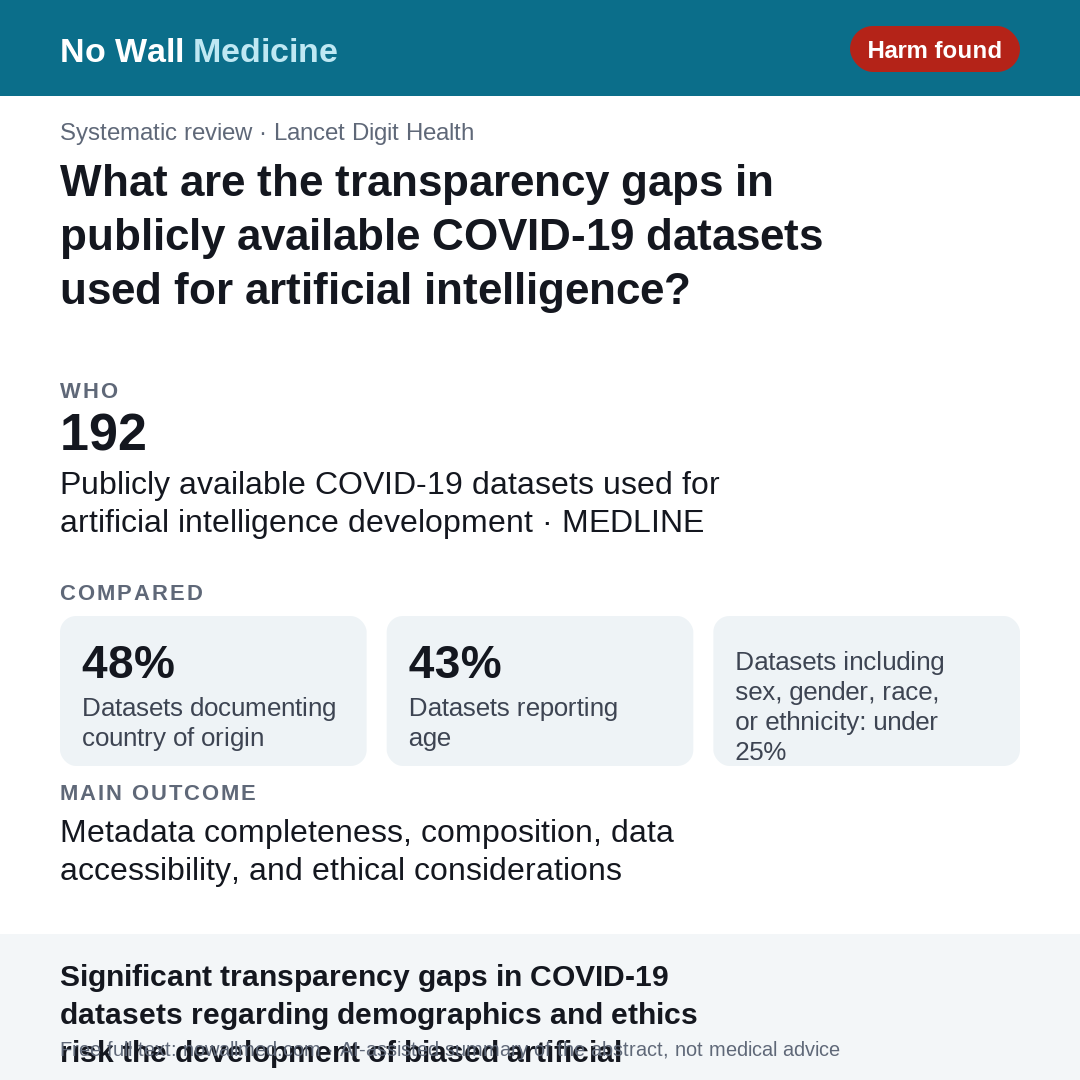
Bottom line: Significant transparency gaps in COVID-19 datasets regarding demographics and ethics risk the development of biased artificial intelligence models.
Lancet Digit Health · 2024-10-26Download image
Clinical question: What are the transparency gaps in publicly available COVID-19 datasets used for artificial intelligence?
Why it matters: It is unknown how complete the metadata and ethical documentation are in the publicly available datasets used to build artificial intelligence models for COVID-19.
Key points
- Researchers analyzed 192 datasets used for artificial intelligence development during the COVID-19 pandemic to assess metadata completeness and ethical documentation.
- Only 48% of datasets documented the country of origin, 43% reported age, and under 25% included sex, gender, race, or ethnicity.
- Information regarding data labeling, ethical review, or consent was frequently missing, and some datasets reused data without adequate traceability.
Headline and key points written with AI from the paper’s abstract, with every number checked against it. Read the paper before relying on them.
Was this summary helpful?
Abstract
During the COVID-19 pandemic, artificial intelligence (AI) models were created to address health-care resource constraints. Previous research shows that health-care datasets often have limitations, leading to biased AI technologies. This systematic review assessed datasets used for AI development during the pandemic, identifying several deficiencies. Datasets were identified by screening articles from MEDLINE and using Google Dataset Search. 192 datasets were analysed for metadata completeness, composition, data accessibility, and ethical considerations. Findings revealed substantial gaps: only 48% of datasets documented individuals' country of origin, 43% reported age, and under 25% included sex, gender, race, or ethnicity. Information on data labelling, ethical review, or consent was frequently missing. Many datasets reused data with inadequate traceability. Notably, historical paediatric chest x-rays appeared in some datasets without acknowledgment. These deficiencies highlight the need for better data quality and transparent documentation to lessen the risk that biased AI models are developed in future health emergencies.
Abstract reproduced under the article’s CC BY licence.
Subject terms
Cite this article
Alderman JE, Charalambides M, Sachdeva G, Laws E, Palmer J, Lee E. Revealing transparency gaps in publicly available COVID-19 datasets used for medical artificial intelligence development-a systematic review. Lancet Digit Health. 2024. doi:10.1016/S2589-7500(24)00146-8
Spotted a mistake? Suggest a correction
Top studies every Monday
The week’s key trials and guidelines in your specialties, plus any topics you follow. By email, free.
Get the weekly digest