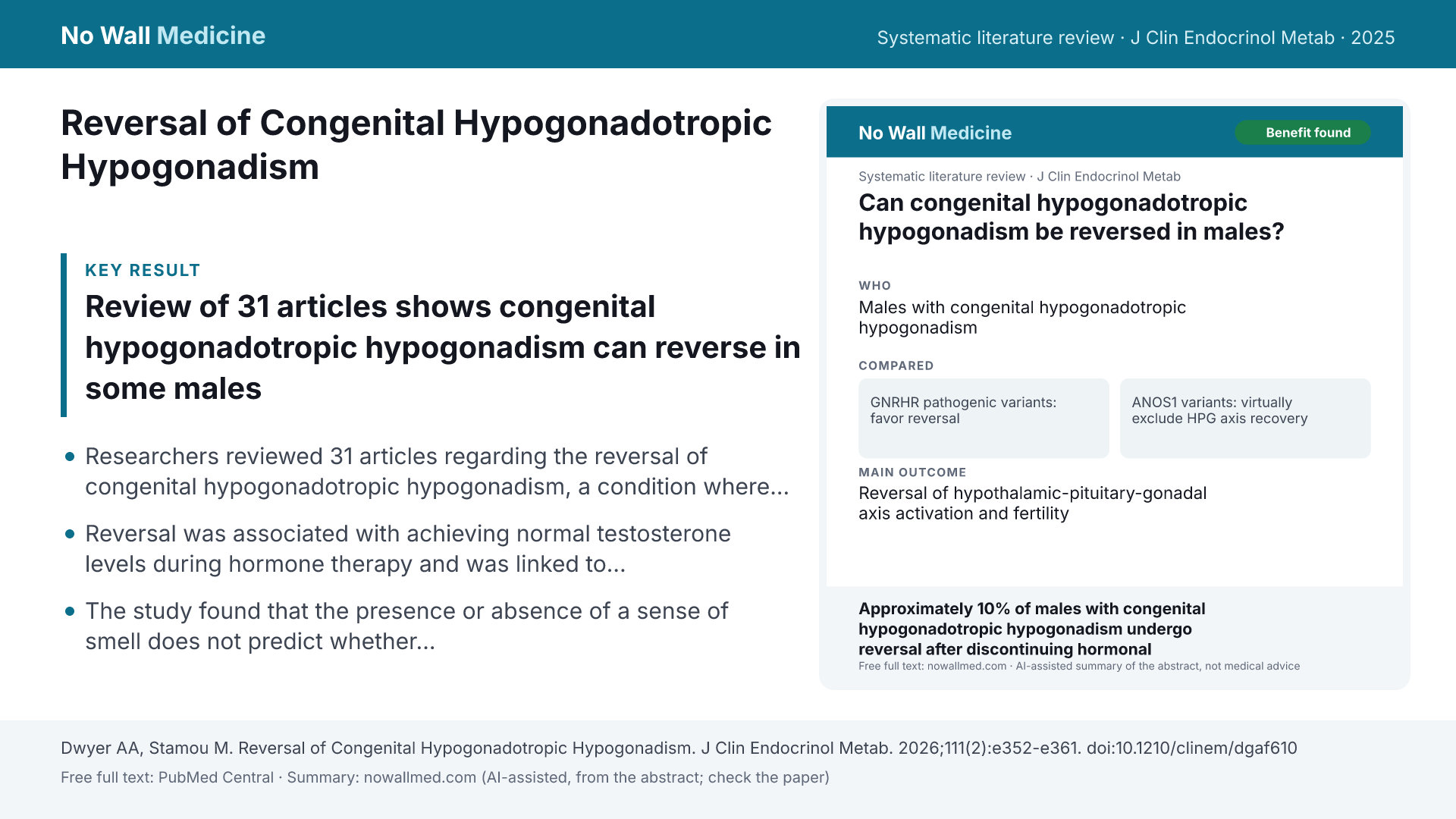
Review of 31 articles shows congenital hypogonadotropic hypogonadism can reverse in some males
Reversal of Congenital Hypogonadotropic Hypogonadism
Systematic literature reviewBenefit found
Can congenital hypogonadotropic hypogonadism be reversed in males?
Who
31
Males with congenital hypogonadotropic hypogonadism
Compared
GNRHR pathogenic variants: favor reversal
ANOS1 variants: virtually exclude HPG axis recovery
Main outcome
Reversal of hypothalamic-pituitary-gonadal axis activation and fertility
Bottom line: Approximately 10% of males with congenital hypogonadotropic hypogonadism undergo reversal after discontinuing hormonal treatment.
J Clin Endocrinol Metab · 2025-11-09Download image
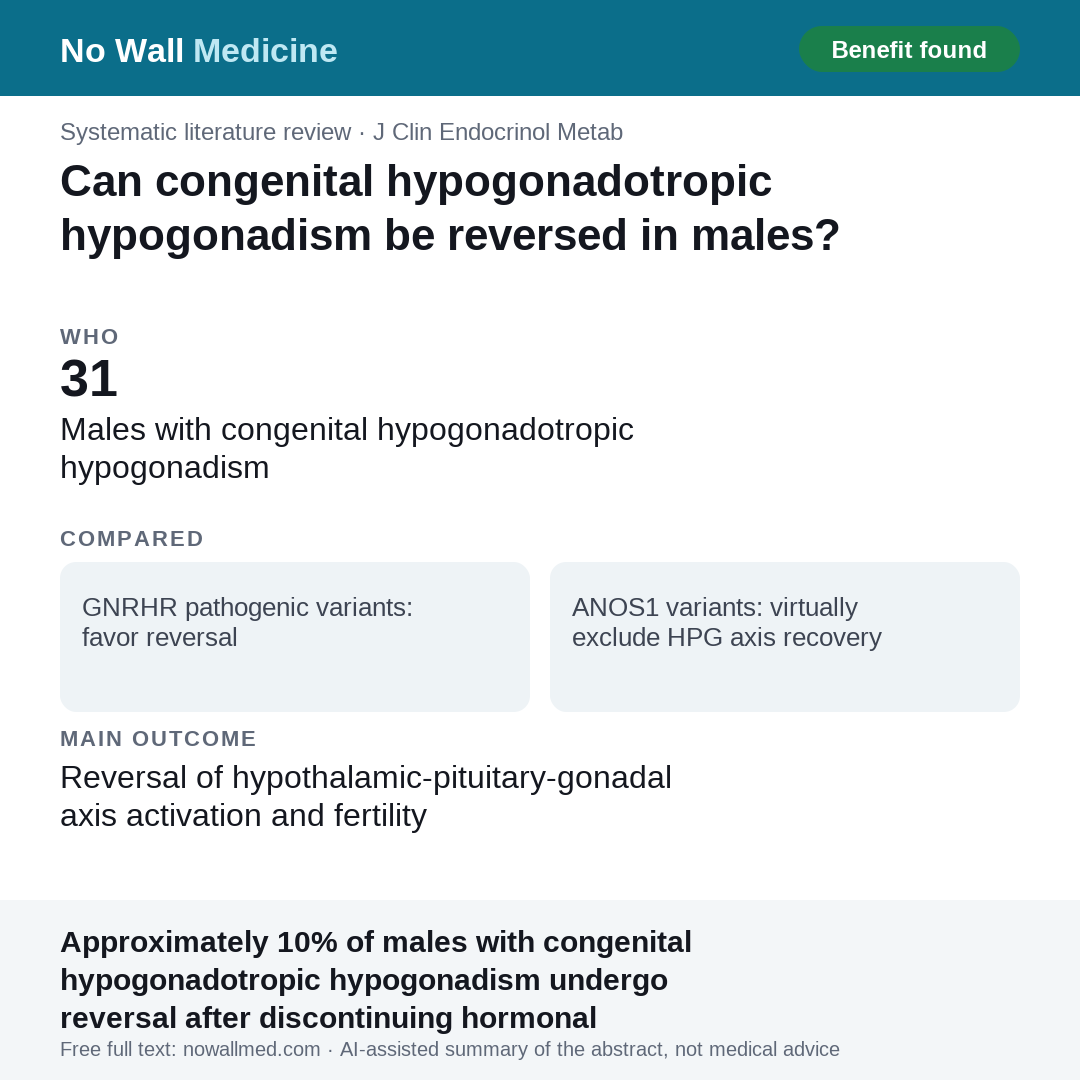
Clinical question: Can congenital hypogonadotropic hypogonadism be reversed in males?
Why it matters: The precise mechanisms behind the reversal of congenital hypogonadotropic hypogonadism in males are not yet fully understood.
Key points
- Researchers reviewed 31 articles regarding the reversal of congenital hypogonadotropic hypogonadism, a condition where the body fails to produce enough hormones for puberty, in males.
- Reversal was associated with achieving normal testosterone levels during hormone therapy and was linked to specific genetic variants like GNRHR, while ANOS1 variants were linked to a lack of recovery.
- The study found that the presence or absence of a sense of smell does not predict whether the hypothalamic-pituitary-gonadal axis, the system controlling reproduction, will recover.
Headline and key points written with AI from the paper’s abstract, with every number checked against it. Read the paper before relying on them.
Was this summary helpful?
Subject terms
Cite this article
Dwyer AA, Stamou M. Reversal of Congenital Hypogonadotropic Hypogonadism. J Clin Endocrinol Metab. 2025. doi:10.1210/clinem/dgaf610
Spotted a mistake? Suggest a correction