Revision skin flaps show a 13.4% failure rate after initial cochlear implant complications
Revision Flap Coverage Following Primary Cochlear Implant Flap Failure: A Systematic Review
Systematic reviewBenefit found
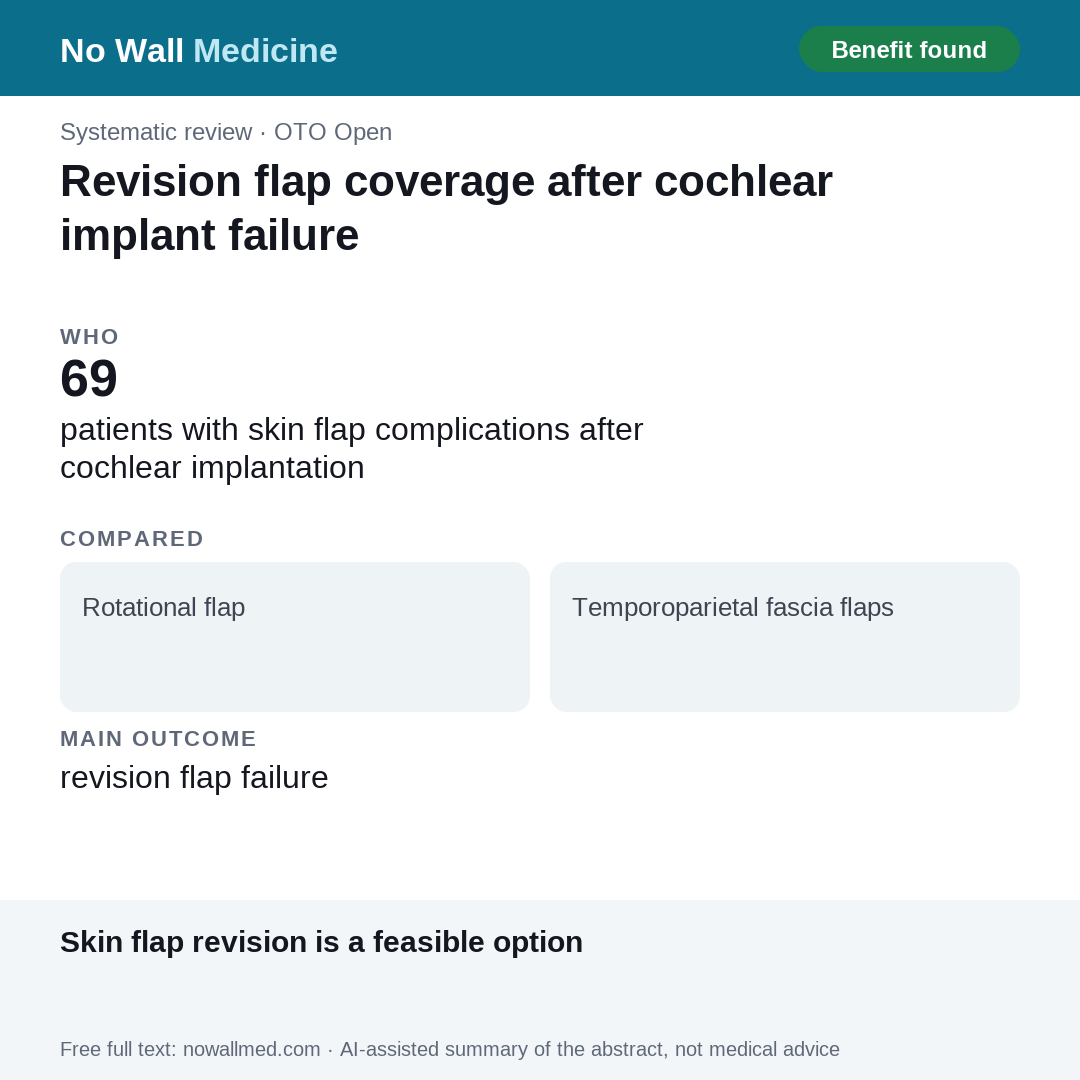
Revision flap coverage after cochlear implant failure
Who
69
patients with skin flap complications after cochlear implantation
Compared
Rotational flap
Temporoparietal fascia flaps
Main outcome
revision flap failure
Bottom line: Skin flap revision is a feasible option
OTO Open · 2025-12-07Download image
Why it matters: Surgeons need to understand the long-term outcomes and complication rates of different skin flap techniques when performing cochlear implant reimplantation after initial wound failure.
Key points
- Researchers reviewed 12 studies involving 69 skin flap revisions performed after initial cochlear implant skin flap failure.
- The review found that 9 revision flap procedures failed, representing a failure rate of 13.4%.
- Rotational flaps, sometimes used with temporoparietal fascia flaps (tissue from the side of the scalp), were noted as successful techniques.
Headline and key points written with AI from the paper’s abstract, with every number checked against it. Read the paper before relying on them.
Cite this article
Pearce AN, Eckard P, Baggett AD, Saadi CC, Dornhoffer JL, Saadi RA. Revision Flap Coverage Following Primary Cochlear Implant Flap Failure: A Systematic Review. OTO Open. 2025. doi:10.1002/oto2.70182
Spotted a mistake? Suggest a correction