Childhood adversity is linked to reduced prefrontal brain volume but not hippocampal or amygdala volume
Revisiting the link between childhood adversity and stress-sensitive brain regions in psychosis and bipolar disorder: a systematic review and meta-analysis
Systematic review and meta-analysisNo clear difference
Are childhood adversity and gray matter volume alterations linked in psychosis and bipolar disorder?
Who
3056
Participants with psychotic disorder and bipolar disorder
Compared
Hippocampus volume: no significant association (p ≥ 0.66)
Amygdala volume: no significant association (p ≥ 0.87)
Main outcome
Gray matter volume alterations in stress-sensitive brain regions
Bottom line: Childhood adversity was not consistently associated with hippocampal or amygdala volume alterations in psychosis and bipolar disorder.
Transl Psychiatry · 2026-09-19Download image
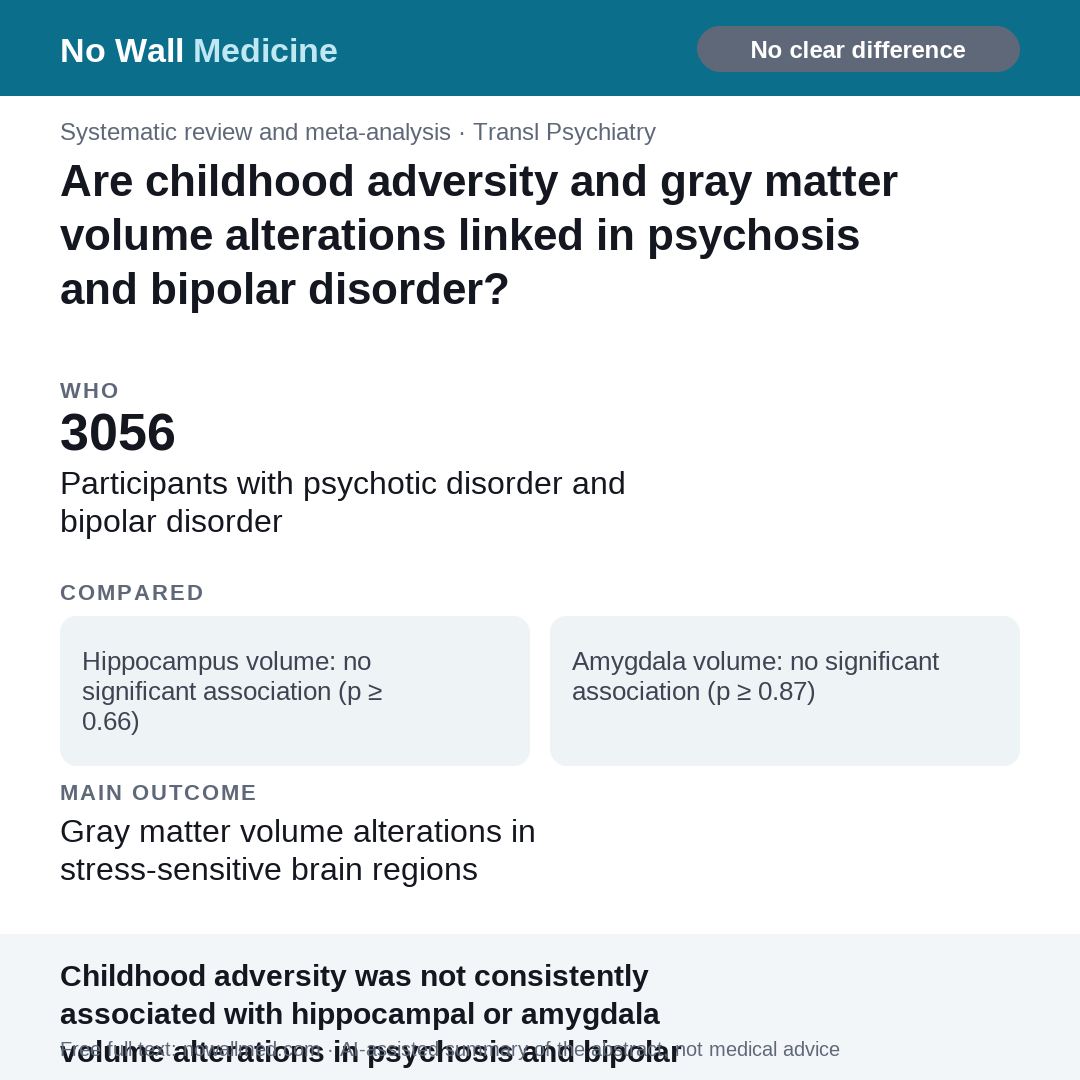
Clinical question: Are childhood adversity and gray matter volume alterations linked in psychosis and bipolar disorder?
Why it matters: Researchers sought to clarify how childhood adversity relates to structural brain changes in people with psychotic disorder and bipolar disorder.
Key points
- Researchers reviewed 29 studies involving 3056 participants with psychotic disorder and bipolar disorder to examine how childhood adversity affects brain structure.
- Most studies showed negative associations between childhood adversity and gray matter volume, particularly in prefrontal regions of the brain.
- Meta-analyses found no significant association between childhood adversity and the volume of the hippocampus (p ≥ 0.66) or the amygdala (p ≥ 0.87).
Headline and key points written with AI from the paper’s abstract, with every number checked against it. Read the paper before relying on them.
Topics
Cite this article
Petrova T, Tennfjord AØ, Cavero D, Holohan A, Kizilkaya M, Ebrahimian-Roodbari A. Revisiting the link between childhood adversity and stress-sensitive brain regions in psychosis and bipolar disorder: a systematic review and meta-analysis. Transl Psychiatry. 2026. doi:10.1038/s41398-026-04457-w
Spotted a mistake? Suggest a correction