Rezivertinib improved progression-free survival in lung cancer patients with brain metastases compared to gefitinib
Rezivertinib in EGFR-Mutated Non-Small Cell Lung Cancer Patients with Central Nervous System Metastasis: Central Nervous System Efficacy from the Phase III REZOR Study
Randomized Phase III trialBenefit found
Does rezivertinib improve central nervous system outcomes in EGFR-mutated non-small cell lung cancer?
Who
369
Treatment-naïve non-small cell lung cancer patients with EGFR mutations and CNS metastases
Compared
24.9 monthsrezivertinib plus gefitinib placebo
15.2 monthsgefitinib plus rezivertinib placebo
Main outcome
central nervous system progression-free survival
Result: hazard ratio 0.58 (95% CI, 0.34 to 0.99)
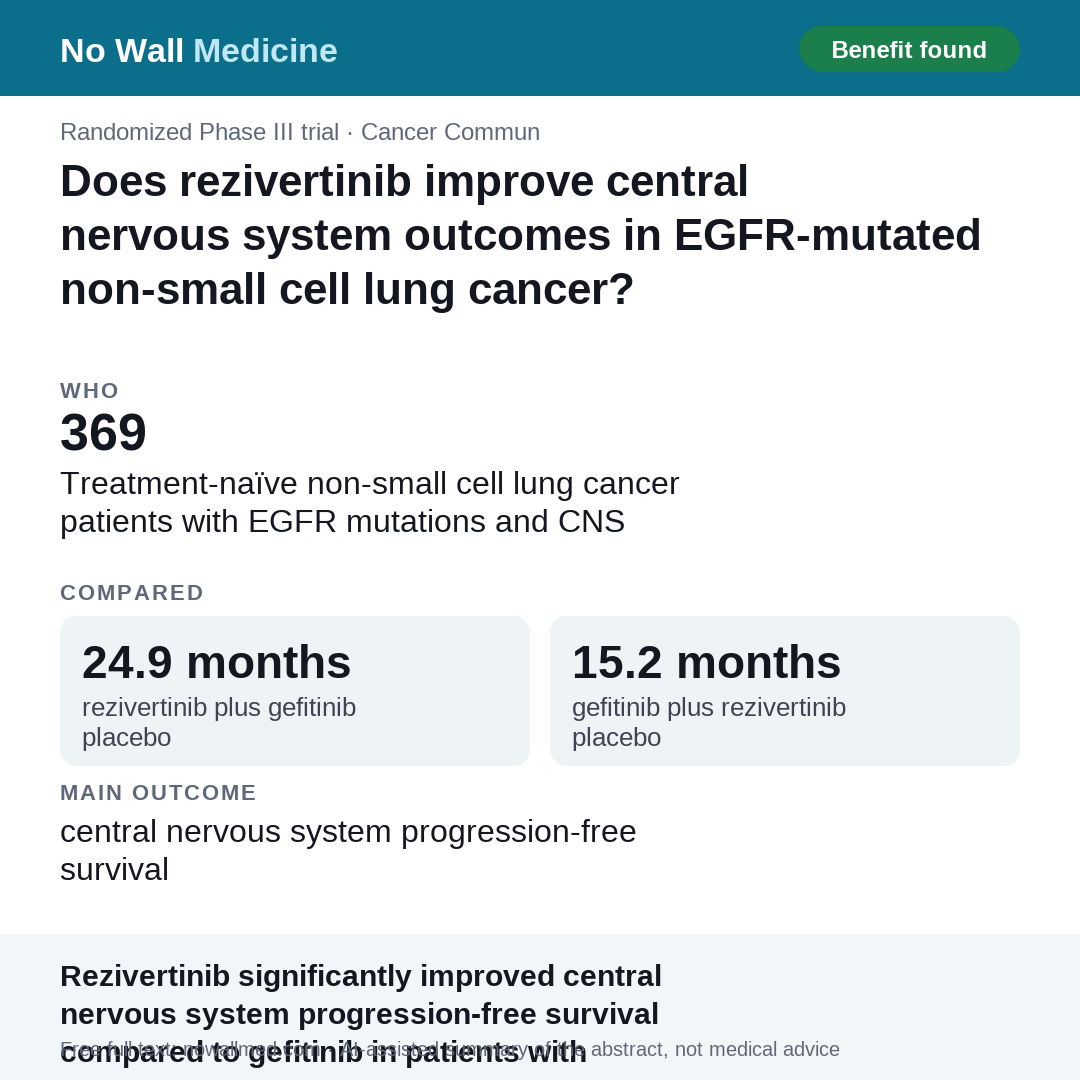
Bottom line: Rezivertinib significantly improved central nervous system progression-free survival compared to gefitinib in patients with EGFR-mutated lung cancer.
Cancer Commun · 2026-03-31Download image
Clinical question: Does rezivertinib improve central nervous system outcomes in EGFR-mutated non-small cell lung cancer?
Why it matters: Researchers sought to evaluate the effectiveness of rezivertinib for treating brain metastases in patients with specific genetic mutations in their lung cancer.
Key points
- The study compared rezivertinib to gefitinib in 159 patients with non-small cell lung cancer and baseline central nervous system metastases.
- Median progression-free survival in the brain was 24.9 months for rezivertinib compared to 15.2 months for gefitinib.
- The objective response rate in patients with measurable brain lesions showed no statistically significant difference between rezivertinib at 83.3% and gefitinib at 76.9%.
Headline and key points written with AI from the paper’s abstract, with every number checked against it. Read the paper before relying on them.
Topics
Cite this article
Yang S, Zhao Y, Sun M, Bi M, Zhu B, Chen Z. Rezivertinib in EGFR-Mutated Non-Small Cell Lung Cancer Patients with Central Nervous System Metastasis: Central Nervous System Efficacy from the Phase III REZOR Study. Cancer Commun. 2026. doi:10.34133/cancomm.0018
Spotted a mistake? Suggest a correction