Rifaximin treatment in hepatic encephalopathy
Why it matters: Rifaximin reduced recurrent hepatic encephalopathy and related hospital admissions.
Context written by the No Wall Medicine team.
Randomized, double-blind trialBenefit found
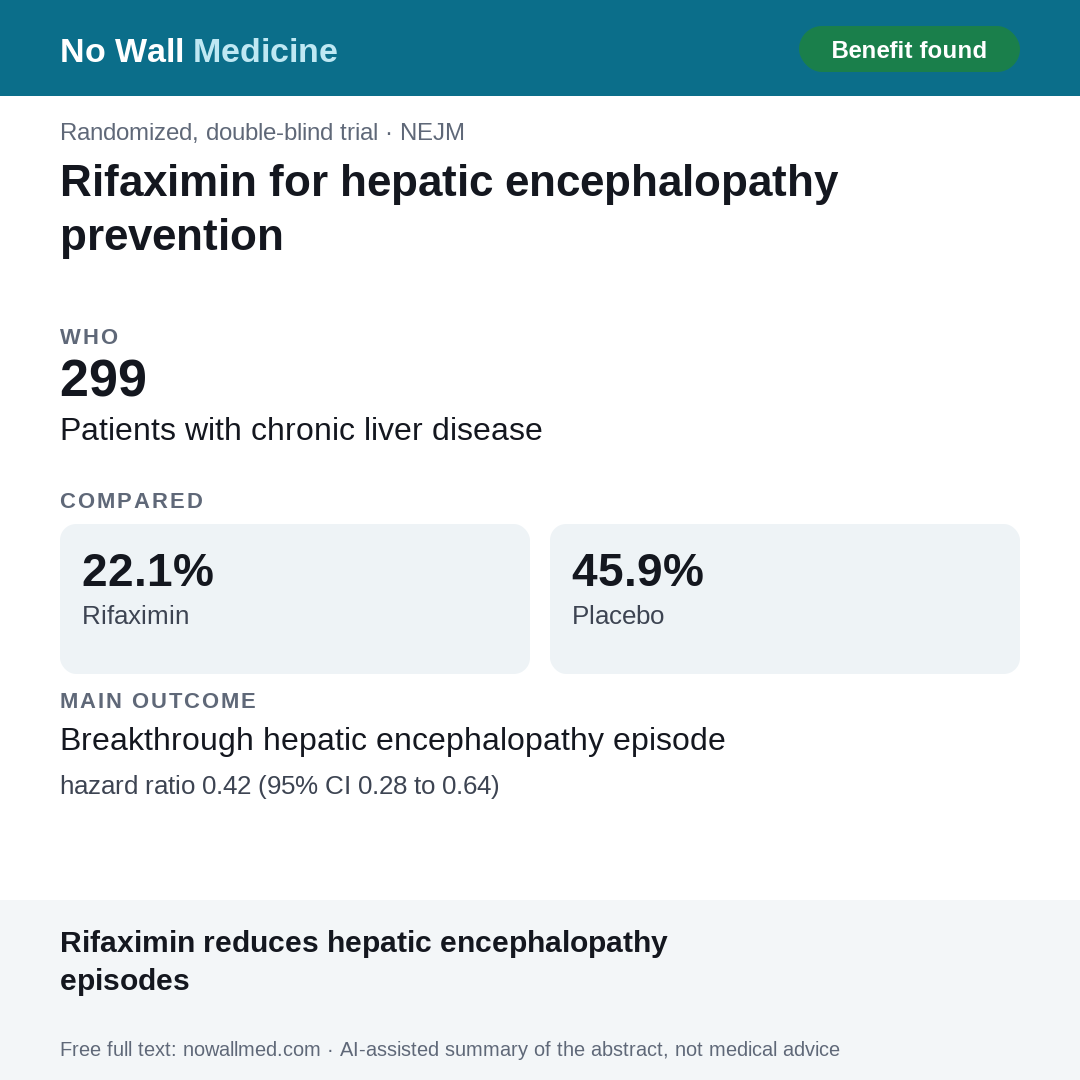
Rifaximin for hepatic encephalopathy prevention
Who
299
Patients with chronic liver disease
Compared
Rifaximin
Placebo
Main outcome
Time to hepatic encephalopathy episode
Result: hazard ratio 0.42 (95% CI 0.28 to 0.64)
Bottom line: Rifaximin prevents hepatic encephalopathy
NEJM · 2010-03-26Download image
Trial at a glance
Bottom line: Rifaximin reduced hepatic encephalopathy risk, hazard ratio 0.42
Clinical question
Rifaximin efficacy in hepatic encephalopathy prevention
Design
Randomized, double-blind, placebo-controlled trial
Who was studied
299 patients with recurrent hepatic encephalopathy
Key inclusion criteria
- in remission from recurrent hepatic encephalopathy
- chronic liver disease
Interventions
- rifaximin: 550 mg twice daily
- placebo: placebo
Primary outcome
time to first breakthrough episode. hazard ratio 0.42, 95% CI 0.28 to 0.64
Secondary outcomes
- time to first hospitalization: rifaximin significantly reduced risk
Written with AI from the abstract; every number was checked against it. Details such as eligibility criteria may be missing because the abstract does not give them. Read the paper before relying on it.
Abstract
Background
Hepatic encephalopathy is a chronically debilitating complication of hepatic cirrhosis. The efficacy of rifaximin, a minimally absorbed antibiotic, is well documented in the treatment of acute hepatic encephalopathy, but its efficacy for prevention of the disease has not been established. Methods
In this randomized, double-blind, placebo-controlled trial, we randomly assigned 299 patients who were in remission from recurrent hepatic encephalopathy resulting from chronic liver disease to receive either rifaximin, at a dose of 550 mg twice daily (140 patients), or placebo (159 patients) for 6 months. The primary efficacy end point was the time to the first breakthrough episode of hepatic encephalopathy. The key secondary end point was the time to the first hospitalization involving hepatic encephalopathy. Results
Rifaximin significantly reduced the risk of an episode of hepatic encephalopathy, as compared with placebo, over a 6-month period (hazard ratio with rifaximin, 0.42; 95% confidence interval [CI], 0.28 to 0.64; PConclusions
Over a 6-month period, treatment with rifaximin maintained remission from hepatic encephalopathy more effectively than did placebo. Rifaximin treatment also significantly reduced the risk of hospitalization involving hepatic encephalopathy. (ClinicalTrials.gov number, NCT00298038.)
Topics
Cite this article
Bass NM, Mullen KD, Sanyal A, Poordad F, Neff G, Leevy CB. Rifaximin treatment in hepatic encephalopathy. NEJM. 2010. doi:10.1056/NEJMoa0907893
Spotted a mistake? Suggest a correction