Rigorous donor selection for fecal microbiota transplantation did not increase remission in ulcerative colitis
Rigorous Donor Selection for Fecal Microbiota Transplantation in Active Ulcerative Colitis: Key Lessons From a Randomized Controlled Trial Halted for Futility
Multi-centric, double-blind, sham-controlled, randomized trialNo clear difference
Does rigorous donor selection for fecal microbiota transplantation improve remission in ulcerative colitis?
Who
72
Patients with moderate to severe ulcerative colitis · Multi-centric
Compared
3Allogenic fecal microbiota transplantation
5Autologous fecal microbiota transplantation
Main outcome
Steroid-free clinical remission at week 8
Bottom line: Rigorous allogenic fecal microbiota transplantation did not increase steroid-free clinical remission compared to autologous transplantation.
Clin Gastroenterol Hepatol · 2024-05-23Download image
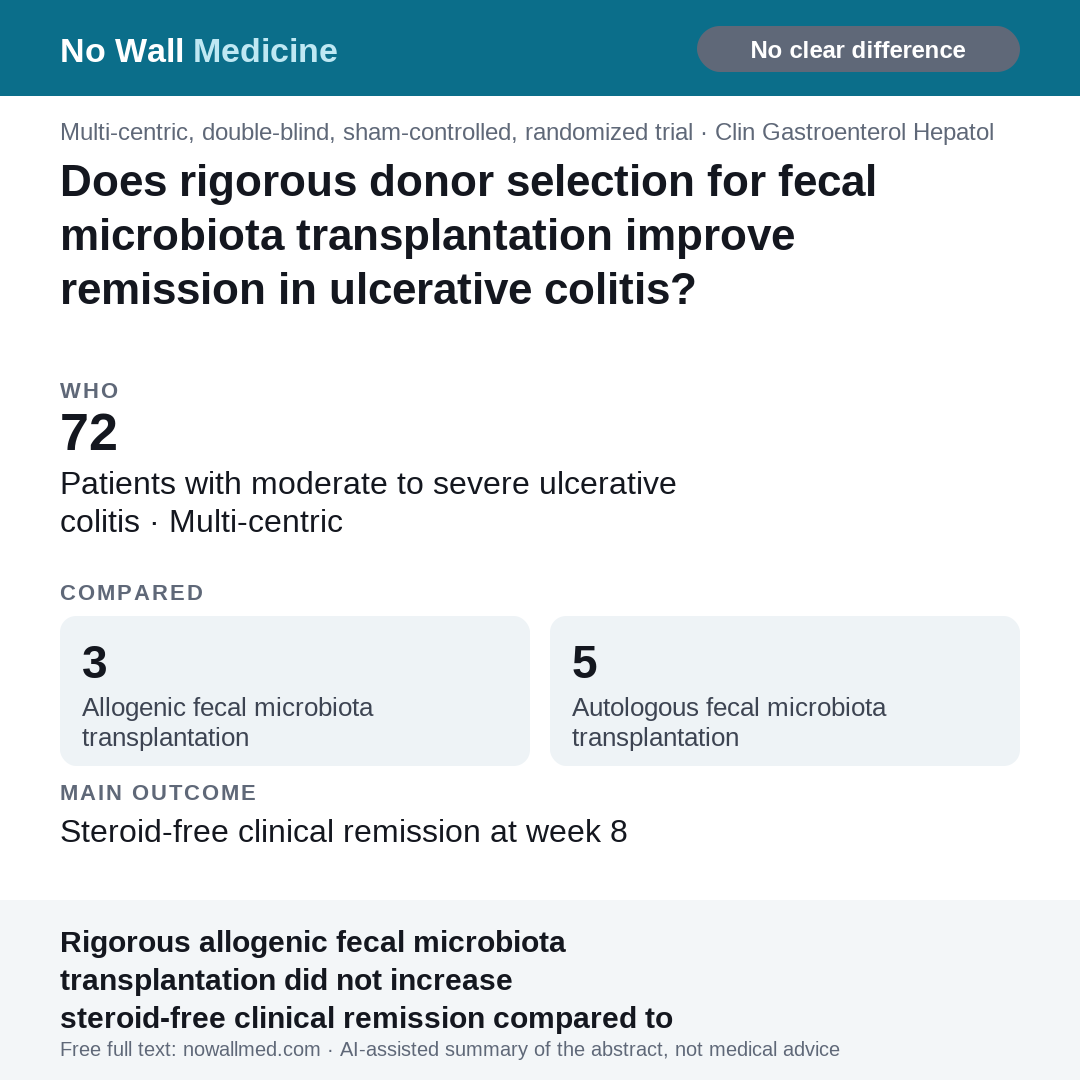
Clinical question: Does rigorous donor selection for fecal microbiota transplantation improve remission in ulcerative colitis?
Why it matters: It was unknown if rigorous donor screening and anaerobic processing of fecal microbiota transplantation could improve clinical remission in patients with active ulcerative colitis.
Key points
- The RESTORE-UC trial studied 72 patients with moderate to severe ulcerative colitis receiving either allogenic or autologous fecal microbiota transplantation, which is the transfer of stool from a donor.
- At week 8, 3 patients in the allogenic group and 5 patients in the autologous group reached steroid-free clinical remission, showing no significant difference between the two treatments.
- Higher rates of enterotype transitions, which are shifts in dominant bacterial groups, were associated with allogenic fecal microbiota transplantation compared to autologous transplantation.
Headline and key points written with AI from the paper’s abstract, with every number checked against it. Read the paper before relying on them.
Was this summary helpful?
Subject terms
Cite this article
Caenepeel C, Deleu S, Vazquez Castellanos JF, Arnauts K, Braekeleire S, Machiels K. Rigorous Donor Selection for Fecal Microbiota Transplantation in Active Ulcerative Colitis: Key Lessons From a Randomized Controlled Trial Halted for Futility. Clin Gastroenterol Hepatol. 2024. doi:10.1016/j.cgh.2024.05.017
Spotted a mistake? Suggest a correction
Top studies every Monday
The week’s key trials and guidelines in your specialties, plus any topics you follow. By email, free.
Get the weekly digest