Risk-benefit assessment of onlay and retrorectus mesh augmentation for incisional hernia prophylaxis: A secondary analysis from network meta-analysis
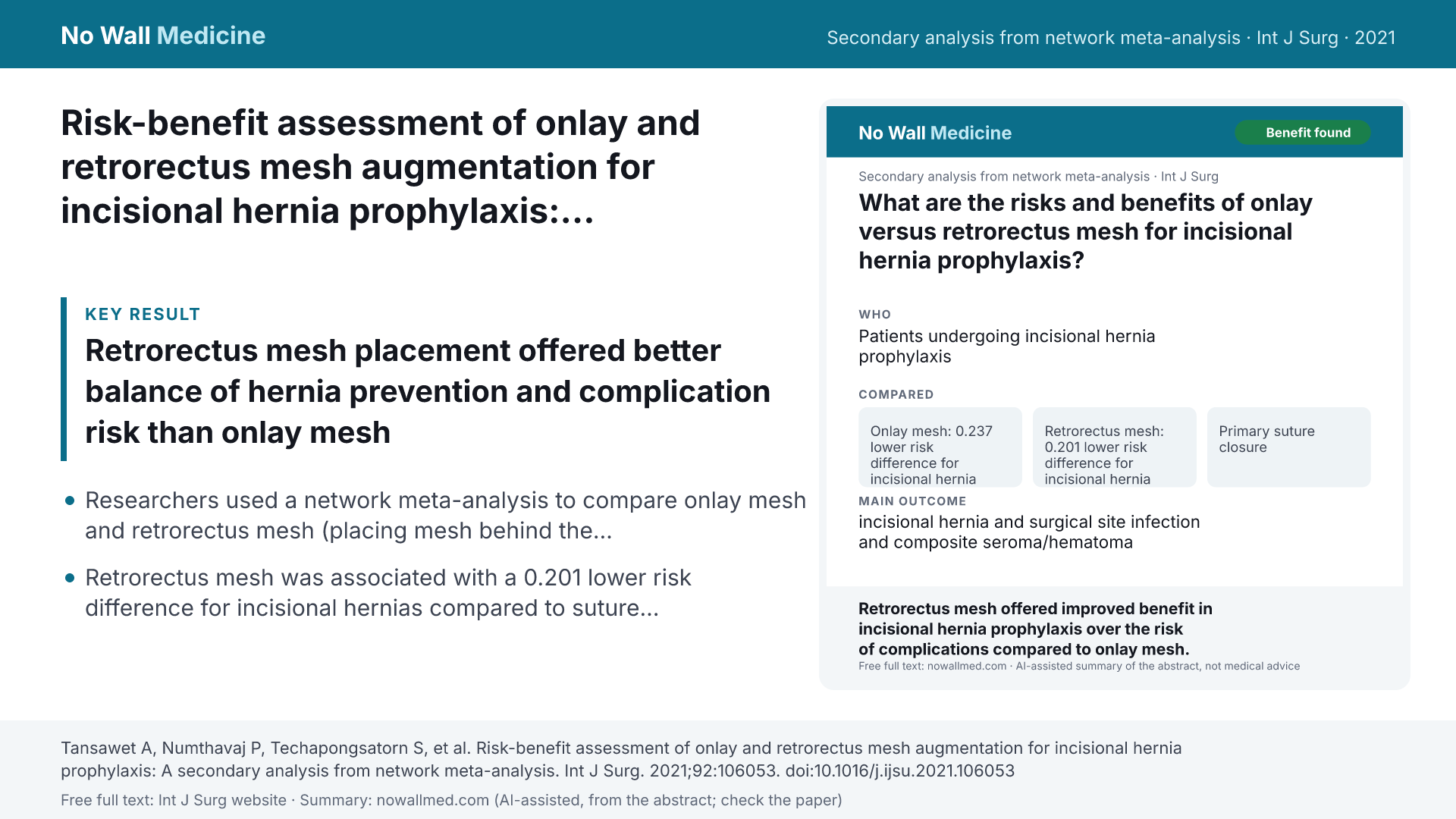
Key result: Retrorectus mesh placement offered better balance of hernia prevention and complication risk than onlay mesh
Secondary analysis from network meta-analysisBenefit found
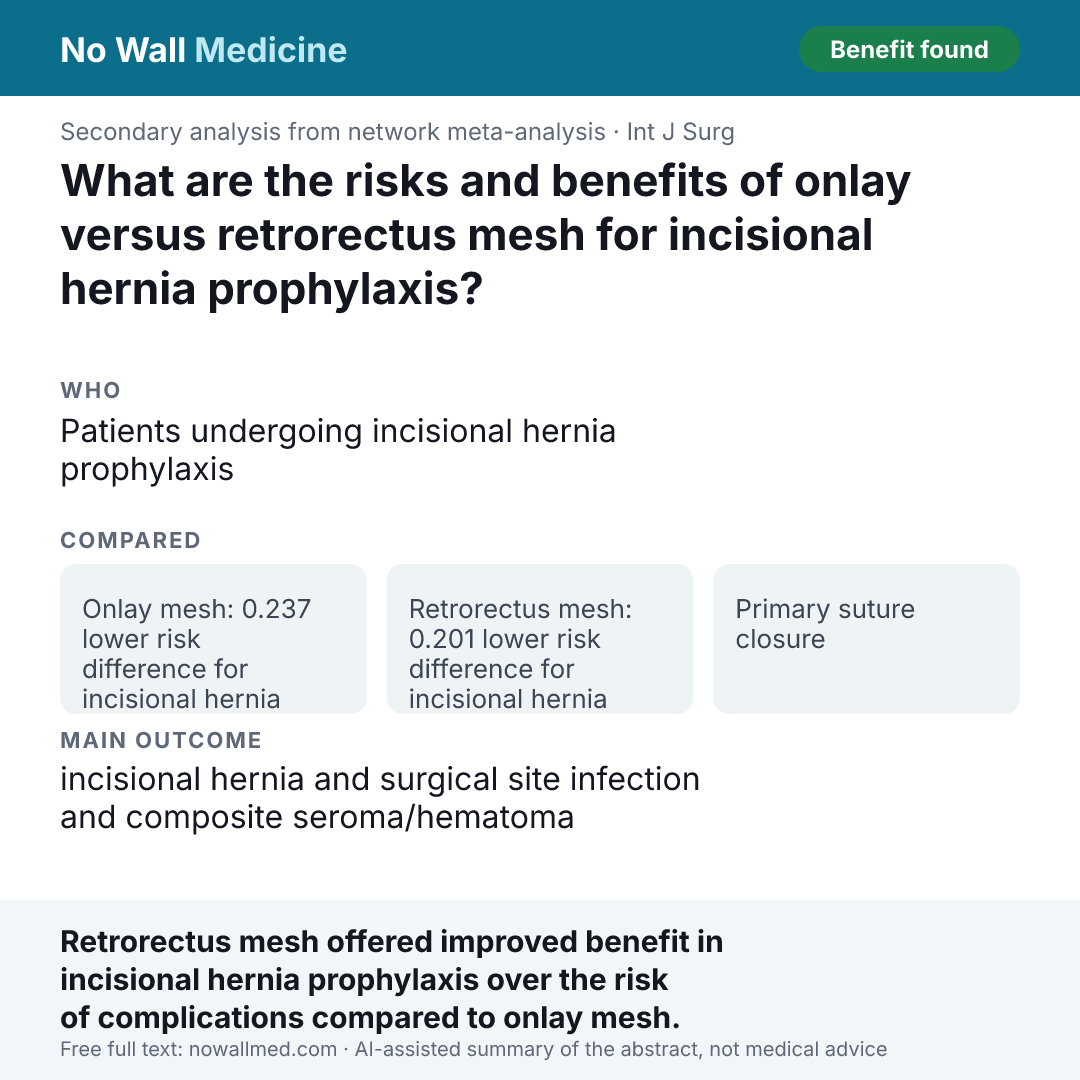
What are the risks and benefits of onlay versus retrorectus mesh for incisional hernia prophylaxis?
Who
Patients undergoing incisional hernia prophylaxis
Compared
Onlay mesh: 0.237 lower risk difference for incisional hernia
Retrorectus mesh: 0.201 lower risk difference for incisional hernia
Primary suture closure
Main outcome
incisional hernia and surgical site infection and composite seroma/hematoma
Bottom line: Retrorectus mesh offered improved benefit in incisional hernia prophylaxis over the risk of complications compared to onlay mesh.
Int J Surg · 2021-08-08 · Save PNG
Key points
- Researchers used a network meta-analysis to compare onlay mesh and retrorectus mesh (placing mesh behind the abdominal muscles) against primary suture closure for preventing incisional hernias.
- Retrorectus mesh was associated with a 0.201 lower risk difference for incisional hernias compared to suture closure, while onlay mesh showed a 0.237 lower risk difference.
- The probability of risk-benefits was much higher for retrorectus mesh than onlay mesh, particularly at low acceptability thresholds of 0.05 and 0.1.
Discussion prompts
- Would these patients look like yours? Who was left out?
- Is the main outcome one that matters to patients?
- Is the difference large enough to change what you do?
Cite: Tansawet A, Numthavaj P, Techapongsatorn S, et al. Risk-benefit assessment of onlay and retrorectus mesh augmentation for incisional hernia prophylaxis: A secondary analysis from network meta-analysis. Int J Surg. 2021;92:106053. doi:10.1016/j.ijsu.2021.106053
Free full text: Int J Surg website · Summary and visual abstract: nowallmed.com/a/risk-benefit-assessment-of-onlay-and-retrorectus-mesh-augmentation-1eqs2z4/ (AI-assisted from the abstract; check the paper before relying on it).