Vaccine effectiveness against COVID-19 declined over time and was lower in high-risk groups
Risk factors affecting COVID-19 vaccine effectiveness identified from 290 cross-country observational studies until February 2022: a meta-analysis and meta-regression
Meta-analysis of 290 observational studiesMixed results
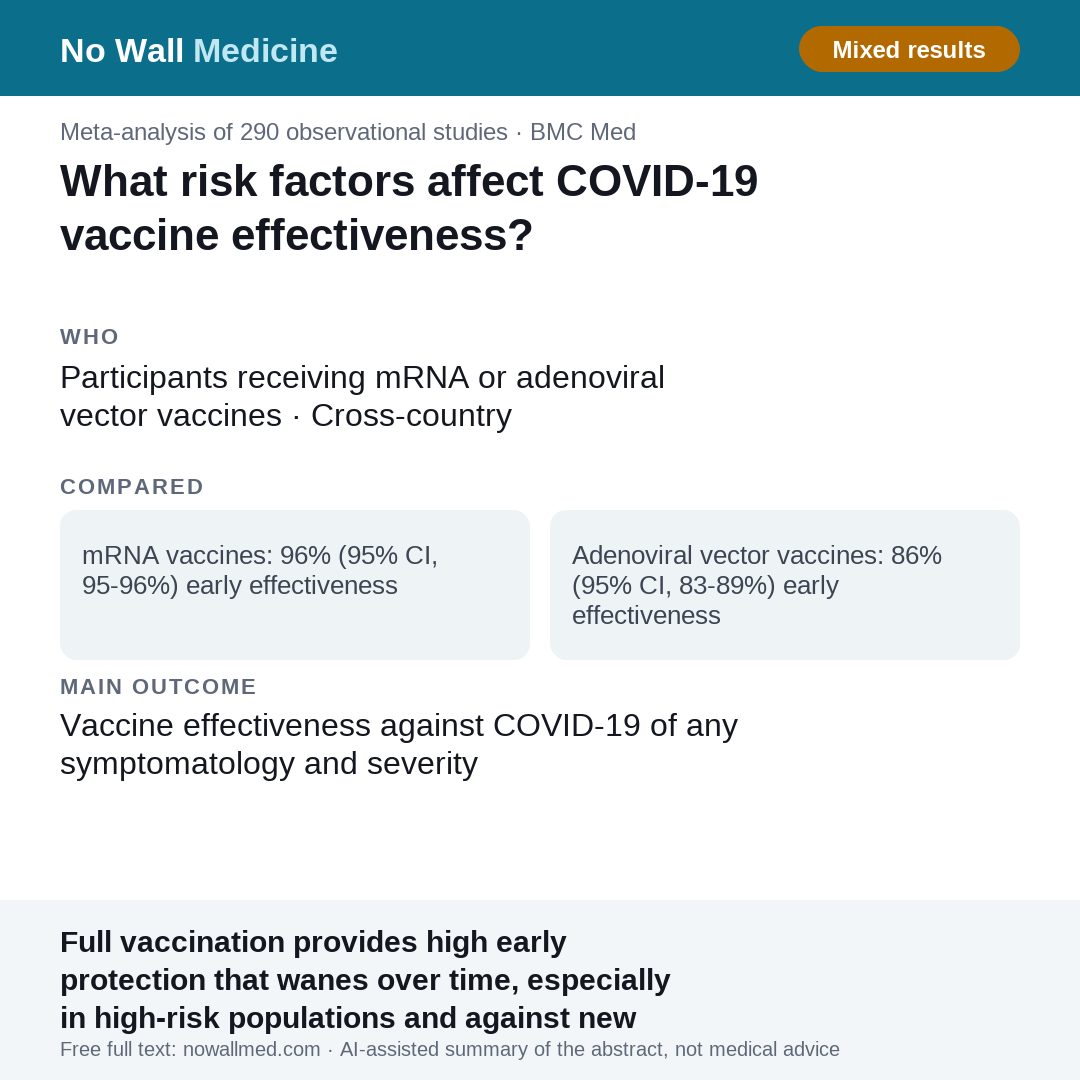
What risk factors affect COVID-19 vaccine effectiveness?
Who
Participants receiving mRNA or adenoviral vector vaccines · Cross-country
Compared
mRNA vaccines: 96% (95% CI, 95-96%) early effectiveness
Adenoviral vector vaccines: 86% (95% CI, 83-89%) early effectiveness
Main outcome
Vaccine effectiveness against COVID-19 of any symptomatology and severity
Bottom line: Full vaccination provides high early protection that wanes over time, especially in high-risk populations and against new variants.
Limitation: The study is based on observational studies which may have inherent bias.
BMC Med · 2022-11-25Download image
Clinical question: What risk factors affect COVID-19 vaccine effectiveness?
Why it matters: It was unknown how specific risk factors and time since vaccination influenced the long-term effectiveness of different COVID-19 vaccine types.
Key points
- Researchers analyzed 290 observational studies to assess how various factors influenced the effectiveness of messenger RNA (mRNA) and adenoviral vector (AdV) vaccines.
- Early effectiveness against any symptom severity fell from 96% for mRNA and 86% for AdV vaccines to 67% for both types in late 2021.
- Lower protection levels were associated with being older than 65 years, having a comorbidity, or living in long-term care or residential homes.
Headline and key points written with AI from the paper’s abstract, with every number checked against it. Read the paper before relying on them.
Was this summary helpful?
Subject terms
Cite this article
Petráš M, Máčalík R, Janovská D, Čelko AM, Dáňová J, Selinger E. Risk factors affecting COVID-19 vaccine effectiveness identified from 290 cross-country observational studies until February 2022: a meta-analysis and meta-regression. BMC Med. 2022. doi:10.1186/s12916-022-02663-z
Spotted a mistake? Suggest a correction
Top studies every Monday
The week’s key trials and guidelines in your specialties, plus any topics you follow. By email, free.
Get the weekly digest