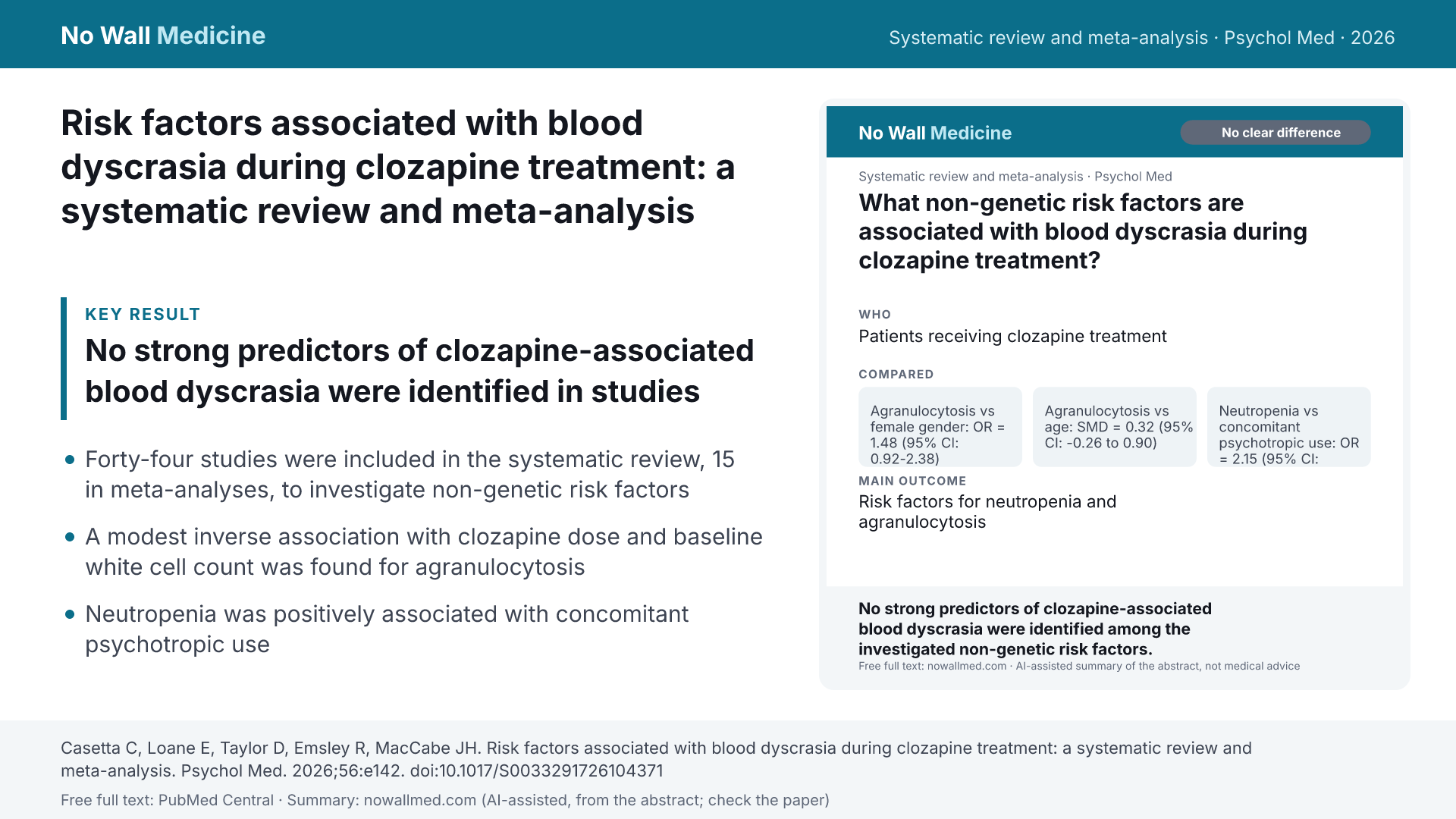
No strong predictors of clozapine-associated blood dyscrasia were identified in studies
Risk factors associated with blood dyscrasia during clozapine treatment: a systematic review and meta-analysis
Systematic review and meta-analysisNo clear difference
What non-genetic risk factors are associated with blood dyscrasia during clozapine treatment?
Who
Patients receiving clozapine treatment
Compared
Agranulocytosis vs female gender: OR = 1.48 (95% CI: 0.92-2.38)
Agranulocytosis vs age: SMD = 0.32 (95% CI: -0.26 to 0.90)
Neutropenia vs concomitant psychotropic use: OR = 2.15 (95% CI: 1.13-4.07)
Main outcome
Risk factors for neutropenia and agranulocytosis
Bottom line: No strong predictors of clozapine-associated blood dyscrasia were identified among the investigated non-genetic risk factors.
Limitation: Study variability, surveillance bias, and lack of consistent differentiation between agranulocytosis and milder neutropenia.
Psychol Med · 2026-05-11 · Save PNG
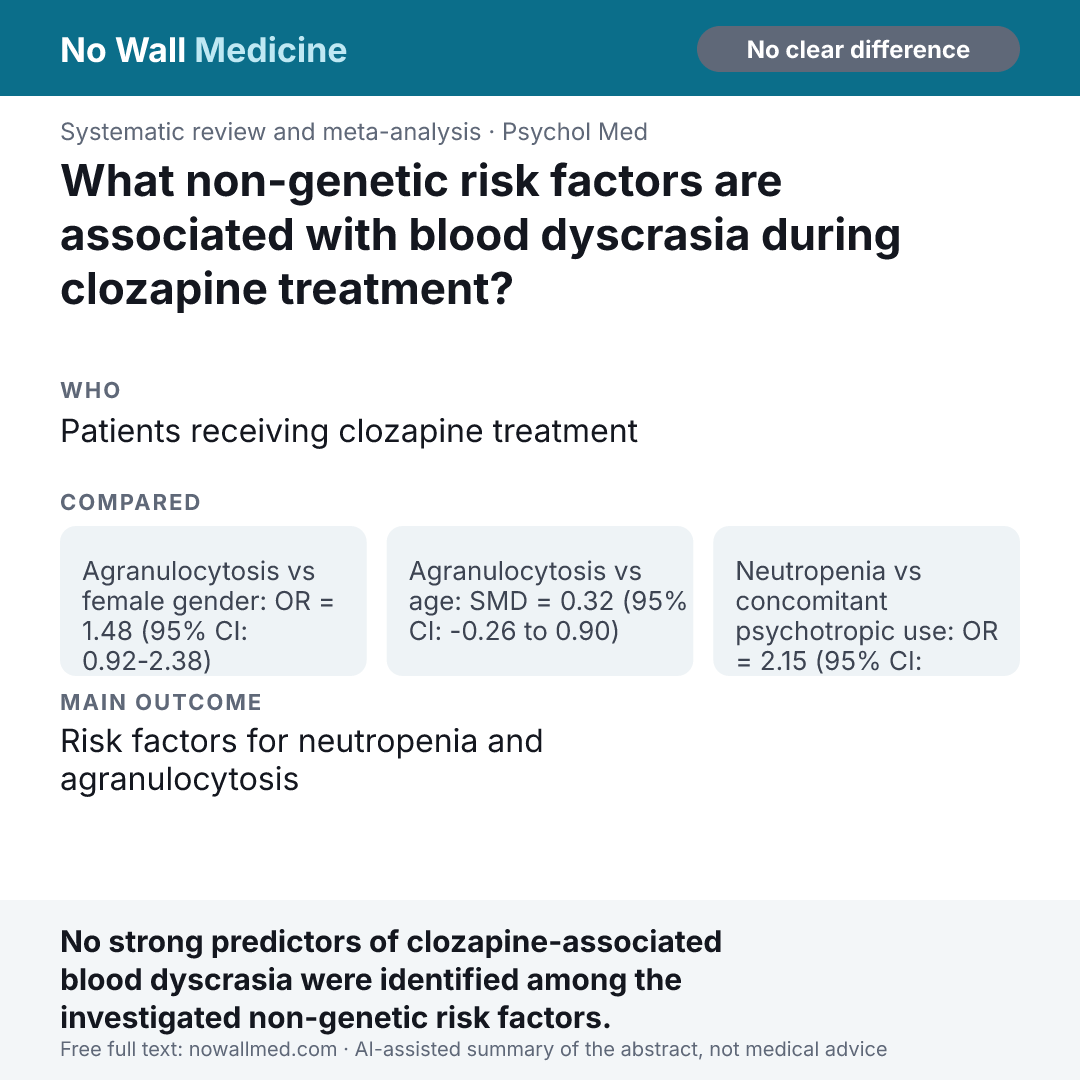
Clinical question: What non-genetic risk factors are associated with blood dyscrasia during clozapine treatment?
Key points
- Forty-four studies were included in the systematic review, 15 in meta-analyses, to investigate non-genetic risk factors.
- A modest inverse association with clozapine dose and baseline white cell count was found for agranulocytosis.
- Neutropenia was positively associated with concomitant psychotropic use.
Limitation the authors note: Findings may be limited by study variability, surveillance bias, and lack of consistent differentiation between agranulocytosis and milder neutropenia
Headline and key points written with AI from the paper’s abstract, with every number checked against it. Read the paper before relying on them.
Was this summary helpful?
Subject terms
Headline, design, result, key points, caveat and citation as plain text.
Cite this article
Casetta C, Loane E, Taylor D, Emsley R, MacCabe JH. Risk factors associated with blood dyscrasia during clozapine treatment: a systematic review and meta-analysis. Psychol Med. 2026;56:e142. doi:10.1017/S0033291726104371
Spotted a mistake? Suggest a correction