Specific knee injuries and surgical procedures are associated with increased risk of osteoarthritis
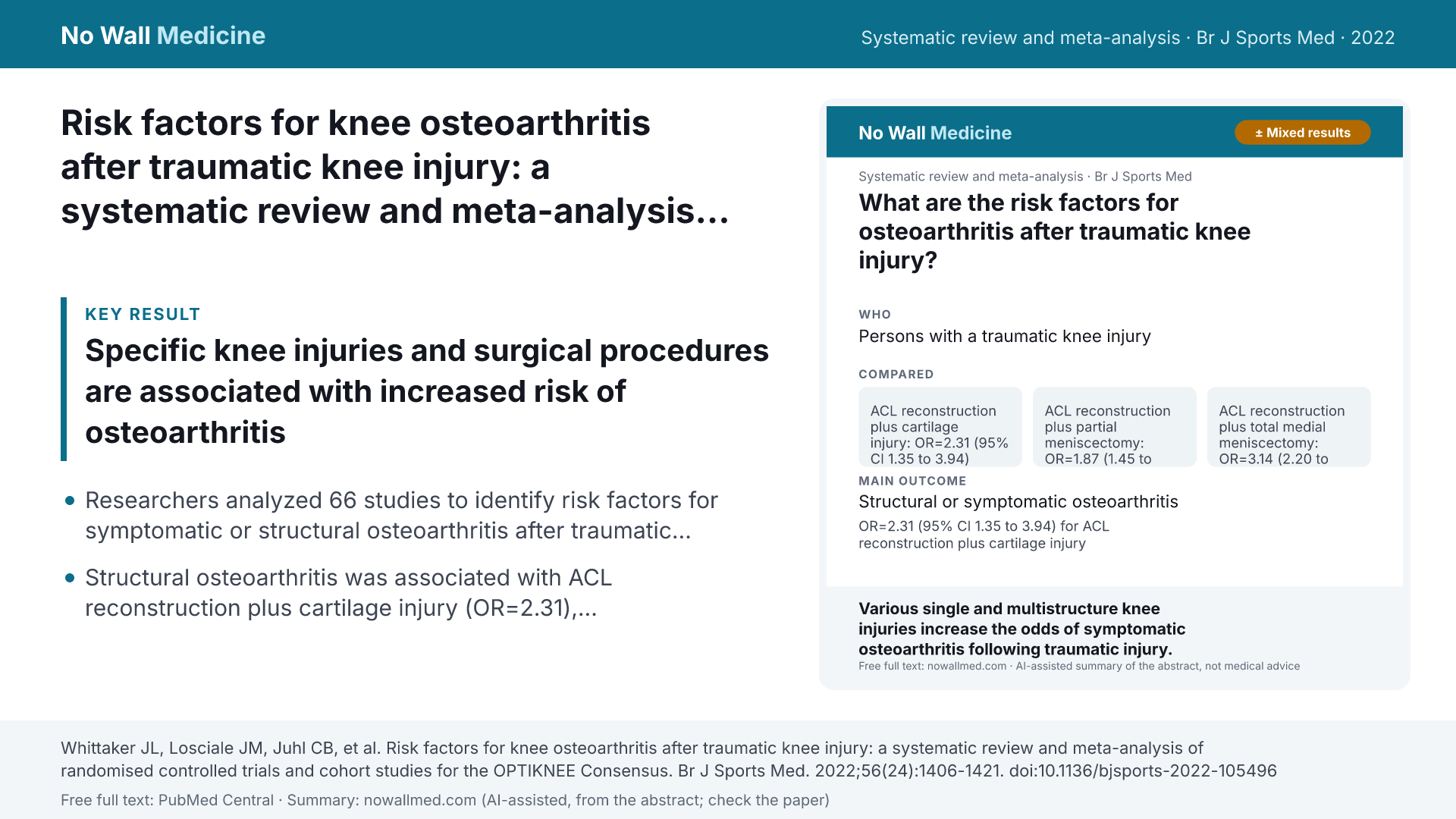
Risk factors for knee osteoarthritis after traumatic knee injury: a systematic review and meta-analysis of randomised controlled trials and cohort studies for the OPTIKNEE Consensus
Systematic review and meta-analysisMixed results
What are the risk factors for osteoarthritis after traumatic knee injury?
Who
Persons with a traumatic knee injury
Compared
ACL reconstruction plus cartilage injury: OR=2.31 (95% CI 1.35 to 3.94)
ACL reconstruction plus partial meniscectomy: OR=1.87 (1.45 to 2.42)
ACL reconstruction plus total medial meniscectomy: OR=3.14 (2.20 to 4.48)
Main outcome
Structural or symptomatic osteoarthritis
Result: OR=2.31 (95% CI 1.35 to 3.94) for ACL reconstruction plus cartilage injury
Bottom line: Various single and multistructure knee injuries increase the odds of symptomatic osteoarthritis following traumatic injury.
Limitation: Risk factor heterogeneity, high risk of bias, and inconsistency in risk factors and osteoarthritis definition.
Br J Sports Med · 2022-09-02 · Save PNG
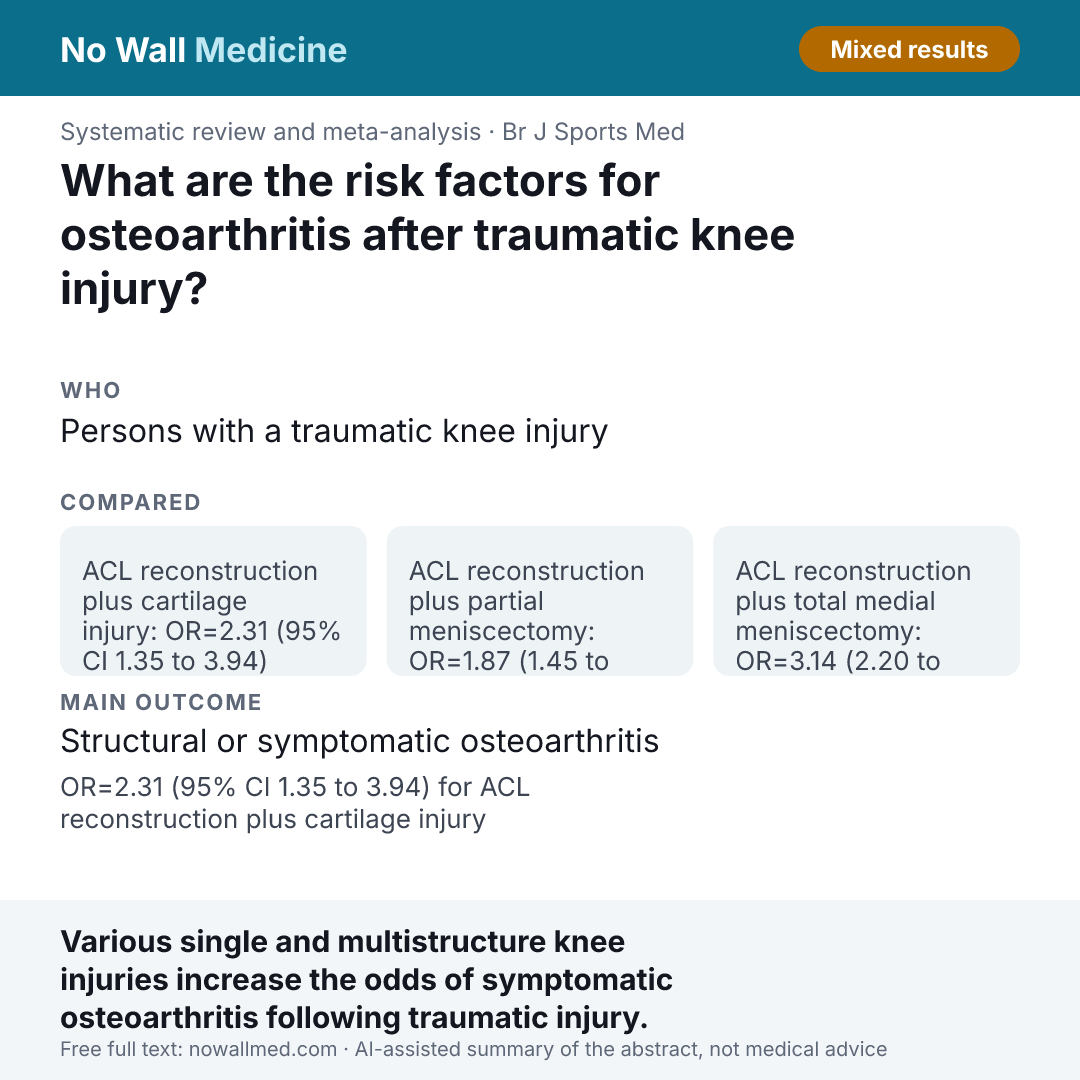
Clinical question: What are the risk factors for osteoarthritis after traumatic knee injury?
Key points
- Researchers analyzed 66 studies to identify risk factors for symptomatic or structural osteoarthritis after traumatic knee injuries.
- Structural osteoarthritis was associated with ACL reconstruction plus cartilage injury (OR=2.31), partial meniscectomy (OR=1.87), and total medial meniscectomy (OR=3.14).
- Symptomatic osteoarthritis was associated with cruciate ligament, collateral ligament, meniscal, chondral, patellar/tibiofemoral dislocation, fracture, and multistructure injuries.
Limitation the authors note: High risk of bias due to attrition or confounding was present in 64% and 49% of studies, respectively.
Headline and key points written with AI from the paper’s abstract, with every number checked against it. Read the paper before relying on them.
Was this summary helpful?
Abstract
Objective
To identify and quantify potential risk factors for osteoarthritis (OA) following traumatic knee injury. Design
Systematic review and meta-analyses that estimated the odds of OA for individual risk factors assessed in more than four studies using random-effects models. Remaining risk factors underwent semiquantitative synthesis. The modified GRADE (Grading of Recommendations Assessment, Development and Evaluation) approach for prognostic factors guided the assessment. Data sources
MEDLINE, EMBASE, CENTRAL, SPORTDiscus, CINAHL searched from inception to 2009-2021. Eligibility
Randomised controlled trials and cohort studies assessing risk factors for symptomatic or structural OA in persons with a traumatic knee injury, mean injury age ≤30 years and minimum 2-year follow-up. Results
Across 66 included studies, 81 unique potential risk factors were identified. High risk of bias due to attrition or confounding was present in 64% and 49% of studies, respectively. Ten risk factors for structural OA underwent meta-analysis (sex, rehabilitation for anterior cruciate ligament (ACL) tear, ACL reconstruction (ACLR), ACLR age, ACLR body mass index, ACLR graft source, ACLR graft augmentation, ACLR+cartilage injury, ACLR+partial meniscectomy, ACLR+total medial meniscectomy). Very-low certainty evidence suggests increased odds of structural OA related to ACLR+cartilage injury (OR=2.31; 95% CI 1.35 to 3.94), ACLR+partial meniscectomy (OR=1.87; 1.45 to 2.42) and ACLR+total medial meniscectomy (OR=3.14; 2.20 to 4.48). Semiquantitative syntheses identified moderate-certainty evidence that cruciate ligament, collateral ligament, meniscal, chondral, patellar/tibiofemoral dislocation, fracture and multistructure injuries increase the odds of symptomatic OA. Conclusion
Moderate-certainty evidence suggests that various single and multistructure knee injuries (beyond ACL tears) increase the odds of symptomatic OA. Risk factor heterogeneity, high risk of bias, and inconsistency in risk factors and OA definition make identifying treatment targets for preventing post-traumatic knee OA challenging.
Abstract reproduced under the article’s CC BY NC licence.
Subject terms
Headline, design, result, key points, caveat and citation as plain text.
Cite this article
Whittaker JL, Losciale JM, Juhl CB, et al. Risk factors for knee osteoarthritis after traumatic knee injury: a systematic review and meta-analysis of randomised controlled trials and cohort studies for the OPTIKNEE Consensus. Br J Sports Med. 2022;56(24):1406-1421. doi:10.1136/bjsports-2022-105496
Spotted a mistake? Suggest a correction