Anatomical and operative factors were linked to complications after minimally invasive donor liver surgery
Risk factors for morbidity in both donor and recipient following minimally invasive donor hepatectomy: a systematic review
Systematic reviewMixed results
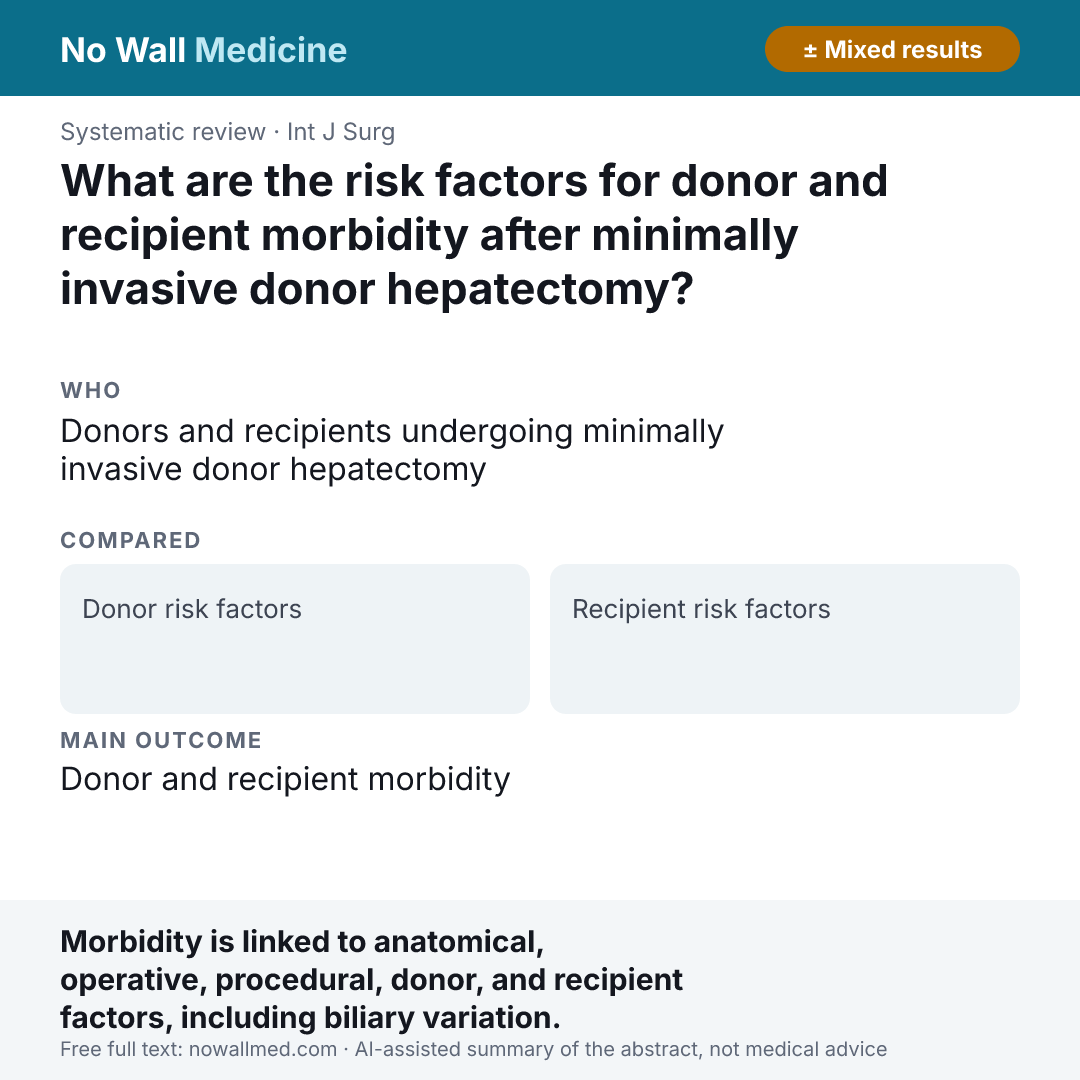
What are the risk factors for donor and recipient morbidity after minimally invasive donor hepatectomy?
Who
Donors and recipients undergoing minimally invasive donor hepatectomy
Compared
Donor risk factors
Recipient risk factors
Main outcome
Donor and recipient morbidity
Bottom line: Morbidity is linked to anatomical, operative, procedural, donor, and recipient factors, including biliary variation.
Limitation: Limited studies on risk factors require multicenter studies with larger sample sizes.
Int J Surg · 2025-10-09 · Save PNG
Clinical question: What are the risk factors for donor and recipient morbidity after minimally invasive donor hepatectomy?
Why it matters: The technical complexity of minimally invasive donor liver transplantation presents potential risks for both the donor and the recipient.
Key points
- Researchers reviewed eight studies published between January 2001 and December 2024 to identify risk factors for complications in donors and recipients after minimally invasive donor hepatectomy.
- Donor complications were linked to short hepatic ducts, multiple ducts or vessels, large grafts, longer operative times, and blood loss, while high BMI was related to converting to open surgery.
- Recipient complications were associated with biliary variations, portal vein thrombosis, hepaticojejunostomy, longer operative times, massive transfusion, and high Model for End-Stage Liver Disease scores.
Limitation the authors note: The authors state that there are limited studies on risk factors and that multicenter studies with larger sample sizes are needed to validate these findings.
Headline and key points written with AI from the paper’s abstract, with every number checked against it. Read the paper before relying on them.
Was this summary helpful?
Subject terms
Headline, design, result, key points, caveat and citation as plain text.
Cite this article
Kim SH, Kim KH, Sudhindran S, Broering DC. Risk factors for morbidity in both donor and recipient following minimally invasive donor hepatectomy: a systematic review. Int J Surg. 2026;112(1):18-26. doi:10.1097/JS9.0000000000003524
Spotted a mistake? Suggest a correction