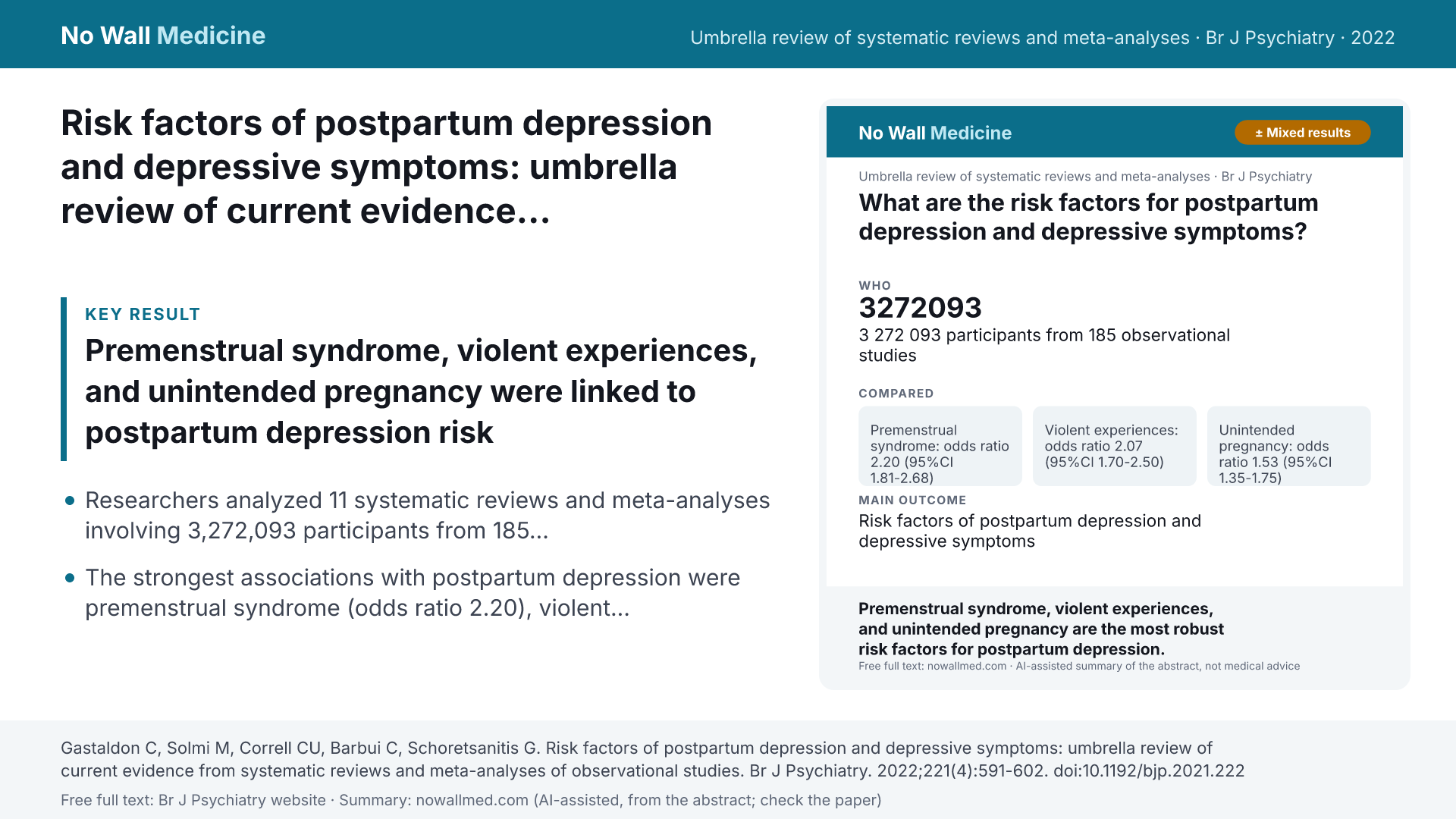
Premenstrual syndrome, violent experiences, and unintended pregnancy were linked to postpartum depression risk
Risk factors of postpartum depression and depressive symptoms: umbrella review of current evidence from systematic reviews and meta-analyses of observational studies
Umbrella review of systematic reviews and meta-analysesMixed results
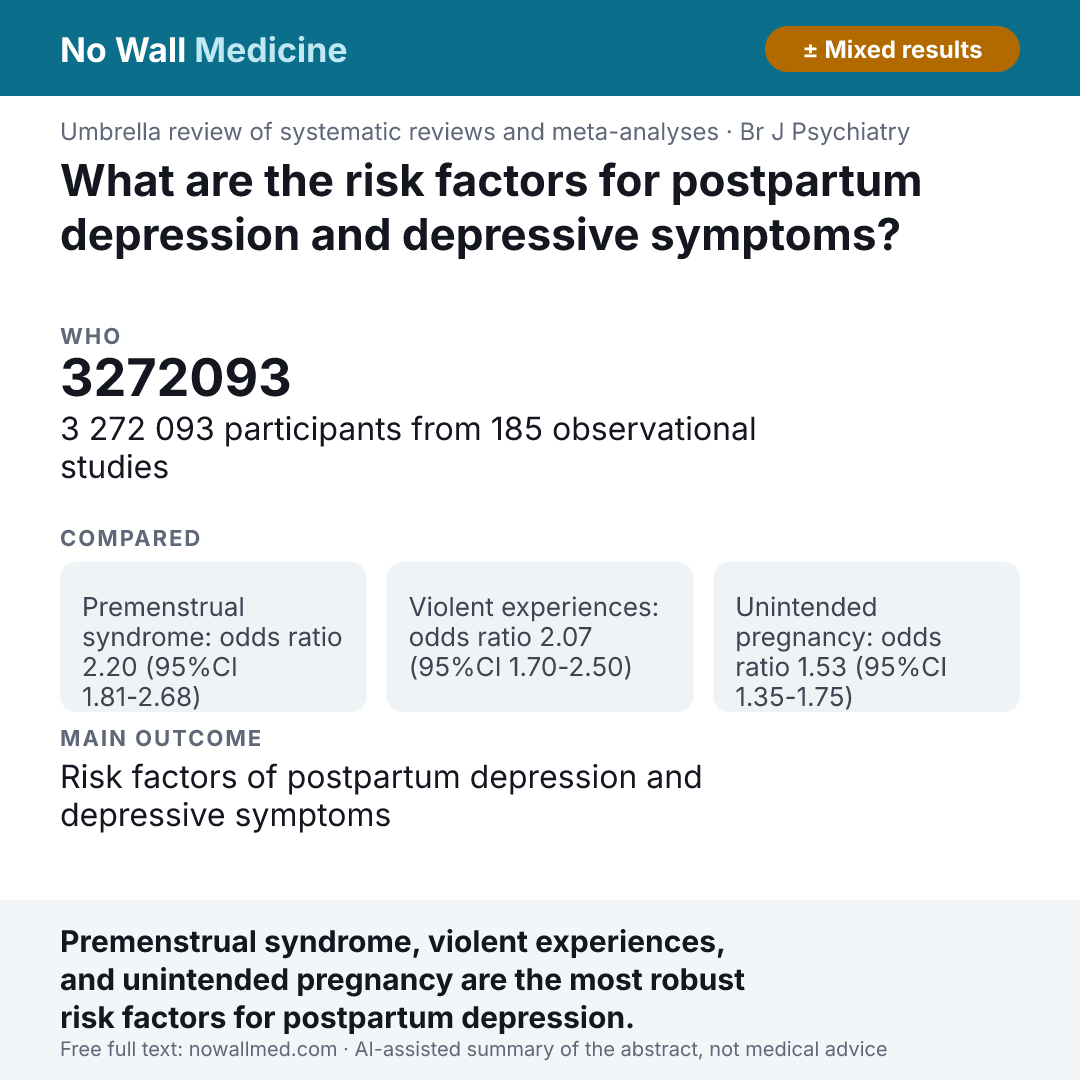
What are the risk factors for postpartum depression and depressive symptoms?
Who
3272093
3 272 093 participants from 185 observational studies
Compared
Premenstrual syndrome: odds ratio 2.20 (95%CI 1.81-2.68)
Violent experiences: odds ratio 2.07 (95%CI 1.70-2.50)
Unintended pregnancy: odds ratio 1.53 (95%CI 1.35-1.75)
Main outcome
Risk factors of postpartum depression and depressive symptoms
Bottom line: Premenstrual syndrome, violent experiences, and unintended pregnancy are the most robust risk factors for postpartum depression.
Br J Psychiatry · 2022-01-28 · Save PNG
Clinical question: What are the risk factors for postpartum depression and depressive symptoms?
Why it matters: Evidence regarding the specific risk factors for postpartum depression is currently fragmented and inconsistent.
Key points
- Researchers analyzed 11 systematic reviews and meta-analyses involving 3,272,093 participants from 185 observational studies.
- The strongest associations with postpartum depression were premenstrual syndrome (odds ratio 2.20), violent experiences (odds ratio 2.07), and unintended pregnancy (odds ratio 1.53).
- No associations reached the level of convincing evidence, and evidence certainty was low or very low for most factors.
Limitation the authors note: The certainty of the evidence was low or very low for most factors according to the Grading of Recommendations-Assessment-Development-Evaluations criteria.
Headline and key points written with AI from the paper’s abstract, with every number checked against it. Read the paper before relying on them.
Was this summary helpful?
Subject terms
Headline, design, result, key points, caveat and citation as plain text.
Cite this article
Gastaldon C, Solmi M, Correll CU, Barbui C, Schoretsanitis G. Risk factors of postpartum depression and depressive symptoms: umbrella review of current evidence from systematic reviews and meta-analyses of observational studies. Br J Psychiatry. 2022;221(4):591-602. doi:10.1192/bjp.2021.222
Spotted a mistake? Suggest a correction