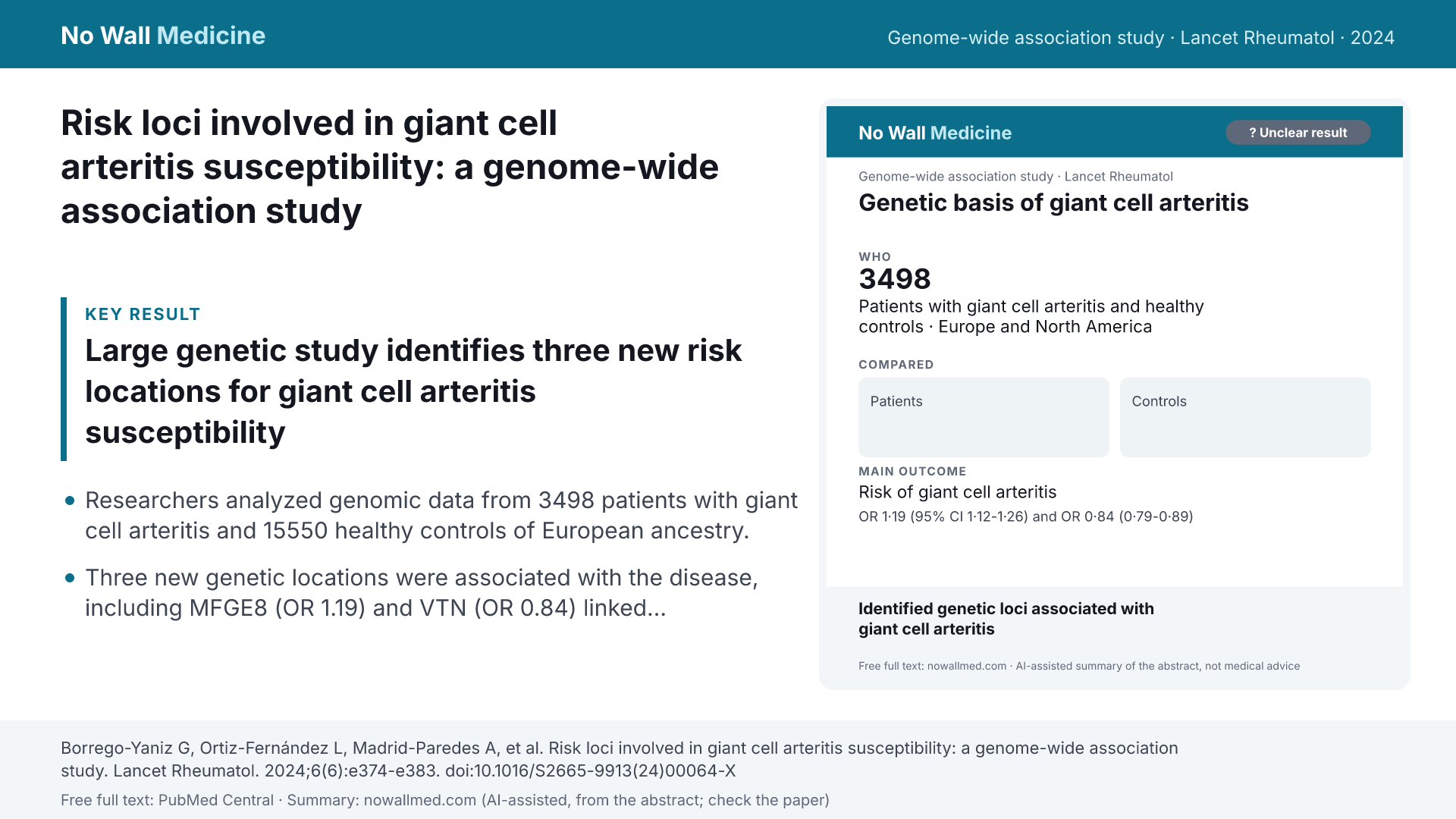
Large genetic study identifies three new risk locations for giant cell arteritis susceptibility
Risk loci involved in giant cell arteritis susceptibility: a genome-wide association study
Genome-wide association studyUnclear result
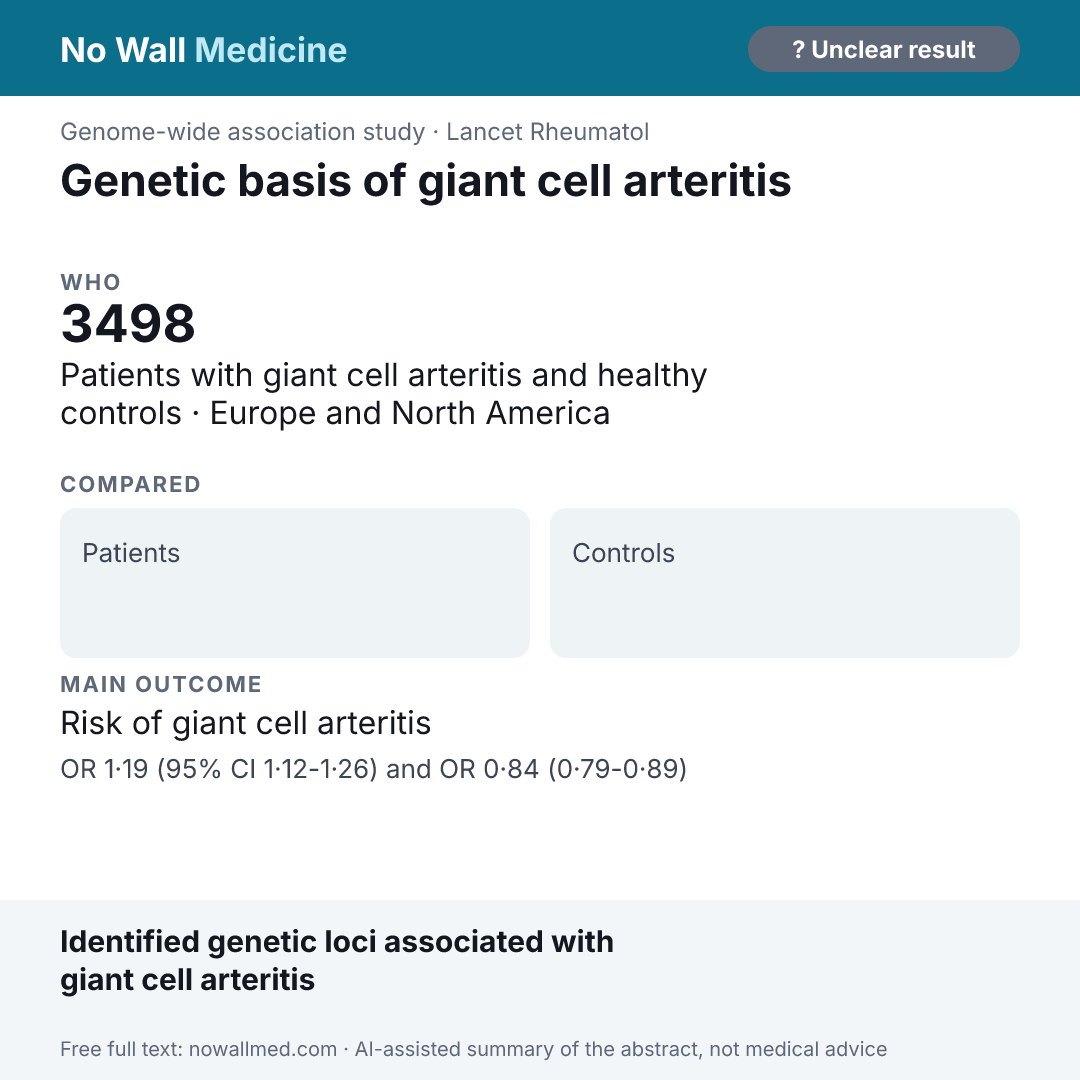
Genetic basis of giant cell arteritis
Who
3498
Patients with giant cell arteritis and healthy controls · Europe and North America
Compared
Patients
Controls
Main outcome
Risk of giant cell arteritis
Result: OR 1·19 (95% CI 1·12-1·26) and OR 0·84 (0·79-0·89)
Bottom line: Identified genetic loci associated with giant cell arteritis
Funded by: Institute of Health Carlos III
Lancet Rheumatol · 2024-05-08 · Save PNG
Key points
- Researchers analyzed genomic data from 3498 patients with giant cell arteritis and 15550 healthy controls of European ancestry.
- Three new genetic locations were associated with the disease, including MFGE8 (OR 1.19) and VTN (OR 0.84) linked to angiogenesis pathways.
- A polygenic risk score model identified individuals at increased risk, with the 90th percentile showing an OR of 2.87.
Headline and key points written with AI from the paper’s abstract, with every number checked against it. Read the paper before relying on them.
Was this summary helpful?
Abstract
Background
Giant cell arteritis is an age-related vasculitis that mainly affects the aorta and its branches in individuals aged 50 years and older. Current options for diagnosis and treatment are scarce, highlighting the need to better understand its underlying pathogenesis. Genome-wide association studies (GWAS) have emerged as a powerful tool for unravelling the pathogenic mechanisms involved in complex diseases. We aimed to characterise the genetic basis of giant cell arteritis by performing the largest GWAS of this vasculitis to date and to assess the functional consequences and clinical implications of identified risk loci. Methods
We collected and meta-analysed genomic data from patients with giant cell arteritis and healthy controls of European ancestry from ten cohorts across Europe and North America. Eligible patients required confirmation of giant cell arteritis diagnosis by positive temporal artery biopsy, positive temporal artery doppler ultrasonography, or imaging techniques confirming large-vessel vasculitis. We assessed the functional consequences of loci associated with giant cell arteritis using cell enrichment analysis, fine-mapping, and causal gene prioritisation. We also performed a drug repurposing analysis and developed a polygenic risk score to explore the clinical implications of our findings. Findings
We included a total of 3498 patients with giant cell arteritis and 15 550 controls. We identified three novel loci associated with risk of giant cell arteritis. Two loci, MFGE8 (rs8029053; p=4·96 × 10-8; OR 1·19 [95% CI 1·12-1·26]) and VTN (rs704; p=2·75 × 10-9; OR 0·84 [0·79-0·89]), were related to angiogenesis pathways and the third locus, CCDC25 (rs11782624; p=1·28 × 10-8; OR 1·18 [1·12-1·25]), was related to neutrophil extracellular traps (NETs). We also found an association between this vasculitis and HLA region and PLG. Variants associated with giant cell arteritis seemed to fulfil a specific regulatory role in crucial immune cell types. Furthermore, we identified several drugs that could represent promising candidates for treatment of this disease. The polygenic risk score model was able to identify individuals at increased risk of developing giant cell arteritis (90th percentile OR 2·87 [95% CI 2·15-3·82]; p=1·73 × 10-13). Interpretation
We have found several additional loci associated with giant cell arteritis, highlighting the crucial role of angiogenesis in disease susceptibility. Our study represents a step forward in the translation of genomic findings to clinical practice in giant cell arteritis, proposing new treatments and a method to measure genetic predisposition to this vasculitis. Funding
Institute of Health Carlos III, Spanish Ministry of Science and Innovation, UK Medical Research Council, and National Institute for Health and Care Research.
Abstract reproduced under the article’s CC BY licence.
Subject terms
Headline, design, result, key points, caveat and citation as plain text.
Cite this article
Borrego-Yaniz G, Ortiz-Fernández L, Madrid-Paredes A, et al. Risk loci involved in giant cell arteritis susceptibility: a genome-wide association study. Lancet Rheumatol. 2024;6(6):e374-e383. doi:10.1016/S2665-9913(24)00064-X
Spotted a mistake? Suggest a correction