Interruptive digital alerts increased the frequency of in-person suicide risk assessments in neurology patients
Risk Model-Guided Clinical Decision Support for Suicide Screening: A Randomized Clinical Trial
Comparative effectiveness randomized clinical trialBenefit found
Does interruptive or noninterruptive clinical decision support improve suicide risk assessment decisions?
Who
561
Patients scheduled for routine care in neurology departments · Vanderbilt University Medical Center, US Mid-South
Compared
Interruptive clinical decision support: 121 of 289 encounters [42%]
Noninterruptive clinical decision support: 12 of 307 encounters [4%]
Main outcome
Decision to assess suicide risk in person
Result: odds ratio 17.70 (95% CI 6.42-48.79)
Bottom line: Interruptive clinical decision support significantly increased decisions to perform face-to-face suicide risk assessments compared to noninterruptive support.
JAMA Netw Open · 2025-01-02Download image
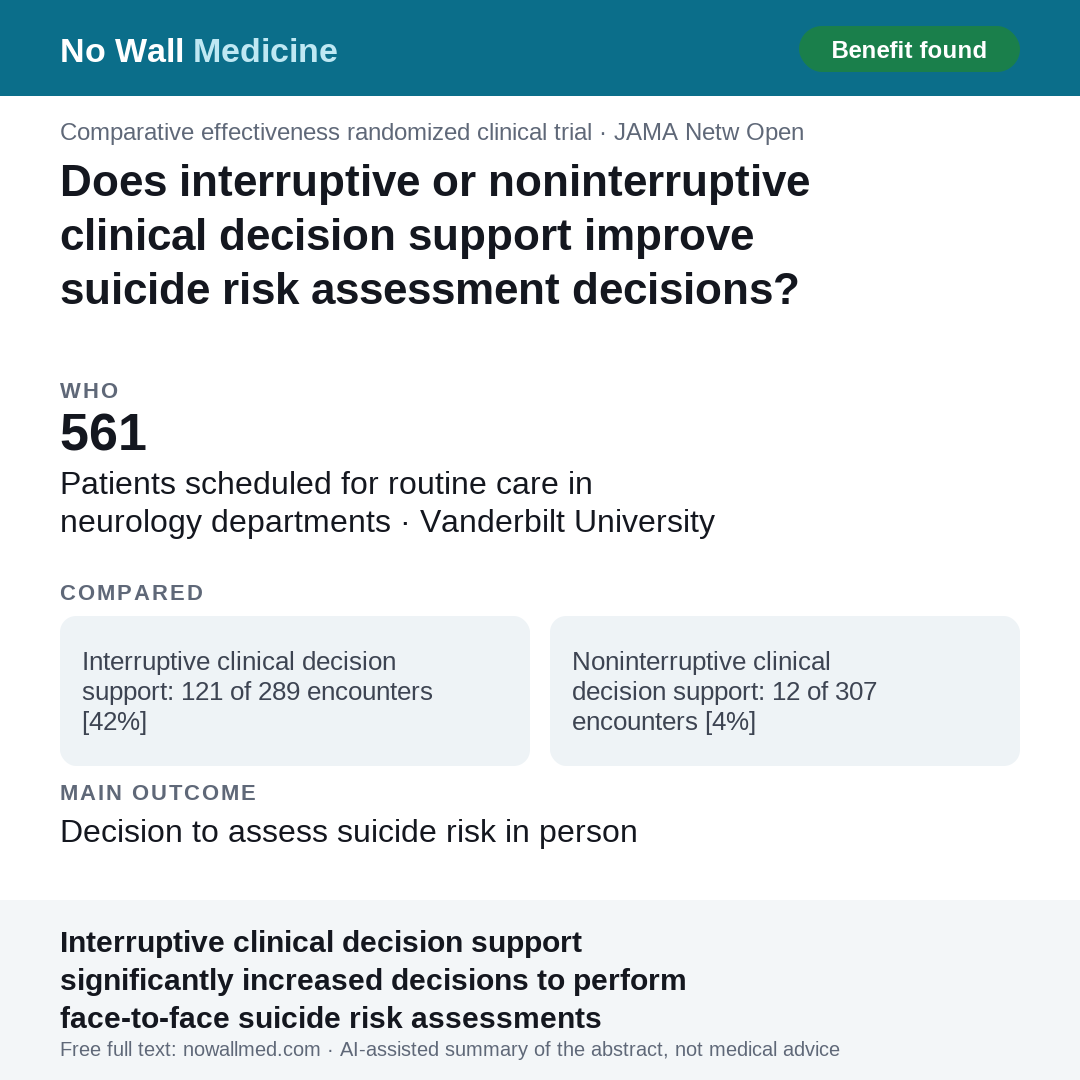
Clinical question: Does interruptive or noninterruptive clinical decision support improve suicide risk assessment decisions?
Why it matters: It is unknown how to best integrate scalable statistical risk models into clinical workflows without creating alert burden for clinicians.
Key points
- Researchers randomized 561 patients with 596 encounters to receive either interruptive or noninterruptive clinical decision support, which are digital tools designed to prompt clinicians to act.
- The interruptive alert system led to decisions to screen in 121 of 289 encounters (42%), compared to 12 of 307 encounters (4%) for the noninterruptive system.
- No documented episodes of suicidal ideation or suicide attempts occurred in either treatment group during the study period.
Headline and key points written with AI from the paper’s abstract, with every number checked against it. Read the paper before relying on them.
Topics
Cite this article
Walsh CG, Ripperger MA, Novak L, Reale C, Anders S, Spann A. Risk Model-Guided Clinical Decision Support for Suicide Screening: A Randomized Clinical Trial. JAMA Netw Open. 2025. doi:10.1001/jamanetworkopen.2024.52371
Spotted a mistake? Suggest a correction
Top studies every Monday
The week’s key trials and guidelines in your specialties, by email. Free.
Get the weekly digest