Risk Models to Predict Mortality in Burn Patients: A Systematic Review and Meta-analysis
Systematic review and meta-analysisBenefit found
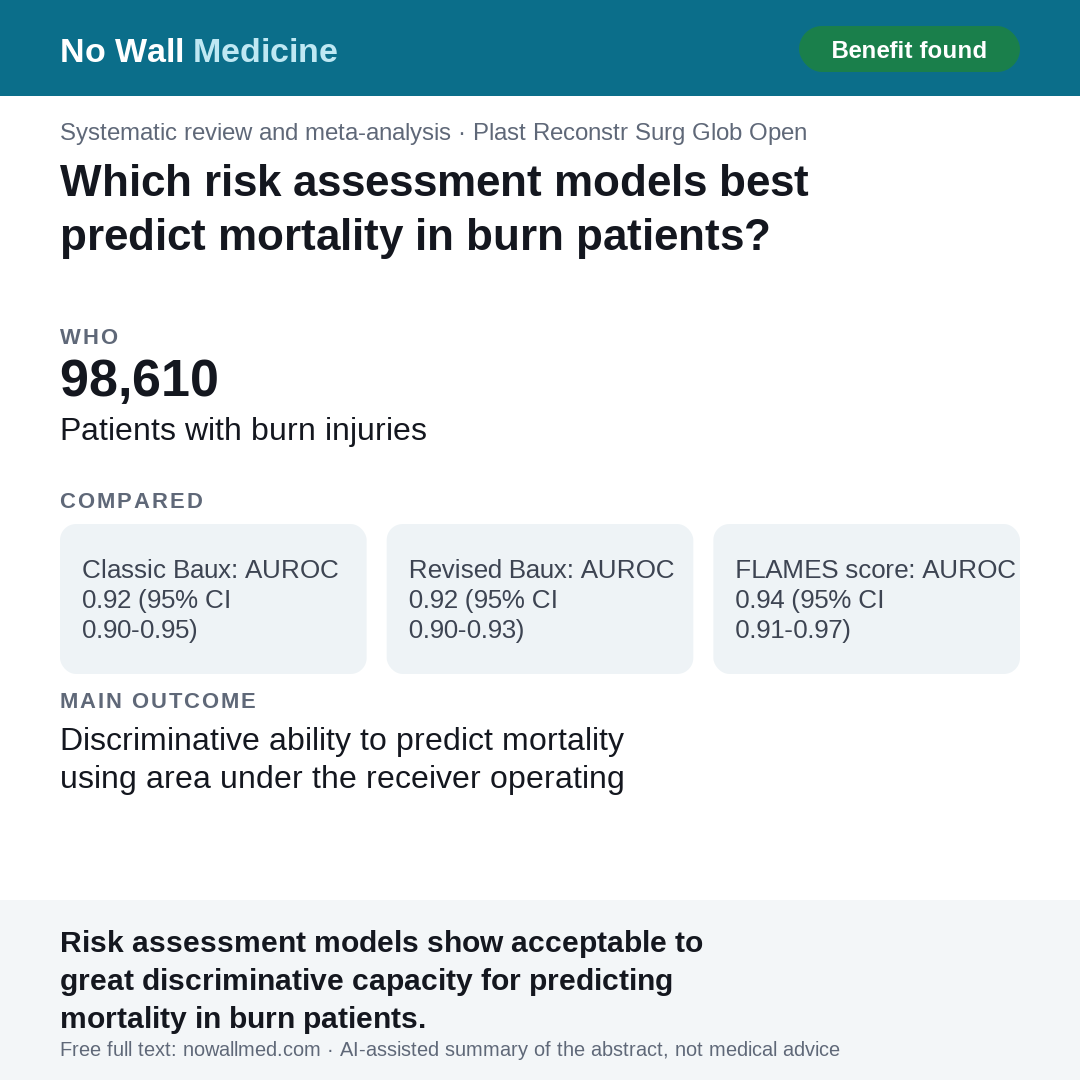
Which risk assessment models best predict mortality in burn patients?
Who
98,610
Patients with burn injuries
Compared
Classic Baux: AUROC 0.92 (95% CI 0.90-0.95)
Revised Baux: AUROC 0.92 (95% CI 0.90-0.93)
FLAMES score: AUROC 0.94 (95% CI 0.91-0.97)
Main outcome
Discriminative ability to predict mortality using area under the receiver operating characteristic curve
Bottom line: Risk assessment models show acceptable to great discriminative capacity for predicting mortality in burn patients.
Plast Reconstr Surg Glob Open · 2022-12-16Download image
Clinical question: Which risk assessment models best predict mortality in burn patients?
Abstract
Unlabelled
The predictive capability of various risk assessment models (RAMs) in evaluating the risk of mortality in burn patients is not well established. It is also unclear which RAM provides the highest discriminative ability and presents the highest clinical utility. We pooled all available studies to establish this validity and compare the predictive capability of the various RAMs. Methods
We reviewed PubMed, MEDLINE, and Embase from their inception up until December 2021 for studies evaluating risk of mortality in burn patients as stratified by RAMs. Data were pooled using random-effect models and presented as area under the receiver operating characteristic (AUROC) curve. Results
Thirty-four studies, comprising of a total of 98,610 patients, were included in our analysis. Most studies were found to have a low risk of bias and a good measure of applicability. Nine RAMs were evaluated. We discovered that the classic Baux; the revised Baux; and the Fatality by Longevity, APACHE II score, Measured Extent of burn, and Sex (FLAMES) scores presented with the highest discriminative power with there being no significant difference between the results presented by them [AUROCs (95% CI), 0.92 (0.90-0.95), 0.92 (0.90-0.93), 0.94 (0.91-0.97), respectively, with P < 0.00001 for all]. Conclusions
Many RAMs exist with no consensus on the optimal model to utilize and assess risk of mortality for burn patients. This study is the first systematic review and meta-analysis to compare the current RAMs' discriminative ability to predict mortality in patients with burn injuries. This meta-analysis demonstrated that RAMs designed for assessing mortality in individuals with burns have acceptable to great discriminative capacity, with the classic Baux, revised Baux, and FLAMES demonstrating superior discriminative performance in predicting death. FLAMES exhibited the highest discriminative ability among the RAMs studied.
Cite this article
Mrad MA, Al Qurashi AA, Shah Mardan QNM, Al Jabr FA, Almenhali AA, Bamakhrama B. Risk Models to Predict Mortality in Burn Patients: A Systematic Review and Meta-analysis. Plast Reconstr Surg Glob Open. 2022. doi:10.1097/GOX.0000000000004694
Spotted a mistake? Suggest a correction
Top studies every Monday
The week’s key trials and guidelines in your specialties, plus any topics you follow. By email, free.
Get the weekly digest