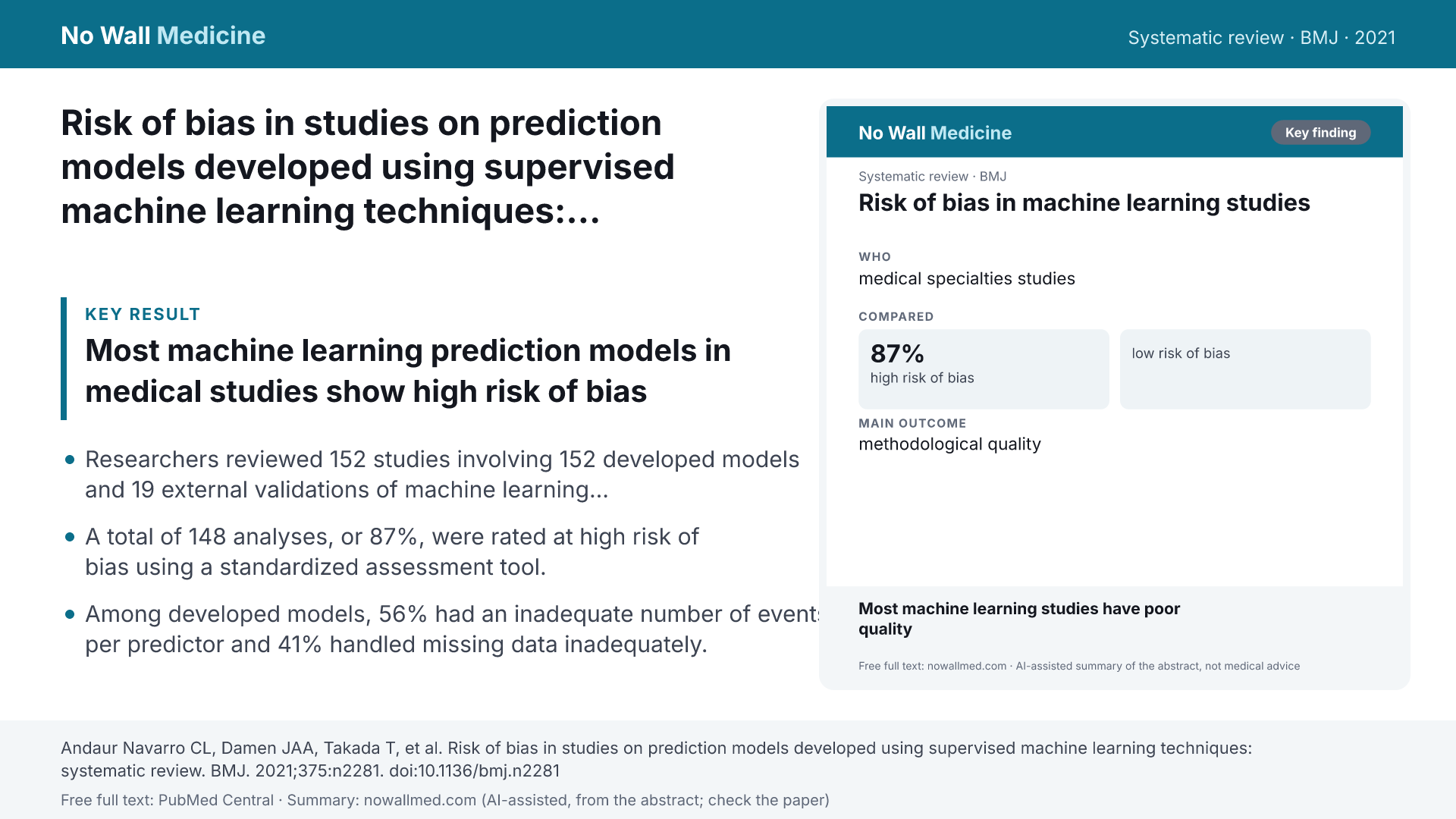
Most machine learning prediction models in medical studies show high risk of bias
Risk of bias in studies on prediction models developed using supervised machine learning techniques: systematic review
Systematic reviewKey finding
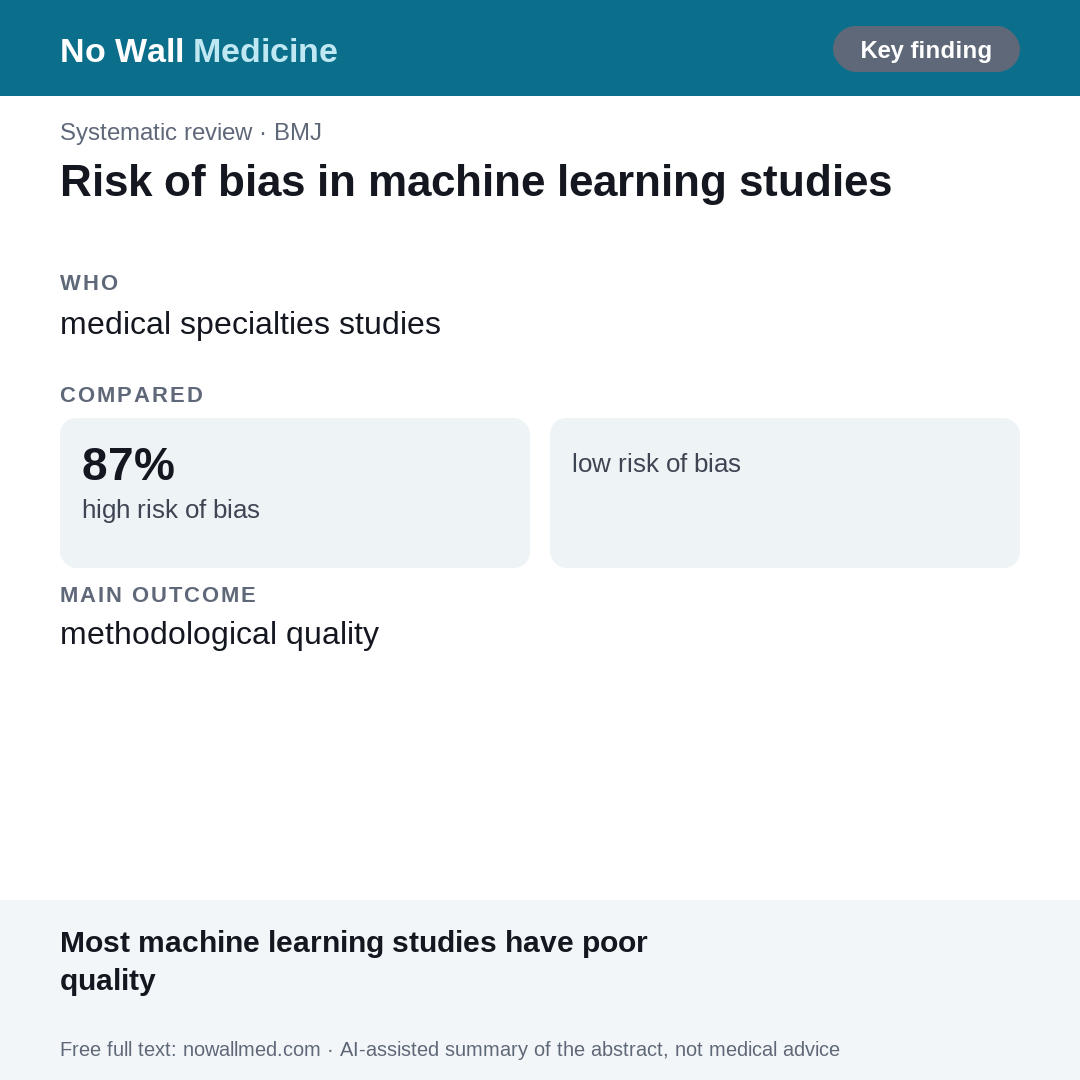
Risk of bias in machine learning studies
Who
medical specialties studies
Compared
87%high risk of bias (148/171)
low risk of bias
Main outcome
methodological quality
Bottom line: Most machine learning studies have poor quality
Limitation: small study size, poor handling of missing data
BMJ · 2021-10-20Download image
Key points
- Researchers reviewed 152 studies involving 152 developed models and 19 external validations of machine learning prediction models.
- A total of 148 analyses, or 87%, were rated at high risk of bias using a standardized assessment tool.
- Among developed models, 56% had an inadequate number of events per predictor and 41% handled missing data inadequately.
Headline and key points written with AI from the paper’s abstract, with every number checked against it. Read the paper before relying on them.
Was this summary helpful?
Abstract
Objective
To assess the methodological quality of studies on prediction models developed using machine learning techniques across all medical specialties. Design
Systematic review. Data sources
PubMed from 1 January 2018 to 31 December 2019. Eligibility criteria
Articles reporting on the development, with or without external validation, of a multivariable prediction model (diagnostic or prognostic) developed using supervised machine learning for individualised predictions. No restrictions applied for study design, data source, or predicted patient related health outcomes. Review methods
Methodological quality of the studies was determined and risk of bias evaluated using the prediction risk of bias assessment tool (PROBAST). This tool contains 21 signalling questions tailored to identify potential biases in four domains. Risk of bias was measured for each domain (participants, predictors, outcome, and analysis) and each study (overall). Results
152 studies were included: 58 (38%) included a diagnostic prediction model and 94 (62%) a prognostic prediction model. PROBAST was applied to 152 developed models and 19 external validations. Of these 171 analyses, 148 (87%, 95% confidence interval 81% to 91%) were rated at high risk of bias. The analysis domain was most frequently rated at high risk of bias. Of the 152 models, 85 (56%, 48% to 64%) were developed with an inadequate number of events per candidate predictor, 62 handled missing data inadequately (41%, 33% to 49%), and 59 assessed overfitting improperly (39%, 31% to 47%). Most models used appropriate data sources to develop (73%, 66% to 79%) and externally validate the machine learning based prediction models (74%, 51% to 88%). Information about blinding of outcome and blinding of predictors was, however, absent in 60 (40%, 32% to 47%) and 79 (52%, 44% to 60%) of the developed models, respectively. Conclusion
Most studies on machine learning based prediction models show poor methodological quality and are at high risk of bias. Factors contributing to risk of bias include small study size, poor handling of missing data, and failure to deal with overfitting. Efforts to improve the design, conduct, reporting, and validation of such studies are necessary to boost the application of machine learning based prediction models in clinical practice. Systematic review registration
PROSPERO CRD42019161764.
Abstract reproduced under the article’s CC BY licence.
Subject terms
Headline, design, result, key points, caveat and citation as plain text.
Cite this article
Andaur Navarro CL, Damen JAA, Takada T, et al. Risk of bias in studies on prediction models developed using supervised machine learning techniques: systematic review. BMJ. 2021. doi:10.1136/bmj.n2281
Spotted a mistake? Suggest a correction