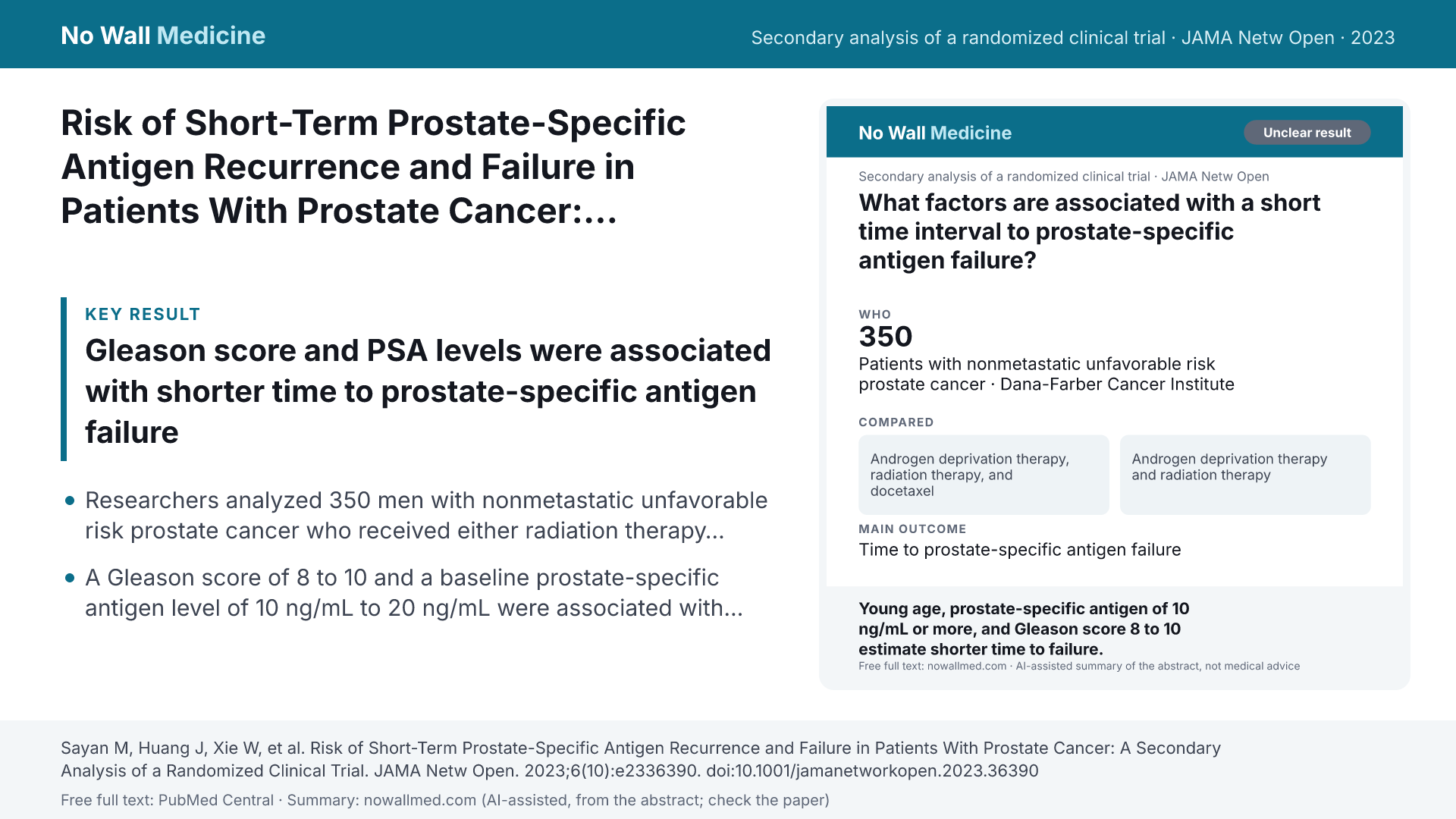
Risk of Short-Term Prostate-Specific Antigen Recurrence and Failure in Patients With Prostate Cancer: A Secondary Analysis of a Randomized Clinical Trial
Key result: Gleason score and PSA levels were associated with shorter time to prostate-specific antigen failure
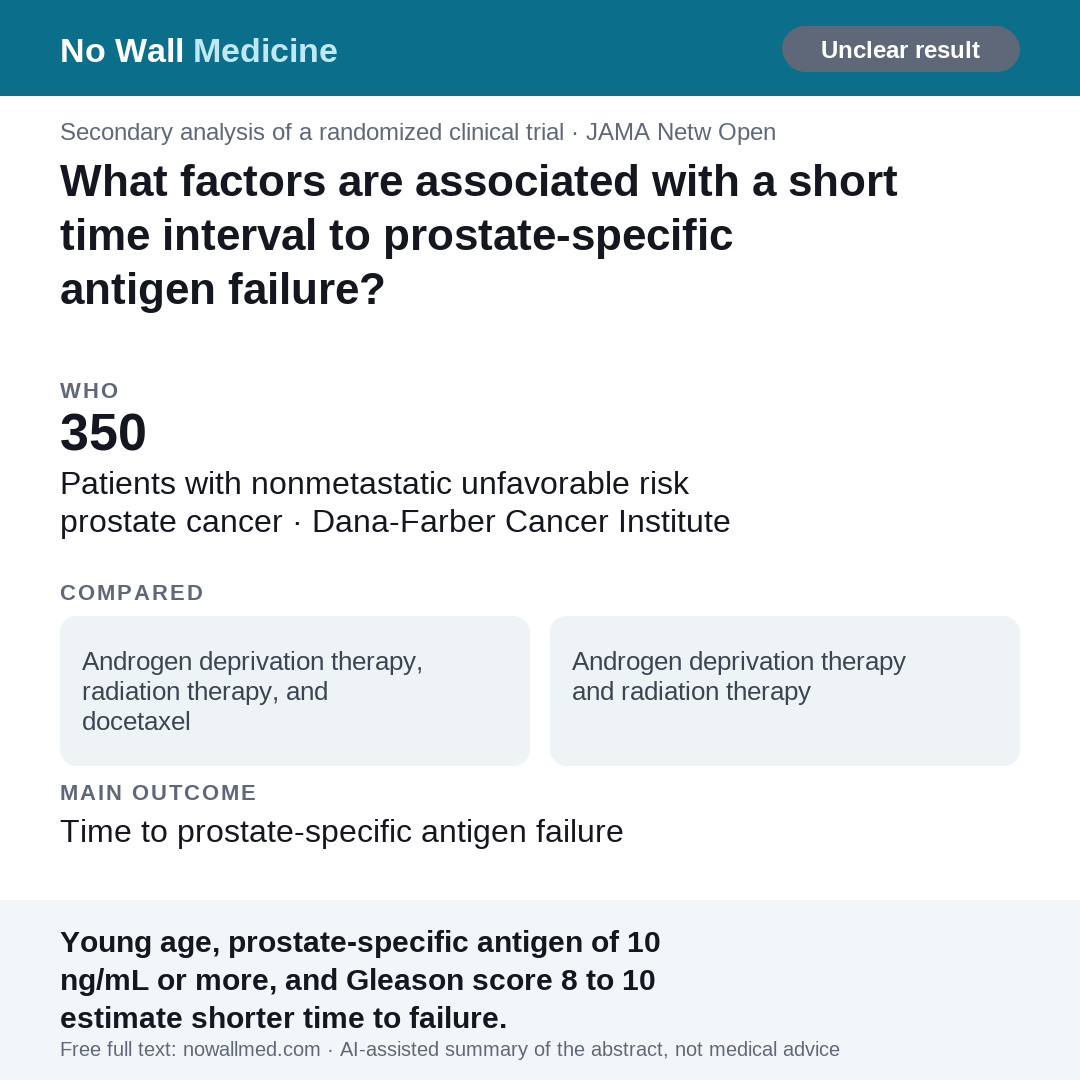
Secondary analysis of a randomized clinical trialUnclear result
What factors are associated with a short time interval to prostate-specific antigen failure?
Who
350
Patients with nonmetastatic unfavorable risk prostate cancer · Dana-Farber Cancer Institute
Compared
Androgen deprivation therapy, radiation therapy, and docetaxel
Androgen deprivation therapy and radiation therapy
Main outcome
Time to prostate-specific antigen failure
Bottom line: Young age, prostate-specific antigen of 10 ng/mL or more, and Gleason score 8 to 10 estimate shorter time to failure.
JAMA Netw Open · 2023-10-02Download image
Key points
- Researchers analyzed 350 men with nonmetastatic unfavorable risk prostate cancer who received either radiation therapy plus docetaxel with hormone therapy or radiation therapy with hormone therapy alone.
- A Gleason score of 8 to 10 and a baseline prostate-specific antigen level of 10 ng/mL to 20 ng/mL were associated with a shorter time to failure.
- The high-risk category combining these factors was associated with a shorter time to failure with a subdistribution hazard ratio of 2.69.
Discussion prompts
- Would these patients look like yours? Who was left out?
- Is the main outcome one that matters to patients?
- Is the difference large enough to change what you do?
Cite: Sayan M, Huang J, Xie W, et al. Risk of Short-Term Prostate-Specific Antigen Recurrence and Failure in Patients With Prostate Cancer: A Secondary Analysis of a Randomized Clinical Trial. JAMA Netw Open. 2023. doi:10.1001/jamanetworkopen.2023.36390
Free full text: PubMed Central · Summary and visual abstract: nowallmed.com/a/risk-of-short-term-prostate-specific-antigen-recurrence-and-failure-1mfiqtu/ (AI-assisted from the abstract; check the paper before relying on it).