Risk Prediction Models for Cardiotoxicity of Chemotherapy Among Patients With Breast Cancer: A Systematic Review
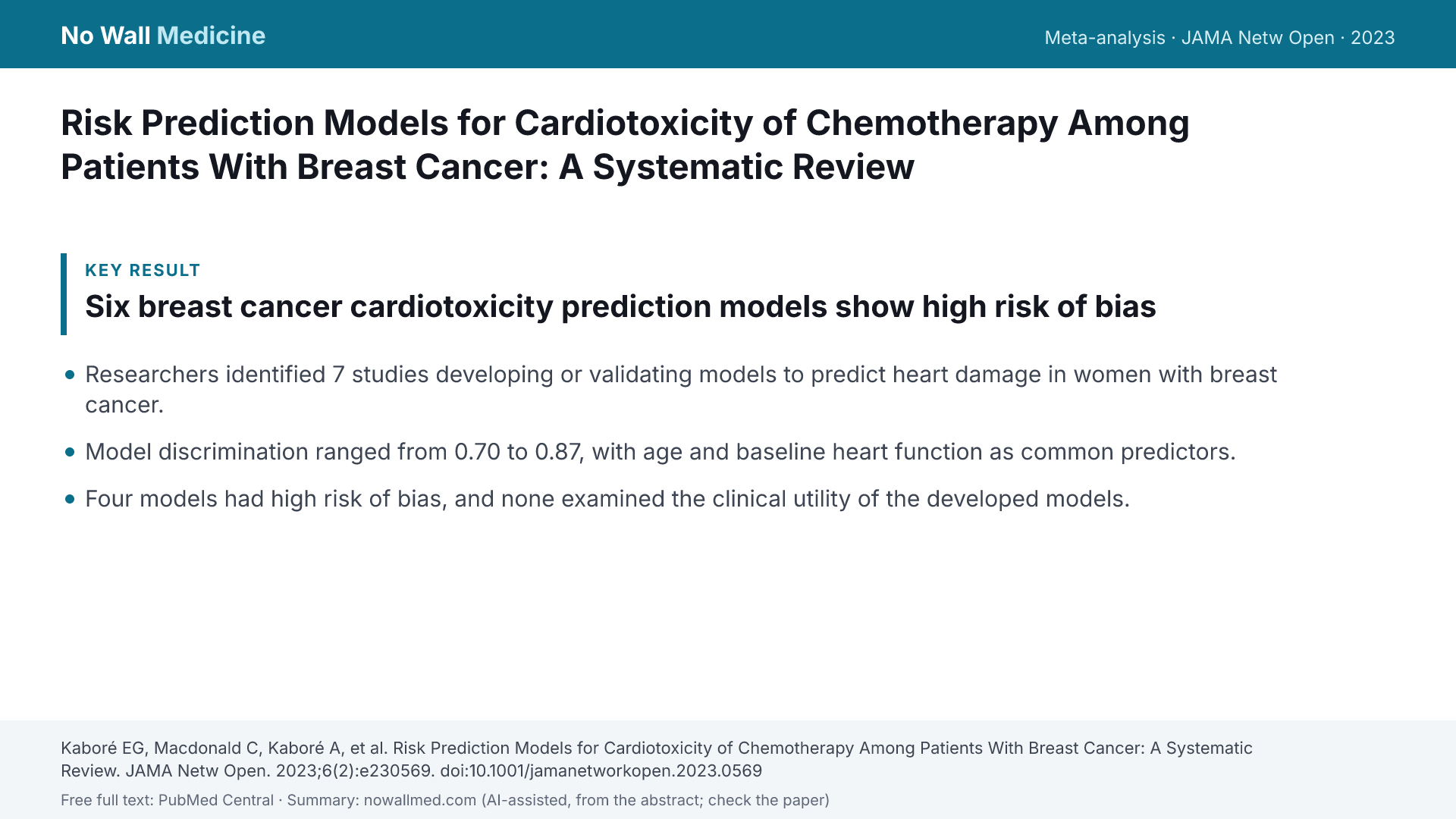
Key result: Six breast cancer cardiotoxicity prediction models show high risk of bias
Key points
- Researchers identified 7 studies developing or validating models to predict heart damage in women with breast cancer.
- Model discrimination ranged from 0.70 to 0.87, with age and baseline heart function as common predictors.
- Four models had high risk of bias, and none examined the clinical utility of the developed models.
Why it matters: Identifying which breast cancer patients will develop heart damage from treatment remains challenging for clinicians.
Limitation the authors note: Most of the included studies were assessed as being at high overall risk of bias.
Discussion prompts
- Would these patients look like yours? Who was left out?
- Is the main outcome one that matters to patients?
- Is the difference large enough to change what you do?
Cite: Kaboré EG, Macdonald C, Kaboré A, et al. Risk Prediction Models for Cardiotoxicity of Chemotherapy Among Patients With Breast Cancer: A Systematic Review. JAMA Netw Open. 2023;6(2):e230569. doi:10.1001/jamanetworkopen.2023.0569
Free full text: PubMed Central · Summary and visual abstract: nowallmed.com/a/risk-prediction-models-for-cardiotoxicity-of-chemotherapy-among-omagjp/ (AI-assisted from the abstract; check the paper before relying on it).