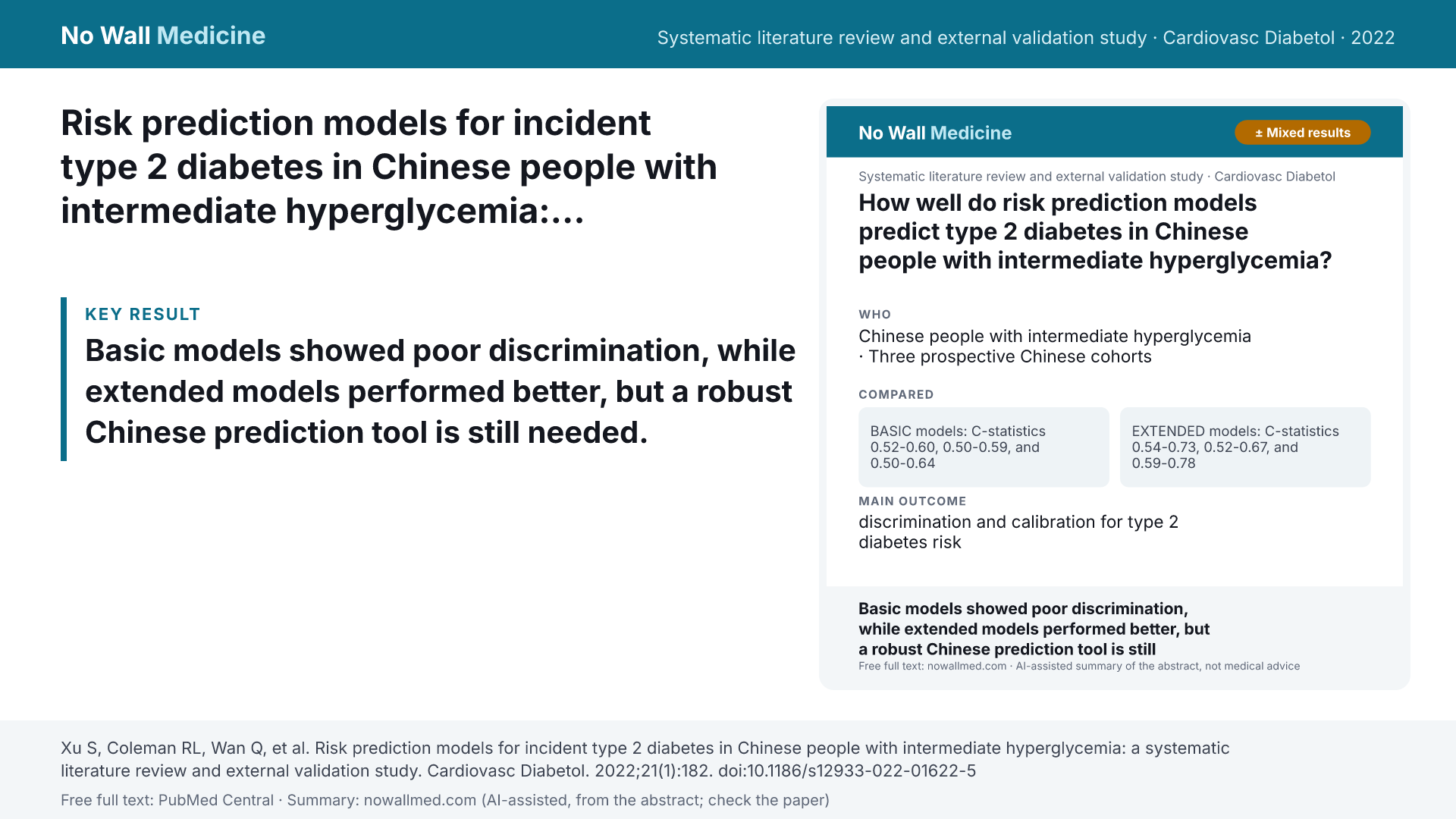
Risk prediction models for incident type 2 diabetes in Chinese people with intermediate hyperglycemia: a systematic literature review and external validation study
Systematic literature review and external validation studyMixed results
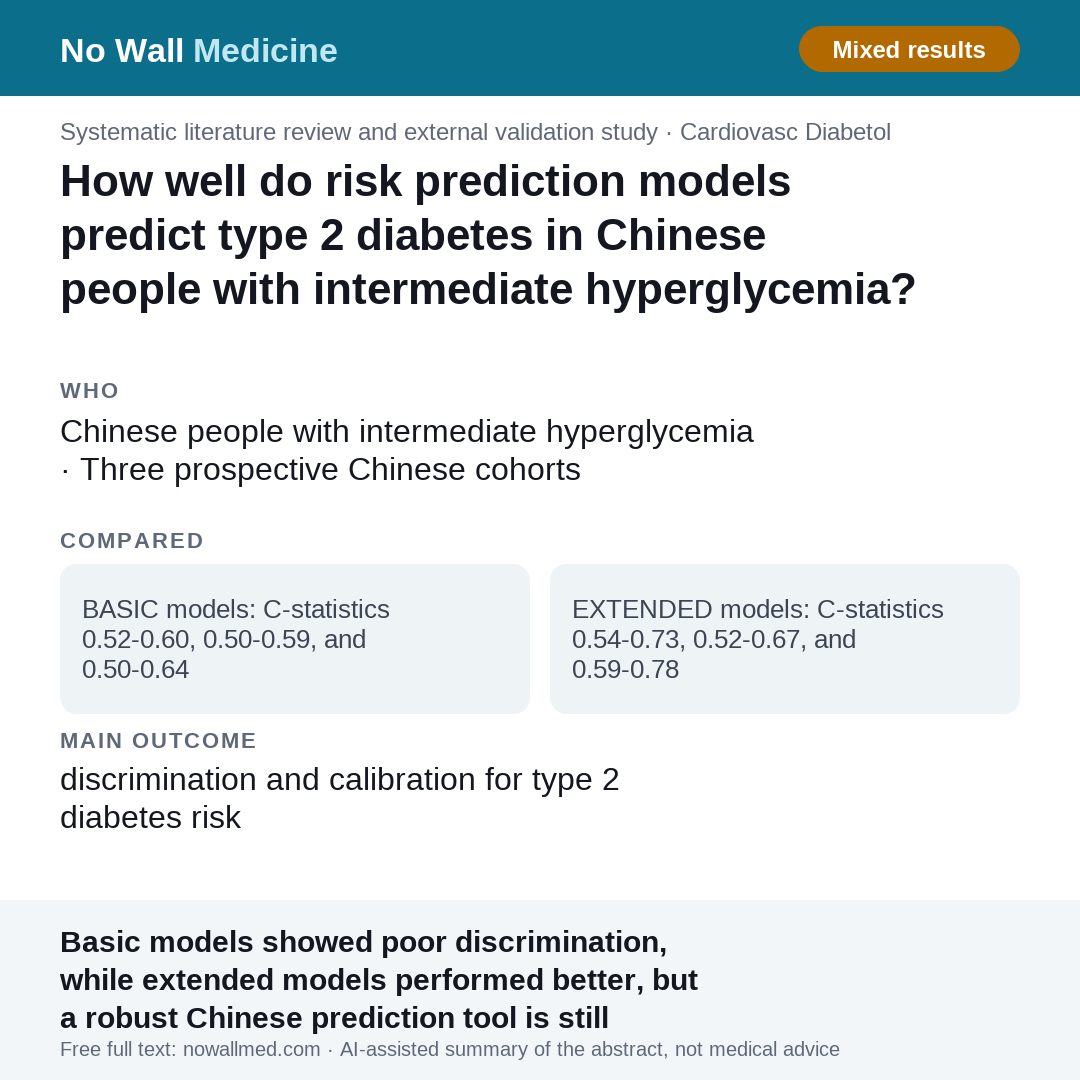
How well do risk prediction models predict type 2 diabetes in Chinese people with intermediate hyperglycemia?
Who
Chinese people with intermediate hyperglycemia · Three prospective Chinese cohorts
Compared
BASIC models: C-statistics 0.52-0.60, 0.50-0.59, and 0.50-0.64
EXTENDED models: C-statistics 0.54-0.73, 0.52-0.67, and 0.59-0.78
Main outcome
discrimination and calibration for type 2 diabetes risk
Bottom line: Basic models showed poor discrimination, while extended models performed better, but a robust Chinese prediction tool is still needed.
Limitation: The majority of identified studies were at high or unclear risk of bias.
Cardiovasc Diabetol · 2022-09-13Download image
Clinical question: How well do risk prediction models predict type 2 diabetes in Chinese people with intermediate hyperglycemia?
Abstract
Background
People with intermediate hyperglycemia (IH), including impaired fasting glucose and/or impaired glucose tolerance, are at higher risk of developing type 2 diabetes (T2D) than those with normoglycemia. We aimed to evaluate the performance of published T2D risk prediction models in Chinese people with IH to inform them about the choice of primary diabetes prevention measures. Methods
A systematic literature search was conducted to identify Asian-derived T2D risk prediction models, which were eligible if they were built on a prospective cohort of Asian adults without diabetes at baseline and utilized routinely-available variables to predict future risk of T2D. These Asian-derived and five prespecified non-Asian derived T2D risk prediction models were divided into BASIC (clinical variables only) and EXTENDED (plus laboratory variables) versions, with validation performed on them in three prospective Chinese IH cohorts: ACE (n = 3241), Luzhou (n = 1333), and TCLSIH (n = 1702). Model performance was assessed in terms of discrimination (C-statistic) and calibration (Hosmer-Lemeshow test). Results
Forty-four Asian and five non-Asian studies comprising 21 BASIC and 46 EXTENDED T2D risk prediction models for validation were identified. The majority were at high (n = 43, 87.8%) or unclear (n = 3, 6.1%) risk of bias, while only three studies (6.1%) were scored at low risk of bias. BASIC models showed poor-to-moderate discrimination with C-statistics 0.52-0.60, 0.50-0.59, and 0.50-0.64 in the ACE, Luzhou, and TCLSIH cohorts respectively. EXTENDED models showed poor-to-acceptable discrimination with C-statistics 0.54-0.73, 0.52-0.67, and 0.59-0.78 respectively. Fifteen BASIC and 40 EXTENDED models showed poor calibration (P < 0.05), overpredicting or underestimating the observed diabetes risk. Most recalibrated models showed improved calibration but modestly-to-severely overestimated diabetes risk in the three cohorts. The NAVIGATOR model showed the best discrimination in the three cohorts but had poor calibration (P < 0.05). Conclusions
In Chinese people with IH, previously published BASIC models to predict T2D did not exhibit good discrimination or calibration. Several EXTENDED models performed better, but a robust Chinese T2D risk prediction tool in people with IH remains a major unmet need.
Subject terms
Cite this article
Xu S, Coleman RL, Wan Q, et al. Risk prediction models for incident type 2 diabetes in Chinese people with intermediate hyperglycemia: a systematic literature review and external validation study. Cardiovasc Diabetol. 2022. doi:10.1186/s12933-022-01622-5
Spotted a mistake? Suggest a correction