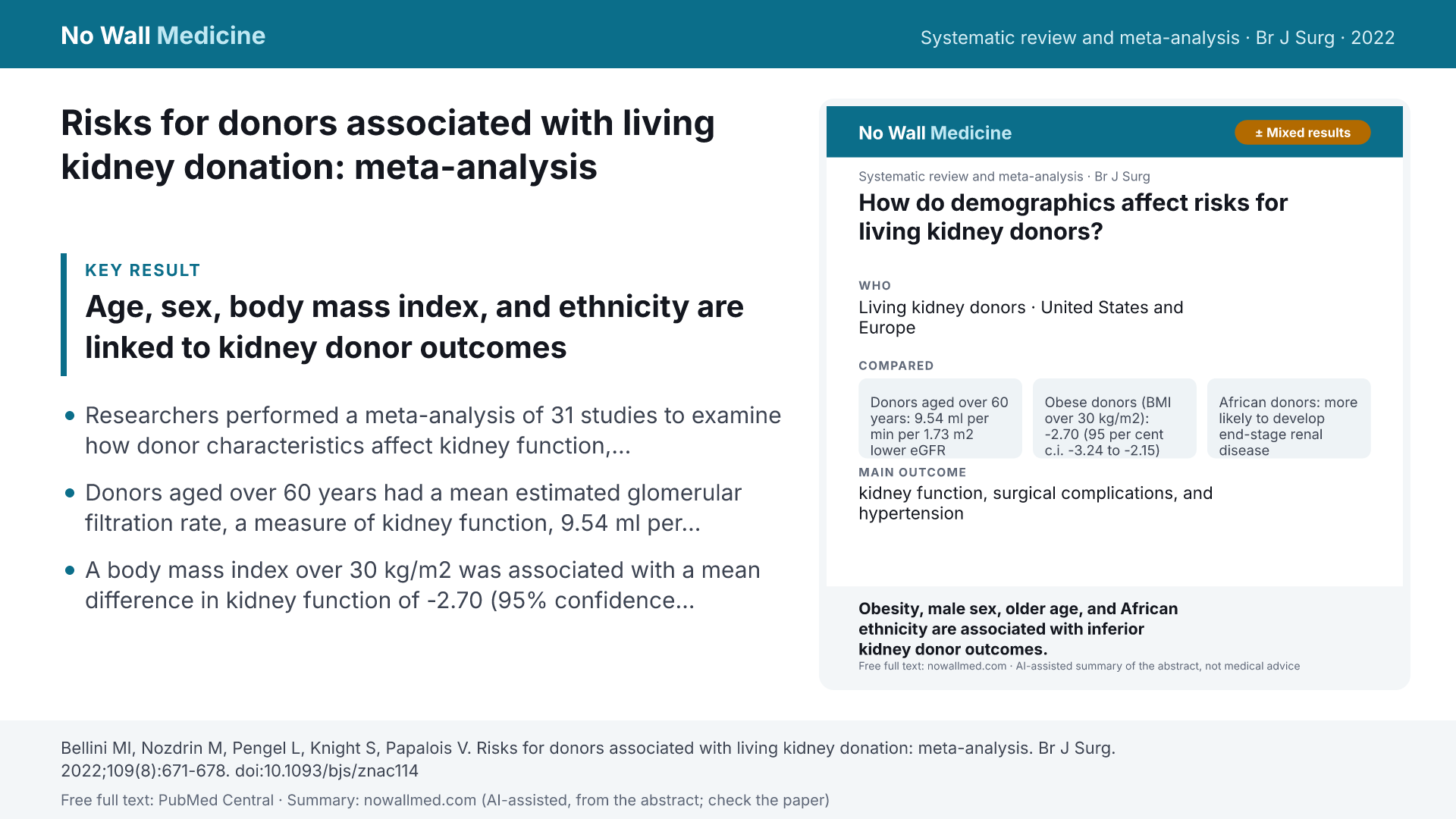
Age, sex, body mass index, and ethnicity are linked to kidney donor outcomes
Risks for donors associated with living kidney donation: meta-analysis
Systematic review and meta-analysisMixed results
How do demographics affect risks for living kidney donors?
Who
Living kidney donors · United States and Europe
Compared
Donors aged over 60 years: 9.54 ml per min per 1.73 m2 lower eGFR
Obese donors (BMI over 30 kg/m2): -2.70 (95 per cent c.i. -3.24 to -2.15) ml per min per 1.73 m2 lower eGFR
African donors: more likely to develop end-stage renal disease
Main outcome
kidney function, surgical complications, and hypertension
Bottom line: Obesity, male sex, older age, and African ethnicity are associated with inferior kidney donor outcomes.
Br J Surg · 2022-05-26 · Save PNG
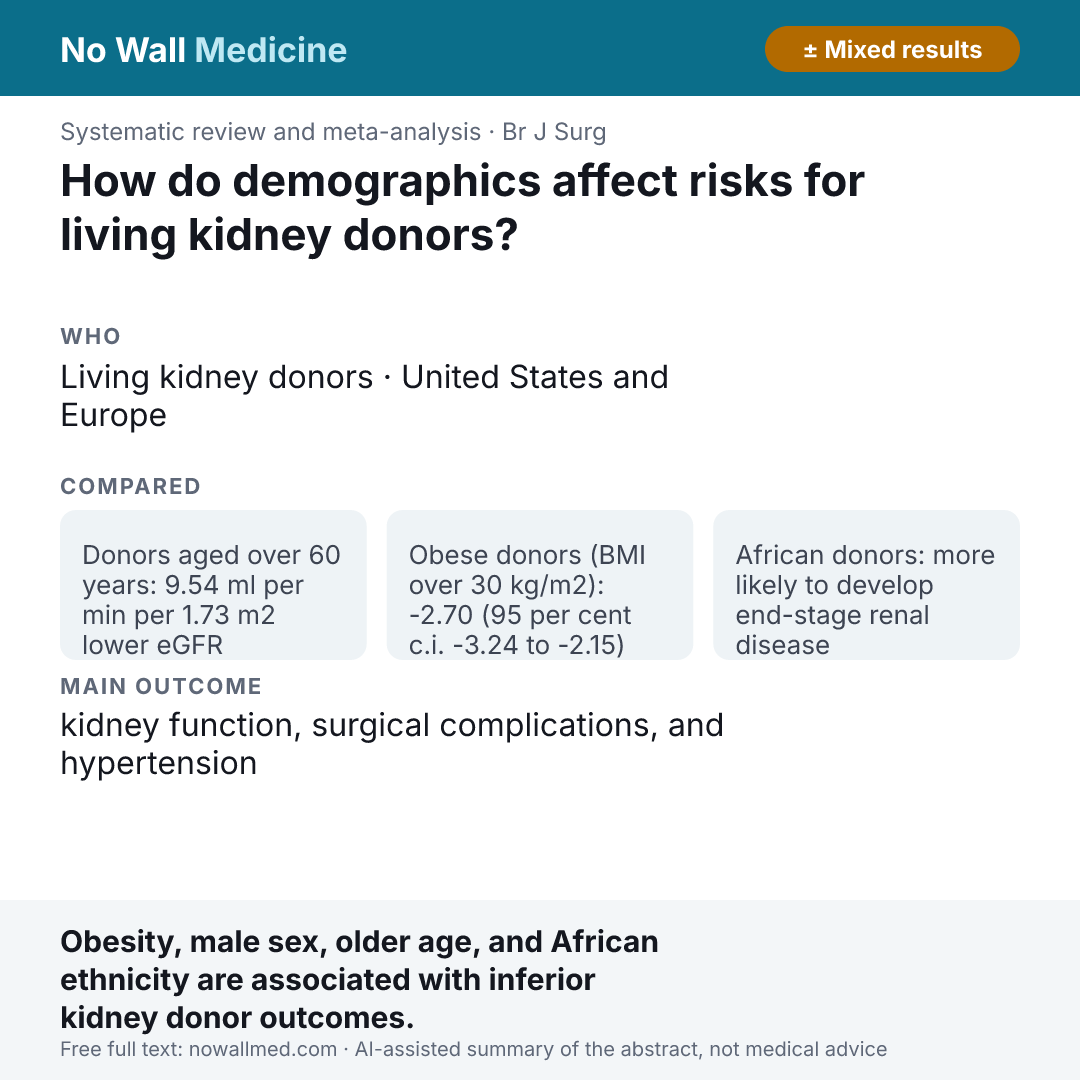
Clinical question: How do demographics affect risks for living kidney donors?
Key points
- Researchers performed a meta-analysis of 31 studies to examine how donor characteristics affect kidney function, surgical complications, and hypertension.
- Donors aged over 60 years had a mean estimated glomerular filtration rate, a measure of kidney function, 9.54 ml per min per 1.73 m2 lower than younger donors.
- A body mass index over 30 kg/m2 was associated with a mean difference in kidney function of -2.70 (95% confidence interval -3.24 to -2.15) ml per min per 1.73 m2 after 1 year.
Headline and key points written with AI from the paper’s abstract, with every number checked against it. Read the paper before relying on them.
Was this summary helpful?
Subject terms
Headline, design, result, key points, caveat and citation as plain text.
Cite this article
Bellini MI, Nozdrin M, Pengel L, Knight S, Papalois V. Risks for donors associated with living kidney donation: meta-analysis. Br J Surg. 2022;109(8):671-678. doi:10.1093/bjs/znac114
Spotted a mistake? Suggest a correction