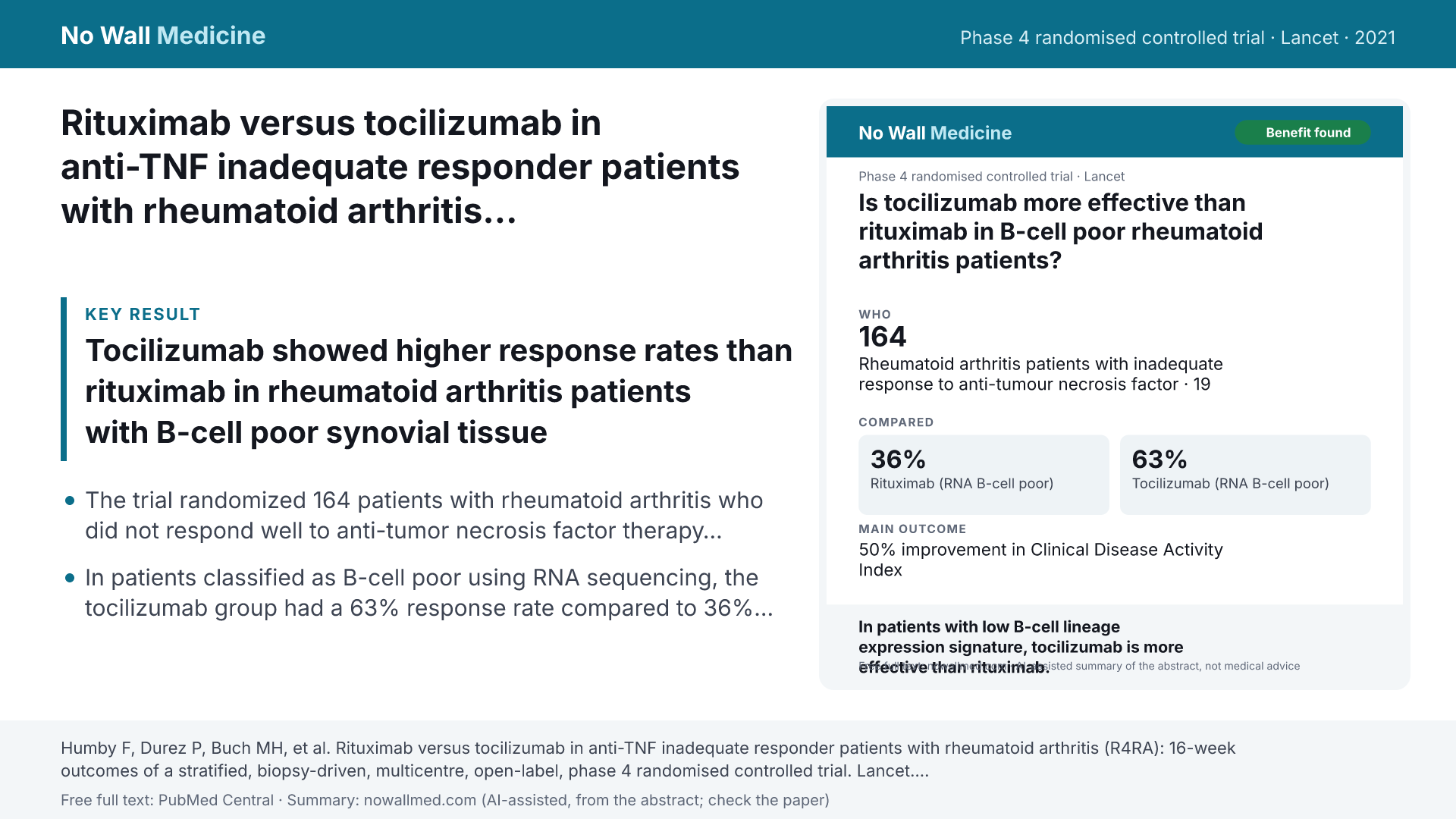
Tocilizumab showed higher response rates than rituximab in rheumatoid arthritis patients with B-cell poor synovial tissue
Rituximab versus tocilizumab in anti-TNF inadequate responder patients with rheumatoid arthritis (R4RA): 16-week outcomes of a stratified, biopsy-driven, multicentre, open-label, phase 4 randomised controlled trial
Phase 4 randomised controlled trialBenefit found
Is tocilizumab more effective than rituximab in B-cell poor rheumatoid arthritis patients?
Who
164
Rheumatoid arthritis patients with inadequate response to anti-tumour necrosis factor · 19 centres across five European countries
Compared
36%Rituximab (RNA B-cell poor) (12/33)
63%Tocilizumab (RNA B-cell poor) (20/32)
Main outcome
50% improvement in Clinical Disease Activity Index
Result: difference 26% [2 to 50], p=0·035
Bottom line: In patients with low B-cell lineage expression signature, tocilizumab is more effective than rituximab.
Limitation: Replication and validation in independent cohorts is required before making clinical recommendations.
Funded by: Efficacy and Mechanism Evaluation programme from the UK National Institute
Lancet · 2021-01-24 · Save PNG
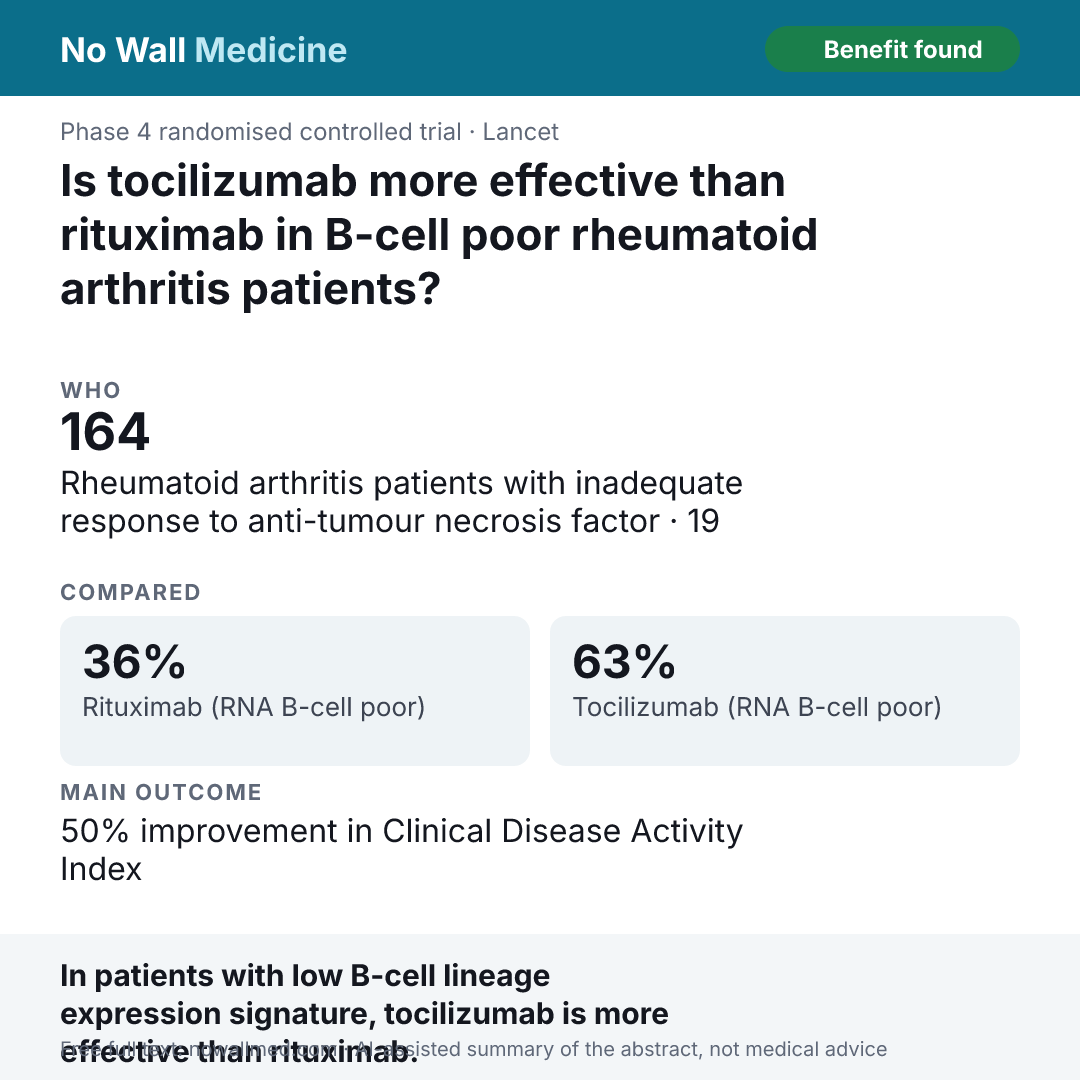
Clinical question: Is tocilizumab more effective than rituximab in B-cell poor rheumatoid arthritis patients?
Key points
- The trial randomized 164 patients with rheumatoid arthritis who did not respond well to anti-tumor necrosis factor therapy to receive either rituximab or tocilizumab.
- In patients classified as B-cell poor using RNA sequencing, the tocilizumab group had a 63% response rate compared to 36% in the rituximab group.
- When using standard histological classification for B-cell poor patients, there was no statistically significant difference in response rates between the rituximab group (45%) and the tocilizumab group (56%).
Headline and key points written with AI from the paper’s abstract, with every number checked against it. Read the paper before relying on them.
Was this summary helpful?
Abstract
Background
Although targeted biological treatments have transformed the outlook for patients with rheumatoid arthritis, 40% of patients show poor clinical response, which is mechanistically still unexplained. Because more than 50% of patients with rheumatoid arthritis have low or absent CD20 B cells-the target for rituximab-in the main disease tissue (joint synovium), we hypothesised that, in these patients, the IL-6 receptor inhibitor tocilizumab would be more effective. The aim of this trial was to compare the effect of tocilizumab with rituximab in patients with rheumatoid arthritis who had an inadequate response to anti-tumour necrosis factor (TNF) stratified for synovial B-cell status. Methods
This study was a 48-week, biopsy-driven, multicentre, open-label, phase 4 randomised controlled trial (rituximab vs tocilizumab in anti-TNF inadequate responder patients with rheumatoid arthritis; R4RA) done in 19 centres across five European countries (the UK, Belgium, Italy, Portugal, and Spain). Patients aged 18 years or older who fulfilled the 2010 American College of Rheumatology and European League Against Rheumatism classification criteria for rheumatoid arthritis and were eligible for treatment with rituximab therapy according to UK National Institute for Health and Care Excellence guidelines were eligible for inclusion in the trial. To inform balanced stratification, following a baseline synovial biopsy, patients were classified histologically as B-cell poor or rich. Patients were then randomly assigned (1:1) centrally in block sizes of six and four to receive two 1000 mg rituximab infusions at an interval of 2 weeks (rituximab group) or 8 mg/kg tocilizumab infusions at 4-week intervals (tocilizumab group). To enhance the accuracy of the stratification of B-cell poor and B-cell rich patients, baseline synovial biopsies from all participants were subjected to RNA sequencing and reclassified by B-cell molecular signature. The study was powered to test the superiority of tocilizumab over rituximab in the B-cell poor population at 16 weeks. The primary endpoint was defined as a 50% improvement in Clinical Disease Activity Index (CDAI50%) from baseline. The trial is registered on the ISRCTN database, ISRCTN97443826, and EudraCT, 2012-002535-28. Findings
Between Feb 28, 2013, and Jan 17, 2019, 164 patients were classified histologically and were randomly assigned to the rituximab group (83 [51%]) or the tocilizumab group (81 [49%]). In patients histologically classified as B-cell poor, there was no statistically significant difference in CDAI50% between the rituximab group (17 [45%] of 38 patients) and the tocilizumab group (23 [56%] of 41 patients; difference 11% [95% CI -11 to 33], p=0·31). However, in the synovial biopsies classified as B-cell poor with RNA sequencing the tocilizumab group had a significantly higher response rate compared with the rituximab group for CDAI50% (rituximab group 12 [36%] of 33 patients vs tocilizumab group 20 [63%] of 32 patients; difference 26% [2 to 50], p=0·035). Occurrence of adverse events (rituximab group 76 [70%] of 108 patients vs tocilizumab group 94 [80%] of 117 patients; difference 10% [-1 to 21) and serious adverse events (rituximab group 8 [7%] of 108 vs tocilizumab group 12 [10%] of 117; difference 3% [-5 to 10]) were not significantly different between treatment groups. Interpretation
The results suggest that RNA sequencing-based stratification of rheumatoid arthritis synovial tissue showed stronger associations with clinical responses compared with histopathological classification. Additionally, for patients with low or absent B-cell lineage expression signature in synovial tissue tocilizumab is more effective than rituximab. Replication of the results and validation of the RNA sequencing-based classification in independent cohorts is required before making treatment recommendations for clinical practice. Funding
Efficacy and Mechanism Evaluation programme from the UK National Institute for Health Research.
Abstract reproduced under the article’s CC BY licence.
Subject terms
Headline, design, result, key points, caveat and citation as plain text.
Cite this article
Humby F, Durez P, Buch MH, et al. Rituximab versus tocilizumab in anti-TNF inadequate responder patients with rheumatoid arthritis (R4RA): 16-week outcomes of a stratified, biopsy-driven, multicentre, open-label, phase 4 randomised controlled trial. Lancet. 2021;397(10271):305-317. doi:10.1016/S0140-6736(20)32341-2
Spotted a mistake? Suggest a correction