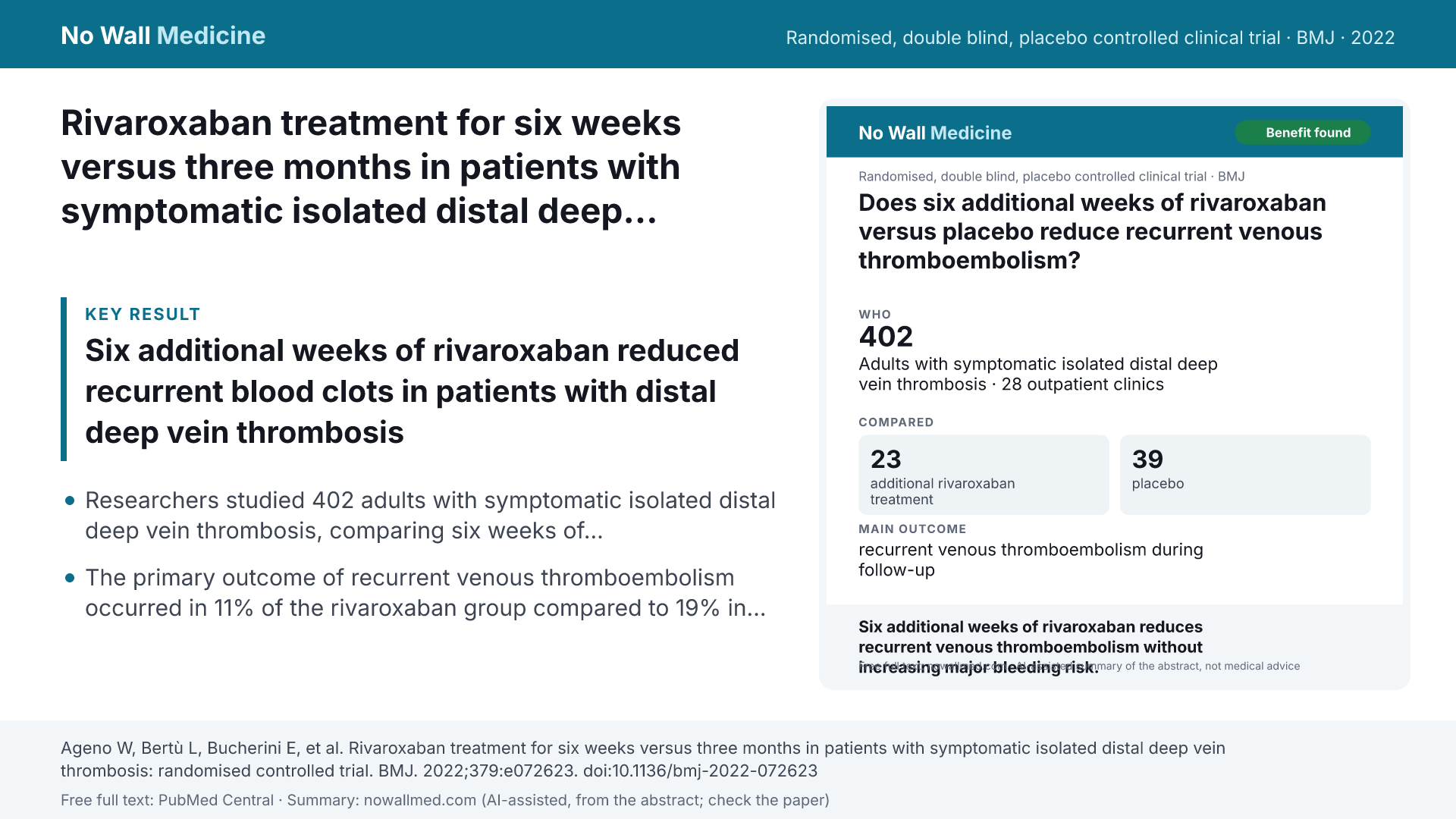
Six additional weeks of rivaroxaban reduced recurrent blood clots in patients with distal deep vein thrombosis
Rivaroxaban treatment for six weeks versus three months in patients with symptomatic isolated distal deep vein thrombosis: randomised controlled trial
Randomised, double blind, placebo controlled clinical trialBenefit found
Does six additional weeks of rivaroxaban versus placebo reduce recurrent venous thromboembolism?
Who
402
Adults with symptomatic isolated distal deep vein thrombosis · 28 outpatient clinics specialising in venous thromboembolism
Compared
23additional rivaroxaban treatment (11%)
39placebo (19%)
Main outcome
recurrent venous thromboembolism during follow-up
Result: relative risk 0.59 (95% confidence interval 0.36 to 0.95)
Bottom line: Six additional weeks of rivaroxaban reduces recurrent venous thromboembolism without increasing major bleeding risk.
BMJ · 2022-11-23 · Save PNG
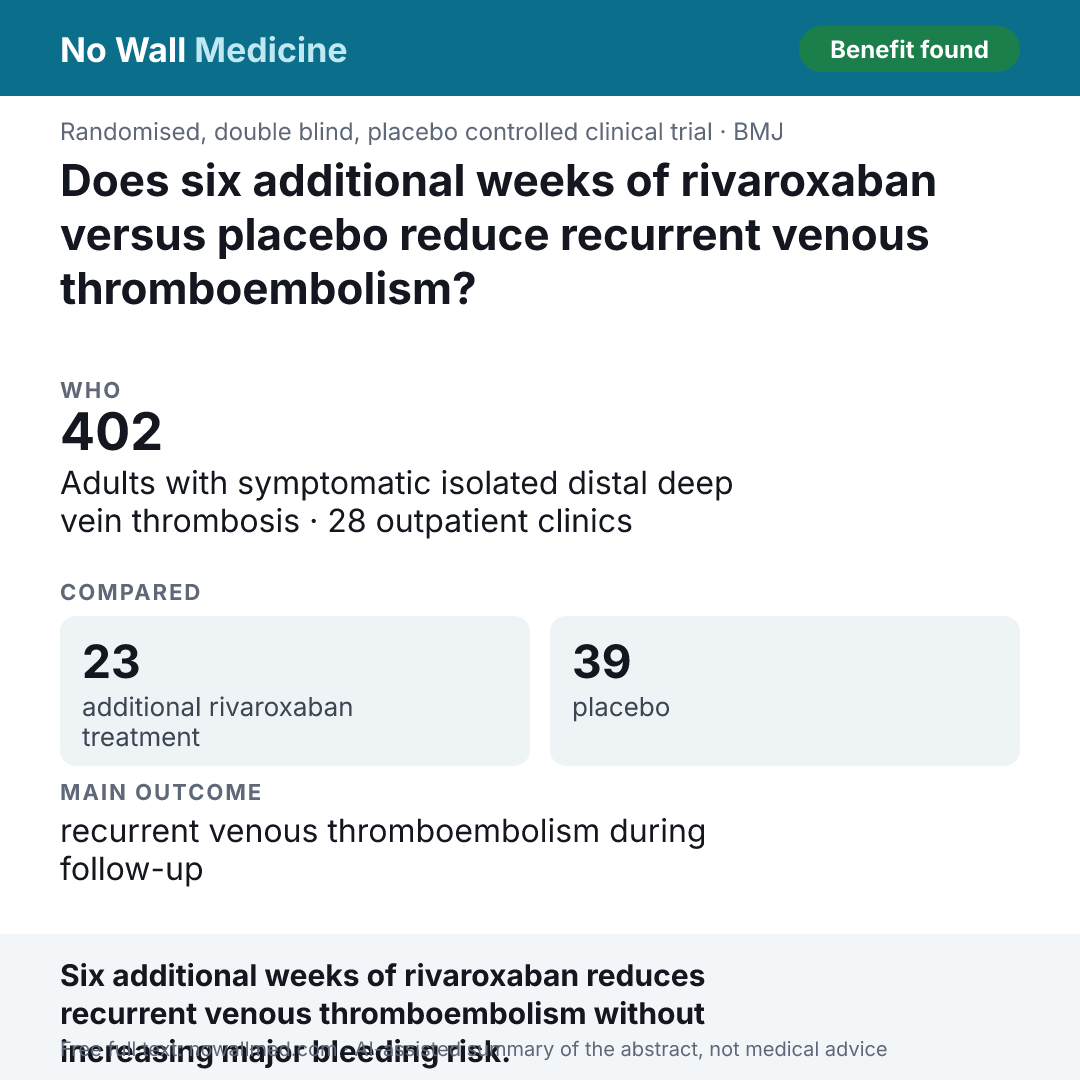
Clinical question: Does six additional weeks of rivaroxaban versus placebo reduce recurrent venous thromboembolism?
Key points
- Researchers studied 402 adults with symptomatic isolated distal deep vein thrombosis, comparing six weeks of additional rivaroxaban to a placebo after an initial six-week treatment course.
- The primary outcome of recurrent venous thromboembolism occurred in 11% of the rivaroxaban group compared to 19% in the placebo group.
- No major bleeding events occurred in either group during the follow-up period.
Headline and key points written with AI from the paper’s abstract, with every number checked against it. Read the paper before relying on them.
Was this summary helpful?
Abstract
Objective
To compare two different treatment durations of rivaroxaban in patients with symptomatic isolated distal deep vein thrombosis (DVT). Design
Randomised, double blind, placebo controlled clinical trial. Setting
28 outpatient clinics specialising in venous thromboembolism. Participants
402 adults (≥18 years) with symptomatic isolated distal DVT. Interventions
After receiving standard dose rivaroxaban for six weeks, participants were randomly assigned to receive rivaroxaban 20 mg or placebo once daily for an additional six weeks. Follow-up was for 24 months from study inclusion. Main outcomes measures
The primary efficacy outcome was recurrent venous thromboembolism during follow-up after randomisation, defined as the composite of progression of isolated distal DVT, recurrent isolated distal DVT, proximal DVT, symptomatic pulmonary embolism, or fatal pulmonary embolism. The primary safety outcome was major bleeding after randomisation until two days from the last dose of rivaroxaban or placebo. An independent committee adjudicated the outcomes. Results
200 adults were randomised to receive additional rivaroxaban treatment and 202 to receive placebo. Isolated distal DVT was unprovoked in 81 (40%) and 86 (43%) patients, respectively. The primary efficacy outcome occurred in 23 (11%) patients in the rivaroxaban arm and 39 (19%) in the placebo arm (relative risk 0.59, 95% confidence interval 0.36 to 0.95; P=0.03, number needed to treat 13, 95% confidence interval 7 to 126). Recurrent isolated distal DVT occurred in 16 (8%) patients in the rivaroxaban arm and 31 (15%) in the placebo arm (P=0.02). Proximal DVT or pulmonary embolism occurred in seven (3%) patients in the rivaroxaban arm and eight (4%) in the placebo arm (P=0.80). No major bleeding events occurred. Conclusions
Rivaroxaban administered for six additional weeks in patients with isolated distal DVT who had an uneventful six week treatment course reduces the risk of recurrent venous thromboembolism, mainly recurrent isolated distal DVT, over a two year follow-up without increasing the risk of haemorrhage. Trial registration
EudraCT 2016-000958-36; ClinicalTrials.gov NCT02722447.
Abstract reproduced under the article’s CC BY NC licence.
Subject terms
Headline, design, result, key points, caveat and citation as plain text.
Cite this article
Ageno W, Bertù L, Bucherini E, et al. Rivaroxaban treatment for six weeks versus three months in patients with symptomatic isolated distal deep vein thrombosis: randomised controlled trial. BMJ. 2022;379:e072623. doi:10.1136/bmj-2022-072623
Spotted a mistake? Suggest a correction