Rivaroxaban versus no anticoagulation for post-discharge thromboprophylaxis after hospitalisation for COVID-19 (MICHELLE): an open-label, multicentre, randomised, controlled trial
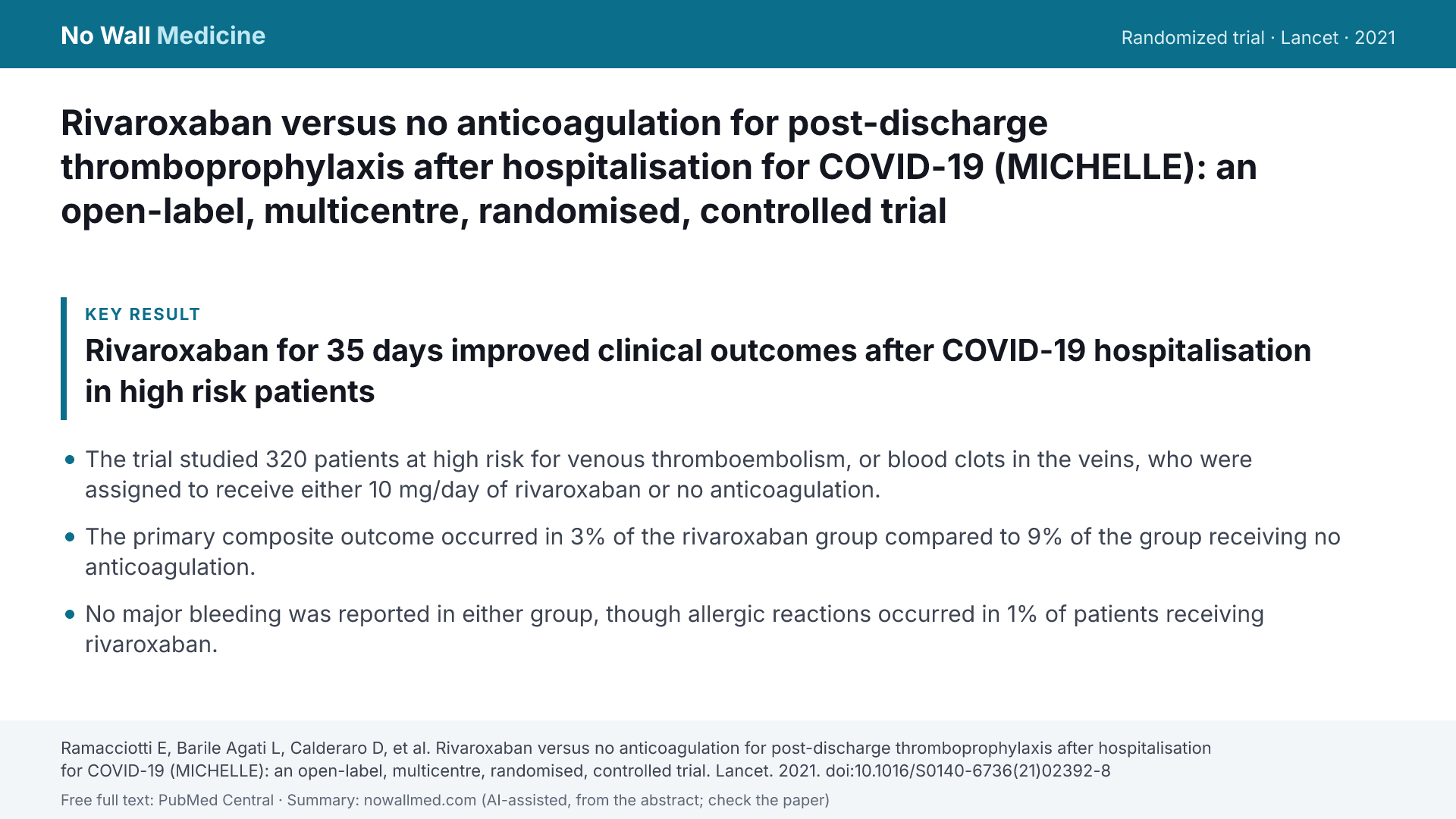
Key result: Rivaroxaban for 35 days improved clinical outcomes after COVID-19 hospitalisation in high risk patients
Key points
- The trial studied 320 patients at high risk for venous thromboembolism, or blood clots in the veins, who were assigned to receive either 10 mg/day of rivaroxaban or no anticoagulation.
- The primary composite outcome occurred in 3% of the rivaroxaban group compared to 9% of the group receiving no anticoagulation.
- No major bleeding was reported in either group, though allergic reactions occurred in 1% of patients receiving rivaroxaban.
Why it matters: The role of extended blood clot prevention after hospital discharge for patients with COVID-19 is unknown.
Discussion prompts
- Would these patients look like yours? Who was left out?
- Is the main outcome one that matters to patients?
- Is the difference large enough to change what you do?
Cite: Ramacciotti E, Barile Agati L, Calderaro D, Aguiar VCR, Spyropoulos AC, de Oliveira CCC. Rivaroxaban versus no anticoagulation for post-discharge thromboprophylaxis after hospitalisation for COVID-19 (MICHELLE): an open-label, multicentre, randomised, controlled trial. Lancet. 2021. doi:10.1016/S0140-6736(21)02392-8
Free full text: PubMed Central · Summary and visual abstract: nowallmed.com/a/rivaroxaban-versus-no-anticoagulation-for-post-discharge-1dam1ez/ (AI-assisted from the abstract; check the paper before relying on it).