Robot-assisted therapy improves motor function but not daily living activities after stroke
Robot-Assisted Therapy for Upper Limb Rehabilitation After Stroke: Umbrella Review
Umbrella review of 21 meta-analysesMixed results
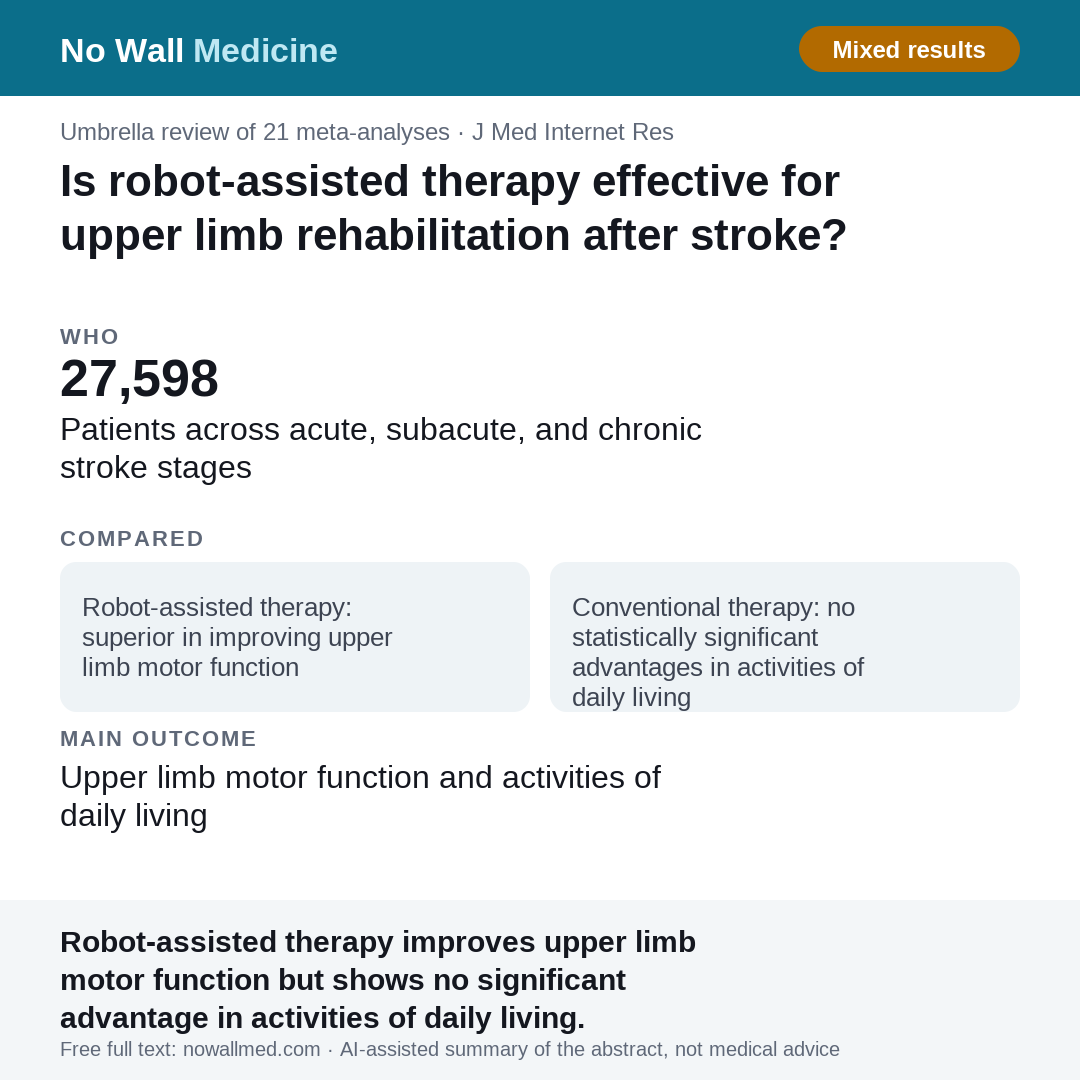
Is robot-assisted therapy effective for upper limb rehabilitation after stroke?
Who
27,598
Patients across acute, subacute, and chronic stroke stages
Compared
Robot-assisted therapy: superior in improving upper limb motor function
Conventional therapy: no statistically significant advantages in activities of daily living
Main outcome
Upper limb motor function and activities of daily living
Bottom line: Robot-assisted therapy improves upper limb motor function but shows no significant advantage in activities of daily living.
Limitation: Significant outcome heterogeneity and methodological limitations inherent to umbrella reviews.
J Med Internet Res · 2026-03-25Download image
Clinical question: Is robot-assisted therapy effective for upper limb rehabilitation after stroke?
Why it matters: Existing systematic reviews on robot-assisted therapy for stroke rehabilitation have provided inconsistent conclusions and lacked a multidimensional framework for clinical decisions.
Key points
- Researchers synthesized 21 meta-analyses involving 535 randomized controlled trials and 27,598 patients across different stroke stages.
- Robot-assisted therapy was superior for improving upper limb motor function but showed no statistically significant advantages in activities of daily living compared to conventional therapy.
- The effectiveness of the treatment was influenced by the stage of the stroke, the level of motor impairment, and the type of robot used.
Limitation the authors note: The current evidence is constrained by significant outcome heterogeneity and methodological limitations inherent to umbrella reviews.
Headline and key points written with AI from the paper’s abstract, with every number checked against it. Read the paper before relying on them.
Topics
Cite this article
Liu S, Zhang X, Zhou L, Zhang J, Liu J, He C. Robot-Assisted Therapy for Upper Limb Rehabilitation After Stroke: Umbrella Review. J Med Internet Res. 2026. doi:10.2196/79363
Spotted a mistake? Suggest a correction