Robotic arm-assisted and manual knee replacement showed similar clinical outcomes at five years
Robotic arm-assisted versus conventional medial unicompartmental knee arthroplasty: five-year clinical outcomes of a randomized controlled trial
Prospective, randomized, parallel, single-centre studyBenefit found
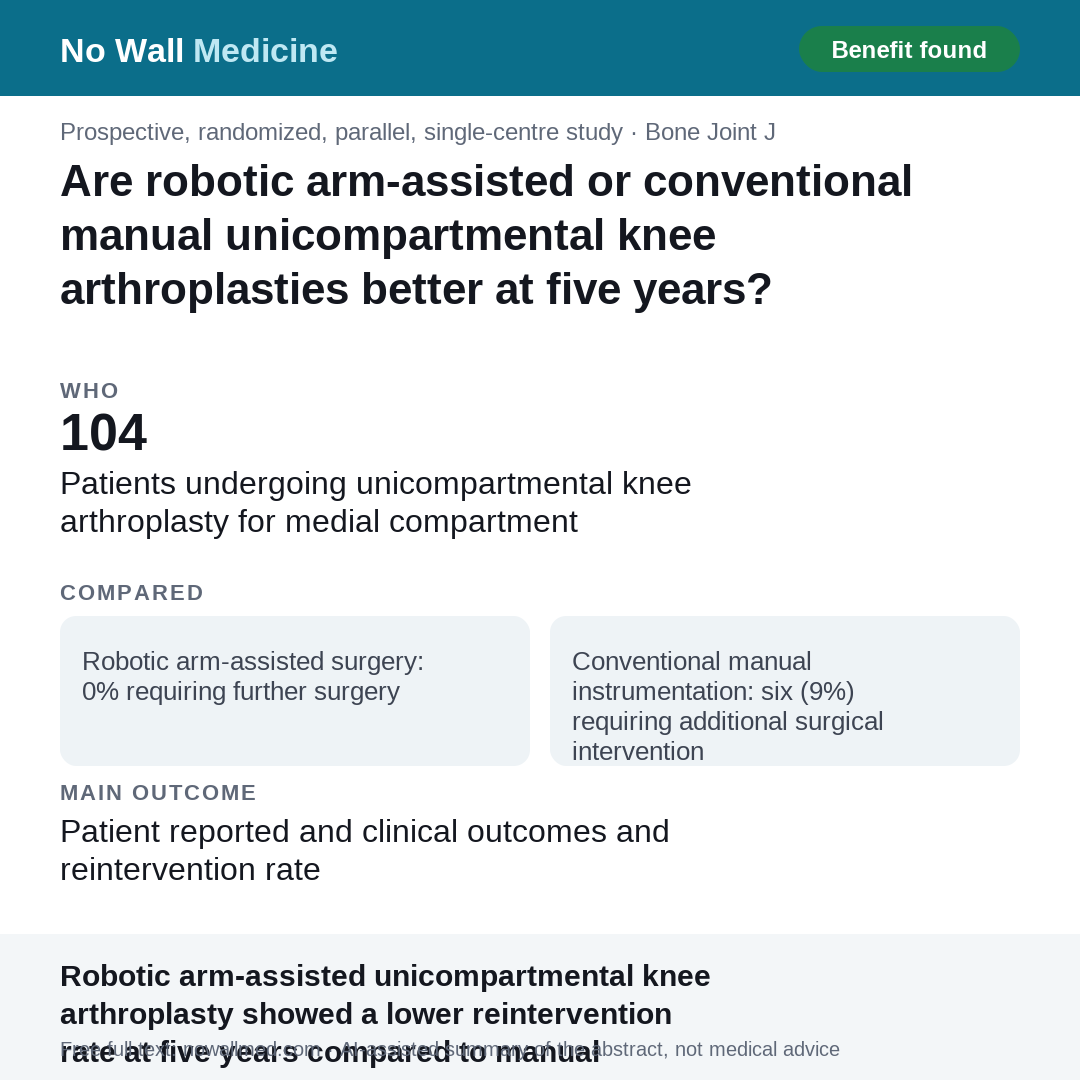
Are robotic arm-assisted or conventional manual unicompartmental knee arthroplasties better at five years?
Who
104
Patients undergoing unicompartmental knee arthroplasty for medial compartment osteoarthritis · Single-centre
Compared
Robotic arm-assisted surgery: 0% requiring further surgery
Conventional manual instrumentation: six (9%) requiring additional surgical intervention
Main outcome
Patient reported and clinical outcomes and reintervention rate
Bottom line: Robotic arm-assisted unicompartmental knee arthroplasty showed a lower reintervention rate at five years compared to manual instrumentation.
Bone Joint J · 2021-06-01Download image
Clinical question: Are robotic arm-assisted or conventional manual unicompartmental knee arthroplasties better at five years?
Why it matters: It is unknown if robotic assistance for bone cutting accuracy in single-compartment knee replacement leads to better long-term clinical results than manual methods.
Key points
- The study followed 104 patients, consisting of 55 receiving robotic arm-assisted surgery and 49 receiving manual instrumentation for single-compartment knee replacement.
- At five years, there were no statistical differences between the two groups in any patient-reported or clinical outcomes.
- The robotic arm-assisted group had a 0% reintervention rate compared to 9% in the manual group, which required additional surgery for 6 patients.
Limitation the authors note: The study was a single-centre trial.
Headline and key points written with AI from the paper’s abstract, with every number checked against it. Read the paper before relying on them.
Was this summary helpful?
Subject terms
Cite this article
Banger M, Doonan J, Rowe P, Jones B, MacLean A, Blyth MJB. Robotic arm-assisted versus conventional medial unicompartmental knee arthroplasty: five-year clinical outcomes of a randomized controlled trial. Bone Joint J. 2021. doi:10.1302/0301-620X.103B6.BJJ-2020-1355.R2
Spotted a mistake? Suggest a correction
Top studies every Monday
The week’s key trials and guidelines in your specialties, plus any topics you follow. By email, free.
Get the weekly digest