Robotic-arm-assisted knee replacement did not improve patient outcomes compared to conventional instruments
Robotic-arm-assisted versus conventional total knee replacement (RACER-Knee): a pragmatic, multicentre, participant-masked and assessor-masked, superiority, randomised controlled trial
Pragmatic, superiority, randomised controlled trialNo clear difference
Does robotic-arm-assisted versus conventional total knee replacement improve clinical efficacy and cost-effectiveness?
Who
339
Patients with advanced knee osteoarthritis · Ten hospitals in Great Britain
Compared
49.2Mako robotic-arm-assisted system (SD 28.4; n=154)
50.2Conventional instruments (29.9; n=158)
Main outcome
Forgotten Joint Score at 12 months
Result: adjusted mean difference -1.5 (95% CI -7.5 to 4.5; p=0.62)
Bottom line: Robotic-arm-assisted total knee replacement was more costly and provided no clinically meaningful patient benefit compared to conventional instruments.
Funded by: UK National Institute for Health and Care Research
Lancet · 2026-08-20Download image
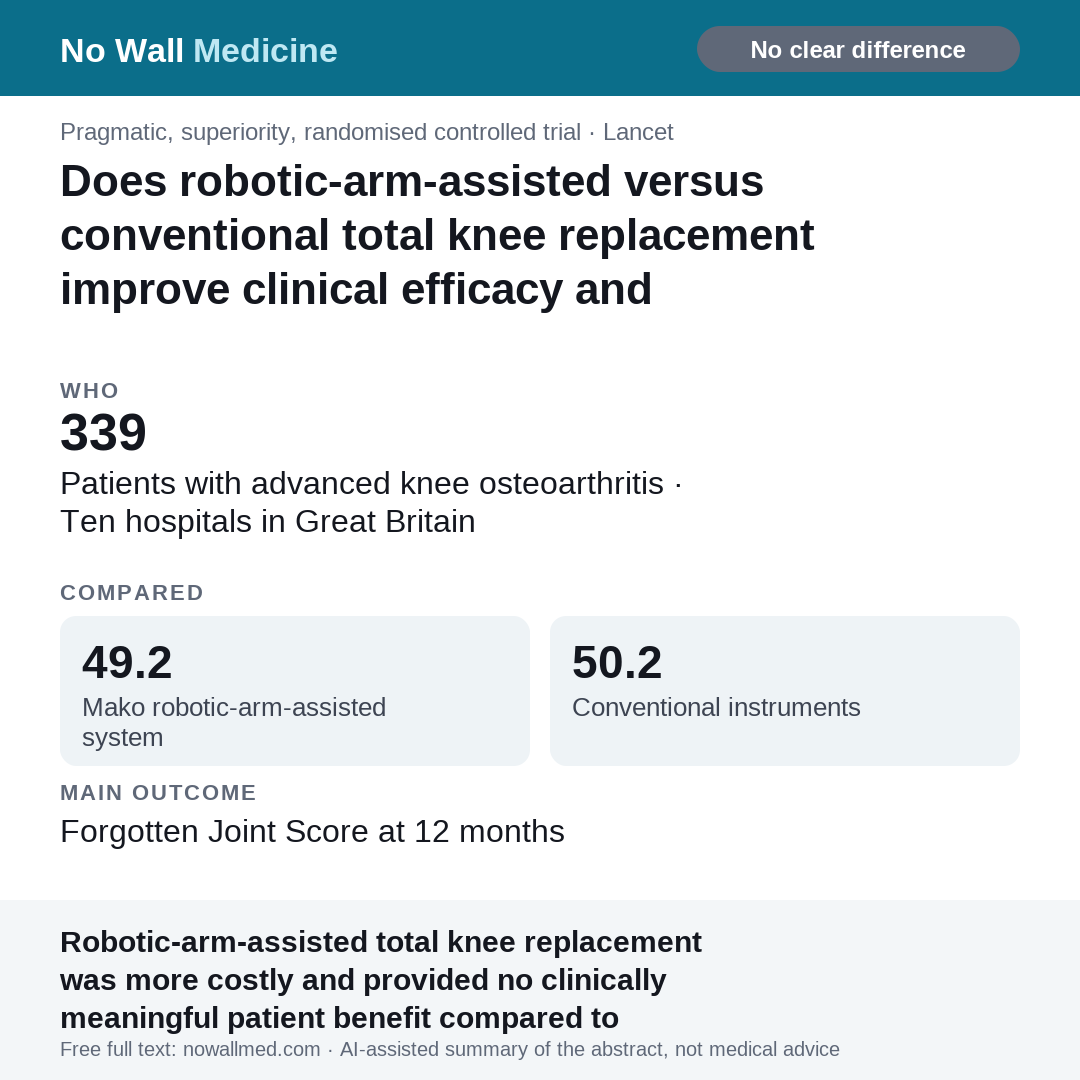
Clinical question: Does robotic-arm-assisted versus conventional total knee replacement improve clinical efficacy and cost-effectiveness?
Why it matters: It is uncertain whether robotic systems improve clinical efficacy and cost-effectiveness for patients undergoing total knee replacement.
Key points
- Researchers conducted a trial involving 339 patients with advanced knee osteoarthritis across ten hospitals in Great Britain.
- At 12 months, the mean Forgotten Joint Score, which measures how much a patient notices their replacement, was 49.2 for robotic-arm-assisted surgery and 50.2 for conventional surgery.
- The adjusted mean difference of -1.5 between the two groups was not statistically significant, and both groups had 16 serious adverse events.
Headline and key points written with AI from the paper’s abstract, with every number checked against it. Read the paper before relying on them.
Abstract
Background
Robotic systems are being increasingly used to assist with total knee replacement (TKR). Whether robotic systems improve outcomes after TKR is uncertain. We aimed to ascertain the clinical efficacy and cost-effectiveness of the Mako robotic-arm system compared with conventional instruments for TKR. Methods
We conducted a participant-masked and assessor-masked pragmatic, superiority, randomised controlled trial at ten hospitals in Great Britain involving 33 surgeons. Patients with advanced knee osteoarthritis underwent TKR with conventional instruments (cTKR) or with the Mako robotic-arm-assisted system (rTKR). Key exclusion criteria were inflammatory arthropathy, previous fracture, or the need for complex implants. Participants were randomly assigned (1:1) through a remote computer system using minimisation by age, BMI, centre, surgeon, and primary knee compartment involved. Participants and assessors were masked through methods including using sham incisions, additional draping, and masked operation notes. The primary outcome was the Forgotten Joint Score (FJS) at 12 months after randomisation according to the intention-to-treat principle using a linear mixed-effects model. The prespecified target difference was 12 points. The trial is registered with ISRCTN (ISRCTN27624068), and long-term follow-up is ongoing. Findings
Between Dec 21, 2021, and Dec 13, 2023, 807 patients were screened and 339 were randomly assigned: 168 to rTKR and 171 to cTKR. The median age was 68·8 years (IQR 61·3-75·2), 167 (49%) were female, and 172 (51%) were male. At 12 months, the mean FJS was 49·2 (SD 28·4; n=154) in the rTKR group and 50·2 (29·9; n=158) in the cTKR group. The adjusted mean difference was -1·5 (95% CI -7·5 to 4·5; p=0·62,) favouring cTKR. 16 participants in each group had one serious adverse event. Interpretation
In this pragmatic trial, rTKR as delivered in routine practice was more costly than cTKR and did not provide a clinically meaningful patient benefit at 12 months after randomisation. The two groups had similar safety (ie, harms) profiles. Funding
UK National Institute for Health and Care Research Health Technology Assessment Programme.
Abstract reproduced under the article’s CC BY licence.
Topics
Spotted a mistake? Suggest a correction
More in Orthopedics & Sports Medicine
Higher pre-treatment expectations associated with less pain and better function after physiotherapy
Higher pre-treatment expectations are associated with less pain and better physical function and quality of life after physiotherapy for knee osteoarthritis
Patellofemoral osteochondritis dissecans patients have distinct knee anatomy
Is There an Association Between Abnormal Patellofemoral Morphology and Patellofemoral Osteochondritis Dissecans in Pediatric Patients?
Newly Diagnosed Dyslipidemia Linked to Higher Risk of Osteoarthritis
Association Between Newly Diagnosed Dyslipidemia and Joint-Specific Incident Osteoarthritis: A Nationwide Propensity-Score-Matched Cohort Study