Robotic assistance showed higher accuracy and lower radiation dose than freehand liver tumor ablation
Robotic Assistance in Percutaneous Liver Ablation Therapies: A Systematic Review and Meta-Analysis
Systematic review and meta-analysisBenefit found
How does robotic assistance compare to freehand techniques for percutaneous liver ablation?
Who
33
Percutaneous liver ablation studies
Compared
Robotic approach
Freehand technique
Main outcome
Radiation dose, accuracy, and Euclidean error
Result: radiation dose 0.5582 (95% CI 0.0167-1.0996), accuracy 0.6260 (95% CI 0.1423-1.1097), and Euclidean error 0.8189 (95% CI -0.1020 to 1.7399)
Bottom line: Robotic assistance in percutaneous liver ablation achieves superior results and reduces errors compared with manual applicator insertion.
Ann Surg Open · 2024-03-26Download image
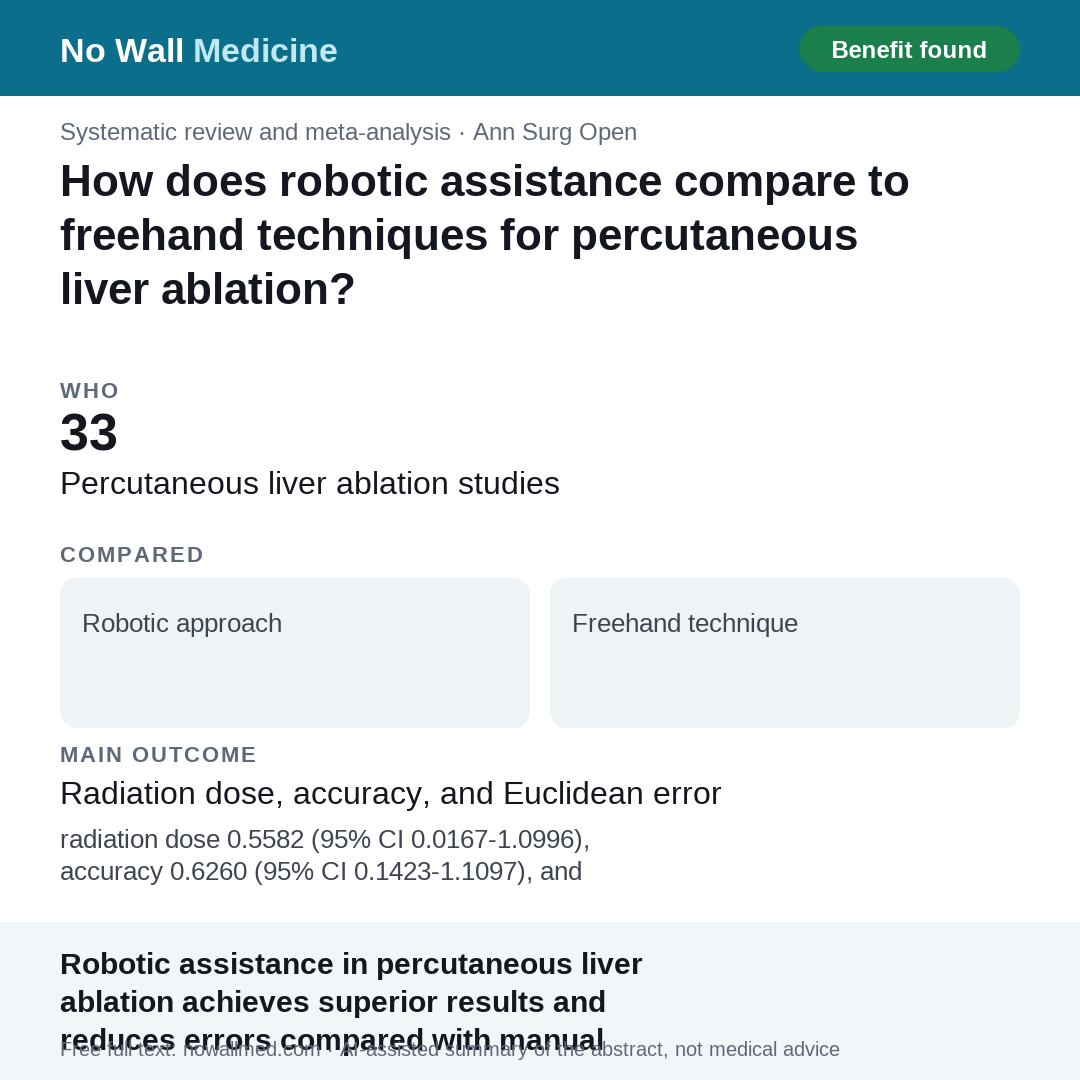
Clinical question: How does robotic assistance compare to freehand techniques for percutaneous liver ablation?
Why it matters: It is unknown how different robotic assistance systems compare to manual techniques regarding procedural accuracy and radiation exposure during liver tumor ablation.
Key points
- Researchers analyzed 33 studies involving 24 different robotic devices used for percutaneous liver ablation, which is a procedure to destroy tumors through the skin.
- The robotic approach was associated with higher accuracy and lower radiation dose compared to the freehand technique, with a dose-length product range of 79-2216 mGy.cm.
- Optical tracking systems were the most common method used, appearing in 25/33, or 75.8%, of the included studies.
Headline and key points written with AI from the paper’s abstract, with every number checked against it. Read the paper before relying on them.
Was this summary helpful?
Cite this article
Uribe Rivera AK, Seeliger B, Goffin L, García-Vázquez A, Mutter D, Giménez ME. Robotic Assistance in Percutaneous Liver Ablation Therapies: A Systematic Review and Meta-Analysis. Ann Surg Open. 2024. doi:10.1097/AS9.0000000000000406
Spotted a mistake? Suggest a correction
Top studies every Monday
The week’s key trials and guidelines in your specialties, plus any topics you follow. By email, free.
Get the weekly digest