Robotic-assisted surgery was associated with higher overall survival than conventional laparoscopy for endometrial cancer
Robotic-assisted versus conventional laparoscopic surgery for endometrial cancer: long-term results of a randomized controlled trial
Randomized controlled trialBenefit found
Are robotic-assisted or conventional laparoscopic surgeries better for endometrial cancer?
Who
97
Patients with low-grade endometrial cancer · Tampere University Hospital, Finland
Compared
Robotic-assisted laparoscopy: 75.5% (64.5-87.5) 10-year overall survival
Conventional laparoscopy: 85.4% (75.4-95.4) 10-year overall survival
Main outcome
Overall survival, progression-free survival, and long-term surgical complications
Result: hazard ratio 0.39 (95% CI 0.15-0.99)
Bottom line: Robotic-assisted laparoscopy showed a minor overall survival benefit but higher rates of trocar site hernia compared to conventional laparoscopy.
AJOG · 2024-08-23Download image
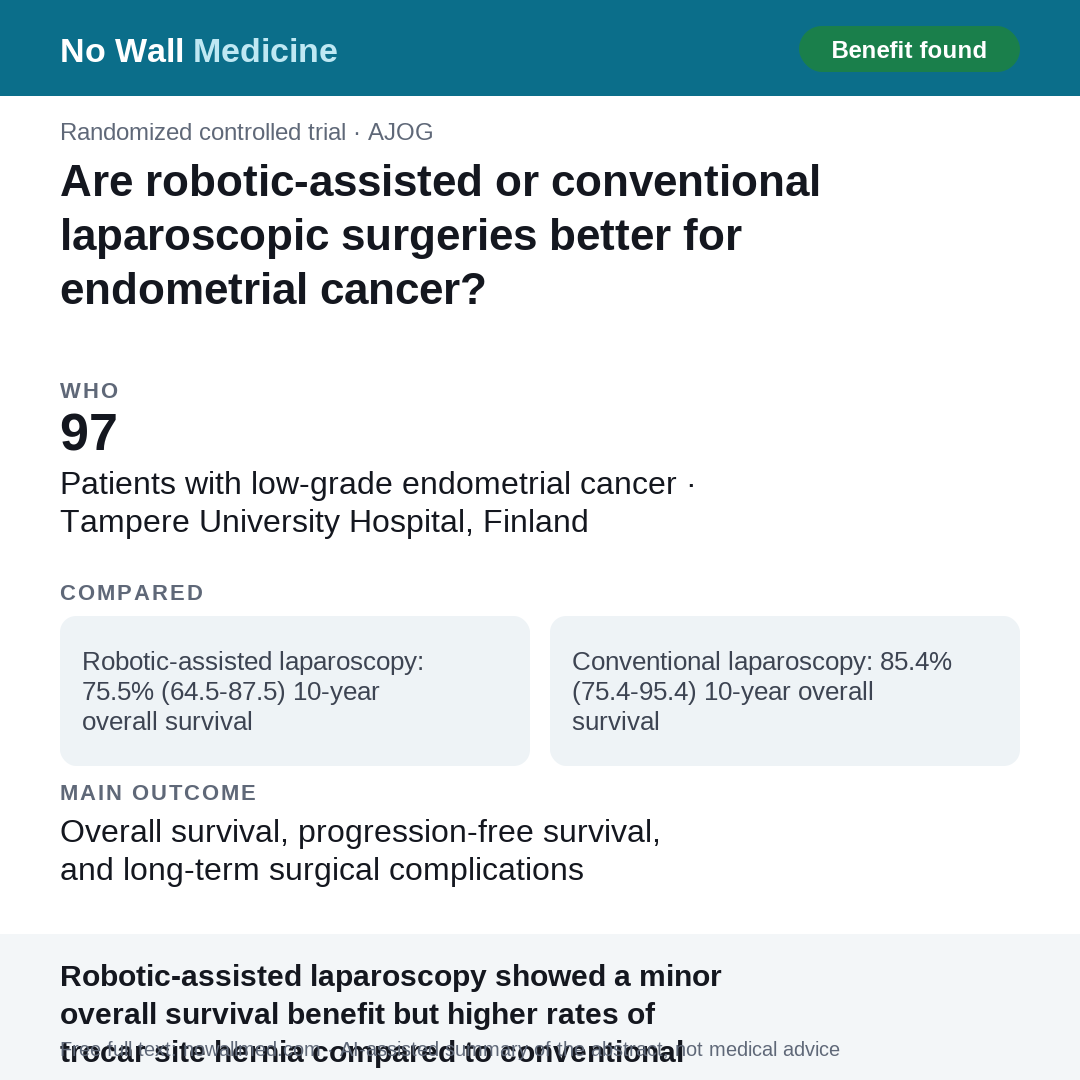
Clinical question: Are robotic-assisted or conventional laparoscopic surgeries better for endometrial cancer?
Why it matters: Long-term oncological outcomes and surgical complications for robotic-assisted laparoscopy in endometrial cancer patients were previously unknown and based only on retrospective studies.
Key points
- Researchers followed 97 patients with low-grade endometrial cancer for at least 10 years after they were randomized to receive either robotic-assisted or conventional laparoscopy.
- Overall survival was higher in the robotic-assisted group compared to the conventional laparoscopy group, while progression-free survival showed no difference between the two methods.
- Trocar site hernia, a type of abdominal wall protrusion, occurred more frequently in the robotic-assisted group at 18.2% compared to 4.1% in the conventional group.
Limitation the authors note: Larger randomized controlled trials are needed to confirm any potential survival benefit.
Headline and key points written with AI from the paper’s abstract, with every number checked against it. Read the paper before relying on them.
Topics
Cite this article
Kivekäs E, Staff S, Huhtala HSA, Mäenpää JU, Nieminen K, Tomás EI. Robotic-assisted versus conventional laparoscopic surgery for endometrial cancer: long-term results of a randomized controlled trial. AJOG. 2024. doi:10.1016/j.ajog.2024.08.028
Spotted a mistake? Suggest a correction
Top studies every Monday
The week’s key trials and guidelines in your specialties, plus any topics you follow. By email, free.
Get the weekly digest