Performing gallbladder removal during gastric bypass did not significantly increase composite complications in a pilot trial
Robotic gastric Roux-en-Y bypass with or without concomitant cholecystectomy: pilot open label randomized trial
Pilot open label randomized trialNo clear difference
Does concomitant cholecystectomy during robotic Roux-en-Y gastric bypass reduce complications?
Who
95
Patients without preoperative gallstones scheduled for Roux-en-Y gastric bypass
Compared
44.9%Roux-en-Y gastric bypass with cholecystectomy
26.1%Roux-en-Y gastric bypass without cholecystectomy
Main outcome
Composite of intraoperative adverse events and 30-day postoperative complications
Result: difference 18.8%; 95% confidence interval -0.6 to 36.8
Bottom line: Concomitant cholecystectomy did not significantly increase composite complications compared to Roux-en-Y gastric bypass alone.
BJS Open · 2026-08-18Download image
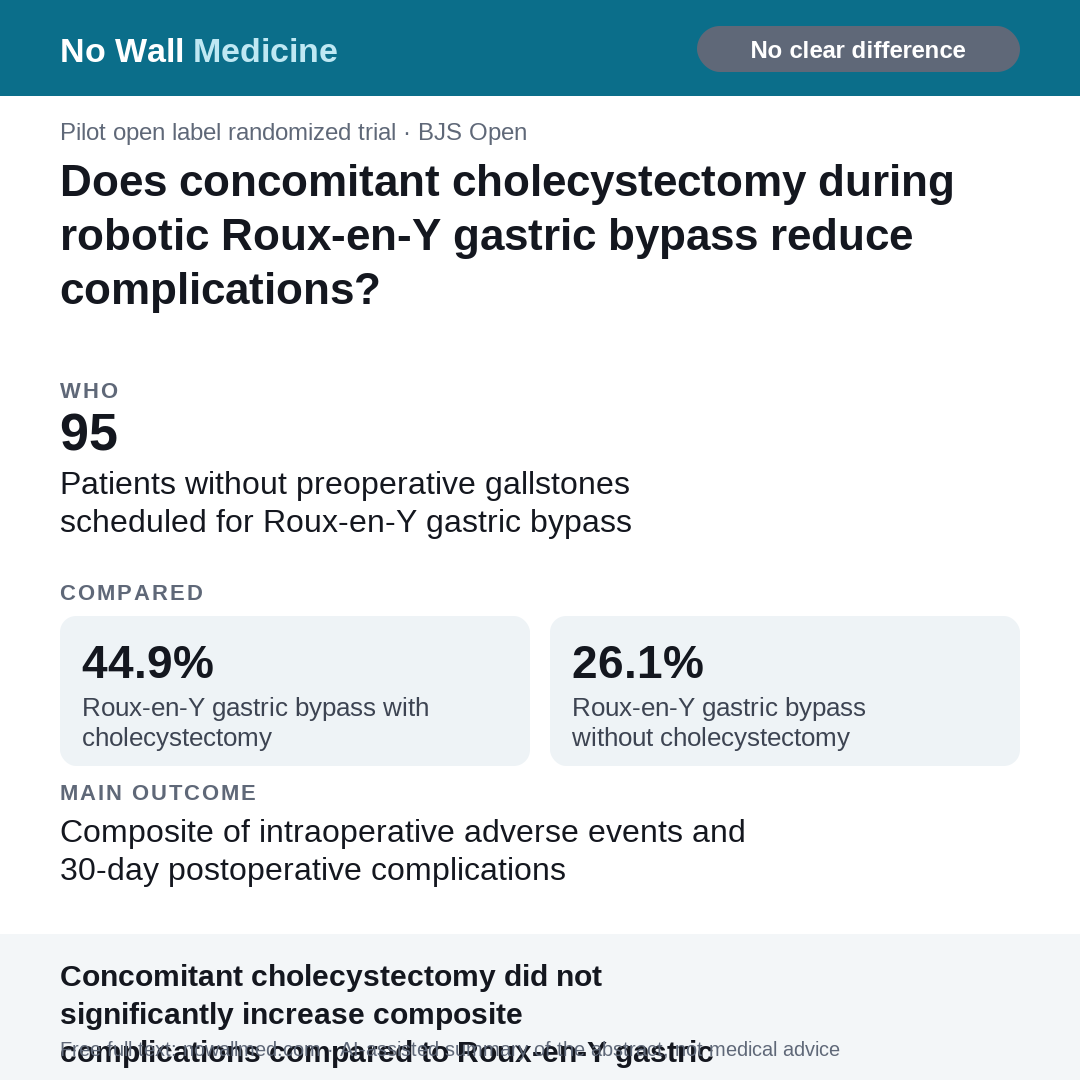
Clinical question: Does concomitant cholecystectomy during robotic Roux-en-Y gastric bypass reduce complications?
Why it matters: Doctors debate whether removing the gallbladder during gastric bypass surgery is necessary to prevent future gallbladder-related issues despite potential surgical risks.
Key points
- Researchers studied 95 patients undergoing robotic Roux-en-Y gastric bypass, comparing those who also had gallbladder removal to those who did not.
- The composite rate of surgical and 30-day postoperative complications was 44.9% with gallbladder removal and 26.1% without, though this difference was not statistically significant.
- During 18 months of follow-up, biliary events occurred in 6.5% of patients without gallbladder removal compared to 2% of patients with gallbladder removal.
Headline and key points written with AI from the paper’s abstract, with every number checked against it. Read the paper before relying on them.
Topics
Spotted a mistake? Suggest a correction