Robotic pancreatic surgery showed similar recovery times compared to open surgery in a multicentre trial
Robotic versus Open Pancreatoduodenectomy (PORTAL): multicentre, single masked, phase 3, non-inferiority randomised controlled trial
Multicentre, single masked, phase 3, non-inferiority randomised controlled trialBenefit found
Is robotic pancreatoduodenectomy non-inferior to open pancreatoduodenectomy for postoperative functional recovery?
Who
268
268 adults with resectable pancreatic or periampullary disease · Seven tertiary high volume pancreatic centres in China
Compared
12.1 daysRobotic pancreatoduodenectomy (95% CI 11.2 to 13.1)
16.0 daysOpen pancreatoduodenectomy (14.5 to 17.5)
Main outcome
Time from surgery to postoperative functional recovery
Result: difference -3.9 days, 95% CI -5.6 to -2.2
Bottom line: Robotic pancreatoduodenectomy was non-inferior to open surgery for functional recovery and associated with shorter hospital stays.
BMJ · 2026-07-01Download image
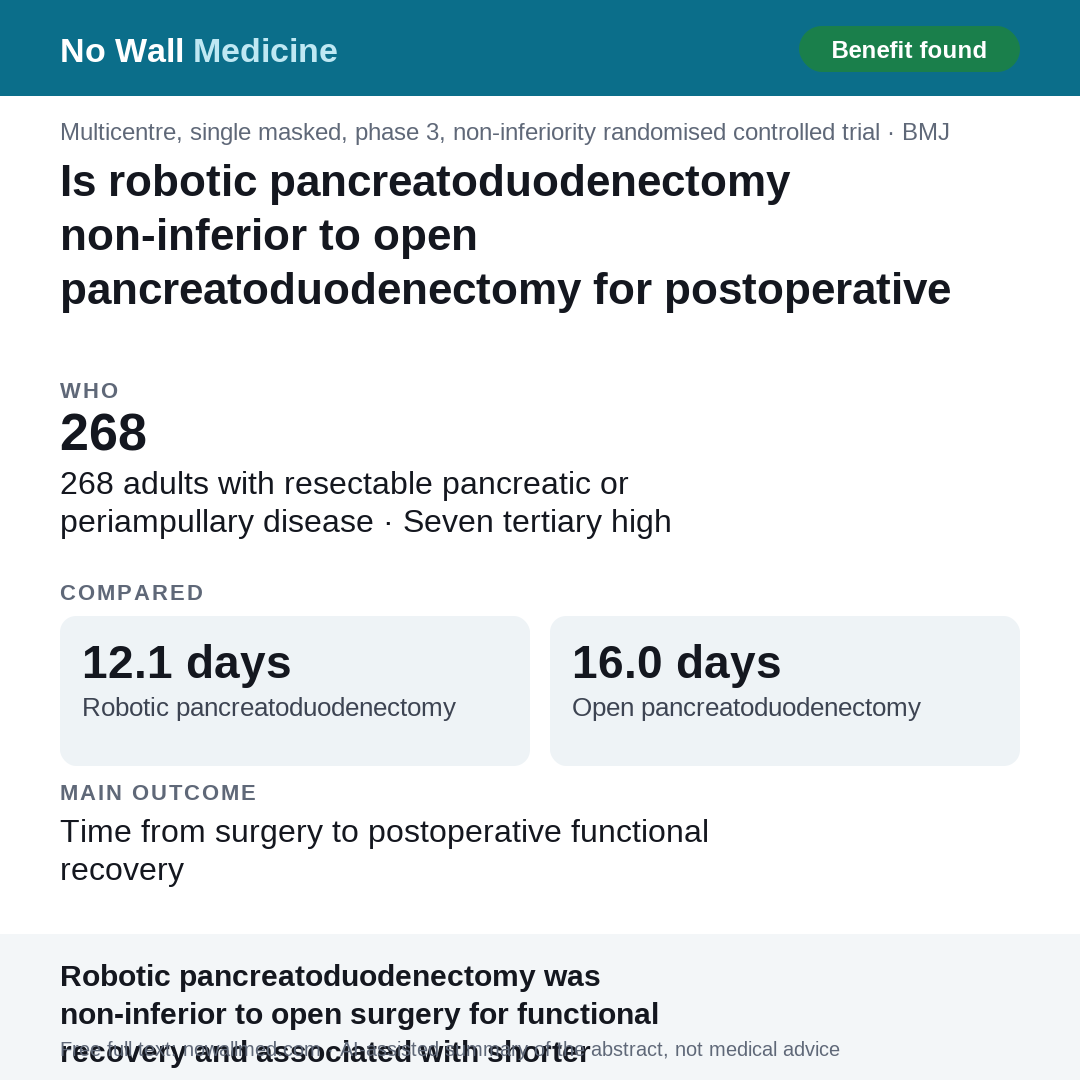
Clinical question: Is robotic pancreatoduodenectomy non-inferior to open pancreatoduodenectomy for postoperative functional recovery?
Why it matters: It was unclear if robotic pancreatoduodenectomy is non-inferior to open surgery regarding postoperative functional recovery and safety.
Key points
- Researchers studied 268 adults with resectable pancreatic or periampullary disease, comparing robotic surgery to open surgery.
- The robotic group had a median time to functional recovery of 12.1 days compared to 16.0 days for the open surgery group.
- Robotic surgery resulted in a shorter hospital stay of 13 days versus 16 days, but had higher median hospital admission costs.
Headline and key points written with AI from the paper’s abstract, with every number checked against it. Read the paper before relying on them.
Abstract
Objective
To determine whether robotic pancreatoduodenectomy (RPD) is non-inferior to open pancreatoduodenectomy (OPD) in terms of postoperative functional recovery, without compromising safety or oncological quality. Design
Multicentre, single masked, phase 3, non-inferiority randomised controlled trial. Setting
Seven tertiary high volume pancreatic centres in China, 15 June 2020 to 28 November 2024. Participants
268 adults with resectable pancreatic or periampullary disease. Interventions
Participants were randomised to receive standardised RPD (n=142) or OPD (n=126), with enhanced recovery pathways. Main outcome measures
The primary outcome was time from surgery to postoperative functional recovery, defined as adequate pain control without parenteral analgesia, ≥50% oral intake without intravenous fluids, independent mobilisation, and absence of active intra-abdominal infection. The restricted mean event time (RMET) within 40 days was a summary for time from surgery to postoperative functional recovery. Secondary outcomes included operative metrics, disease related outcomes, length of stay, postoperative morbidity, including complications of Clavien-Dindo grade II or higher (defined as complications requiring drug treatment or more intensive intervention), and hospital admission costs. Results
Overall, 254 of 268 randomly assigned participants (mean age 62 years; 172 (64.2%) men) underwent surgery, completed follow-up, and were included in the modified intention-to-treat population; 14 did not undergo surgery. In the modified intention-to-treat population, the RMET was 12.1 days (95% confidence interval (CI) 11.2 to 13.1) in the RPD group and 16.0 days (14.5 to 17.5) in the OPD group (difference -3.9 days, 95% CI -5.6 to -2.2; P<0.001). Operative time was longer in the RPD group (300 minutes (interquartile range (IQR) 240-360 minutes) versus 270 (210-300) minutes in the OPD group, P<0.001) but postoperative length of stay was shorter in the RPD group (13 (IQR 11-16) days v 16 (13-20) days, P<0.001). Overall postoperative morbidity was 31.1% (41/132) in the RPD group versus 36.1% (44/122) in the OPD group and incidence of any complications of Clavien-Dindo grade II or higher was 23.5% (31/132) versus 34.4% (42/122), respectively. 90 day mortality was 0.8% (1) in the RPD group and 2.5% (3) in the OPD group. Median total costs of hospital admission (including readmission cost) were higher in the RPD group than in the OPD group (¥130 905 (£14 369; $19 351; €16 628) (IQR ¥114 853-¥152 547) v ¥108 071 (¥92 134-¥128 035), difference ¥22 834 (95% CI ¥16 744 to ¥30 522); P<0.001). Conclusions
In high volume centres with credentialled surgeons, RPD met the non-inferiority margin for time from surgery to postoperative functional recovery, with comparable disease related outcomes and overall burden from postoperative complications. To generate wider system level efficiency gains, the implementation of RPD should take account of institutional expertise, procedural volume, acquisition of robotic surgical platforms and maintenance costs, and the potential for shorter hospital stay. Trial registration
ClinicalTrials.gov NCT04400357.
Abstract reproduced under the article’s CC BY NC licence.
Topics
Cite this article
Jin J, Qin K, Gemenetzis G, Wang Z, Zheng C, Li W. Robotic versus Open Pancreatoduodenectomy (PORTAL): multicentre, single masked, phase 3, non-inferiority randomised controlled trial. BMJ. 2026. doi:10.1136/bmj-2026-319692
Spotted a mistake? Suggest a correction