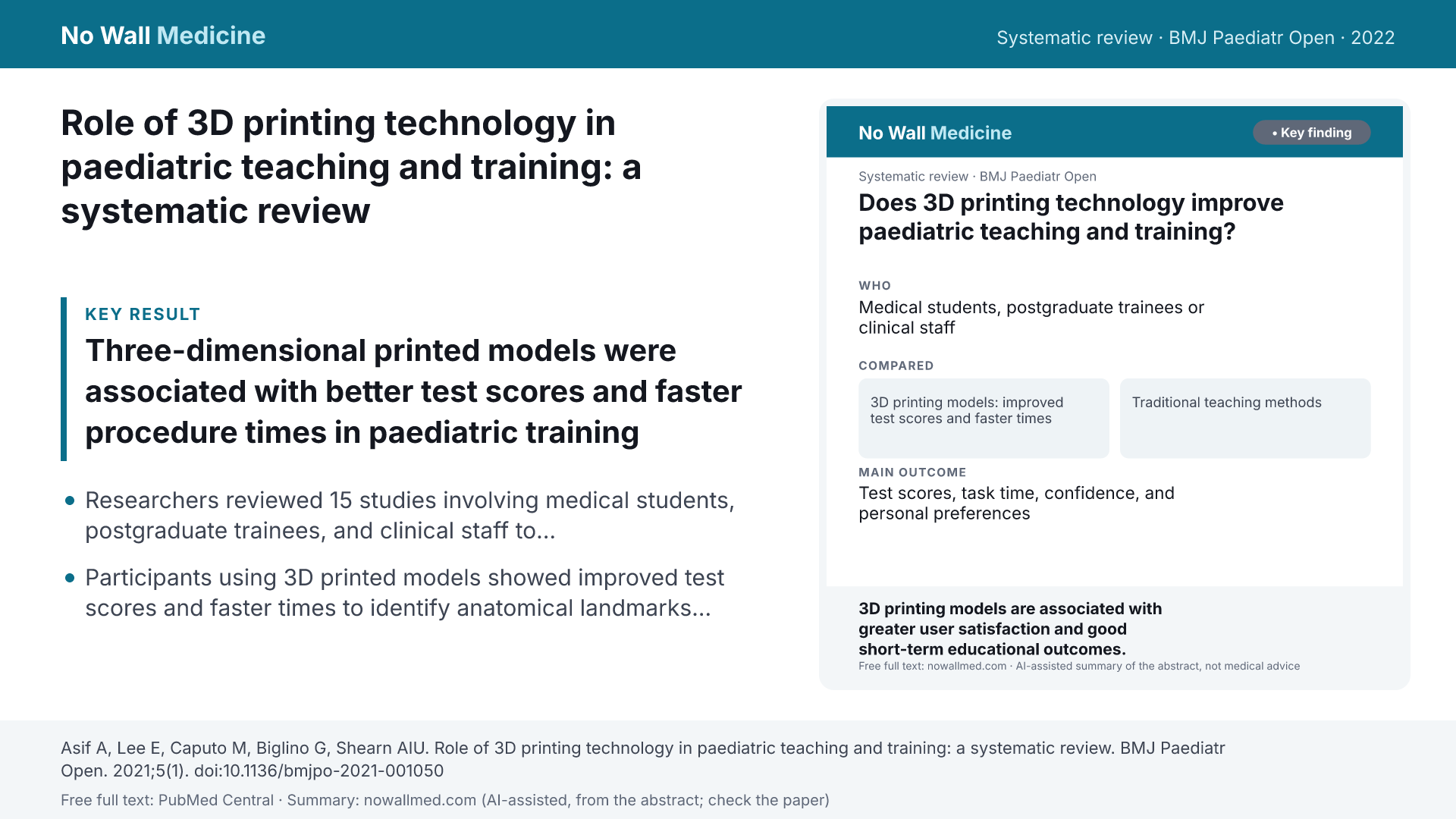
Three-dimensional printed models were associated with better test scores and faster procedure times in paediatric training
Role of 3D printing technology in paediatric teaching and training: a systematic review
Systematic reviewKey finding
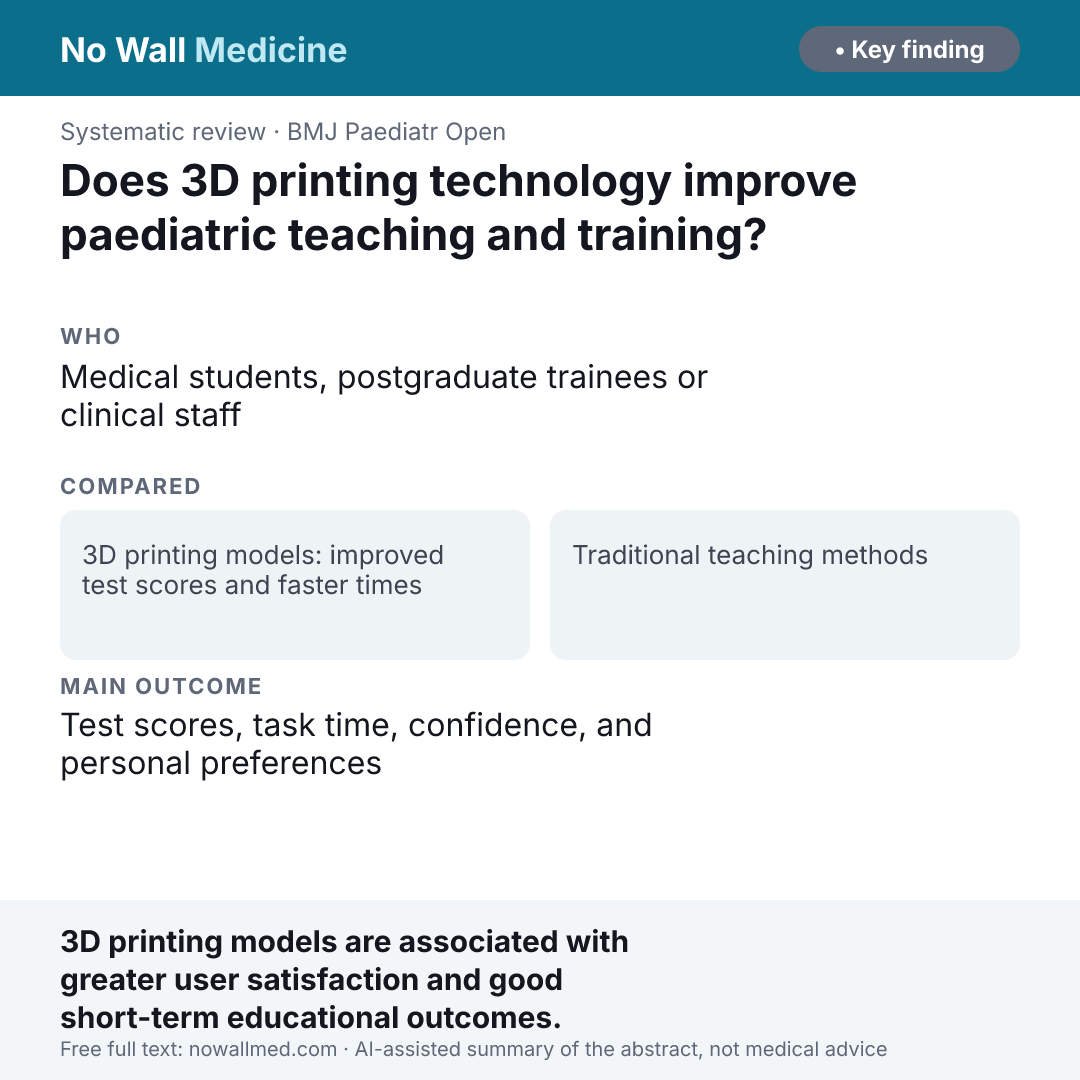
Does 3D printing technology improve paediatric teaching and training?
Who
Medical students, postgraduate trainees or clinical staff
Compared
3D printing models: improved test scores and faster times
Traditional teaching methods
Main outcome
Test scores, task time, confidence, and personal preferences
Bottom line: 3D printing models are associated with greater user satisfaction and good short-term educational outcomes.
Limitation: Mostly non-randomised and single-centred studies that did not address bias or long-term outcomes.
BMJ Paediatr Open · 2022-03-15 · Save PNG
Clinical question: Does 3D printing technology improve paediatric teaching and training?
Why it matters: Undergraduate paediatric training in the UK is brief, leaving clinicians with a lower knowledge base regarding complex congenital conditions encountered in adult practice.
Key points
- Researchers reviewed 15 studies involving medical students, postgraduate trainees, and clinical staff to compare patient-specific 3D printed models with traditional teaching methods.
- Participants using 3D printed models showed improved test scores and faster times to identify anatomical landmarks or complete procedures compared to using 2D diagrams, lectures, or videos.
- The models were associated with higher user satisfaction and self-confidence, though the evidence was considered low-quality.
Limitation the authors note: The review included mostly non-randomised and single-centred studies that did not address bias or report long-term or clinically translatable outcomes.
Headline and key points written with AI from the paper’s abstract, with every number checked against it. Read the paper before relying on them.
Was this summary helpful?
Abstract
Background
In the UK, undergraduate paediatric training is brief, resulting in trainees with a lower paediatric knowledge base compared with other aspects of medicine. With congenital conditions being successfully treated at childhood, adult clinicians encounter and will need to understand these complex pathologies. Patient-specific 3D printed (3DP) models have been used in clinical training, especially for rarer, complex conditions. We perform a systematic review to evaluate the evidence base in using 3DP models to train paediatricians, surgeons, medical students and nurses. Methods
Online databases PubMed, Web of Science and Embase were searched between January 2010 and April 2020 using search terms relevant to "paediatrics", "education", "training" and "3D printing". Participants were medical students, postgraduate trainees or clinical staff. Comparative studies (patient-specific 3DP models vs traditional teaching methods) and non-comparative studies were included. Outcomes gauged objective and subjective measures: test scores, time taken to complete tasks, self-reported confidence and personal preferences on 3DP models. If reported, the cost of and time taken to produce the models were noted. Results
From 587 results, 15 studies fit the criteria of the review protocol, with 5/15 being randomised controlled studies and 10/15 focussing on cardiovascular conditions. Participants using 3DP models demonstrated improved test scores and faster times to complete procedures and identify anatomical landmarks compared with traditional teaching methods (2D diagrams, lectures, videos and supervised clinical events). User feedback was positive, reporting greater user self-confidence in understanding concepts with users wishing for integrated use of 3DP in regular teaching. Four studies reported the costs and times of production, which varied depending on model complexity and printer. 3DP models were cheaper than 'off-the-shelf' models available on the market and had the benefit of using real-world pathologies. These mostly non-randomised and single-centred studies did not address bias or report long-term or clinically translatable outcomes. Conclusions
3DP models were associated with greater user satisfaction and good short-term educational outcomes, with low-quality evidence. Multicentred, randomised studies with long-term follow-up and clinically assessed outcomes are needed to fully assess their benefits in this setting. Prospero registration number
CRD42020179656.
Abstract reproduced under the article’s CC BY licence.
Subject terms
Headline, design, result, key points, caveat and citation as plain text.
Cite this article
Asif A, Lee E, Caputo M, Biglino G, Shearn AIU. Role of 3D printing technology in paediatric teaching and training: a systematic review. BMJ Paediatr Open. 2021;5(1). doi:10.1136/bmjpo-2021-001050
Spotted a mistake? Suggest a correction