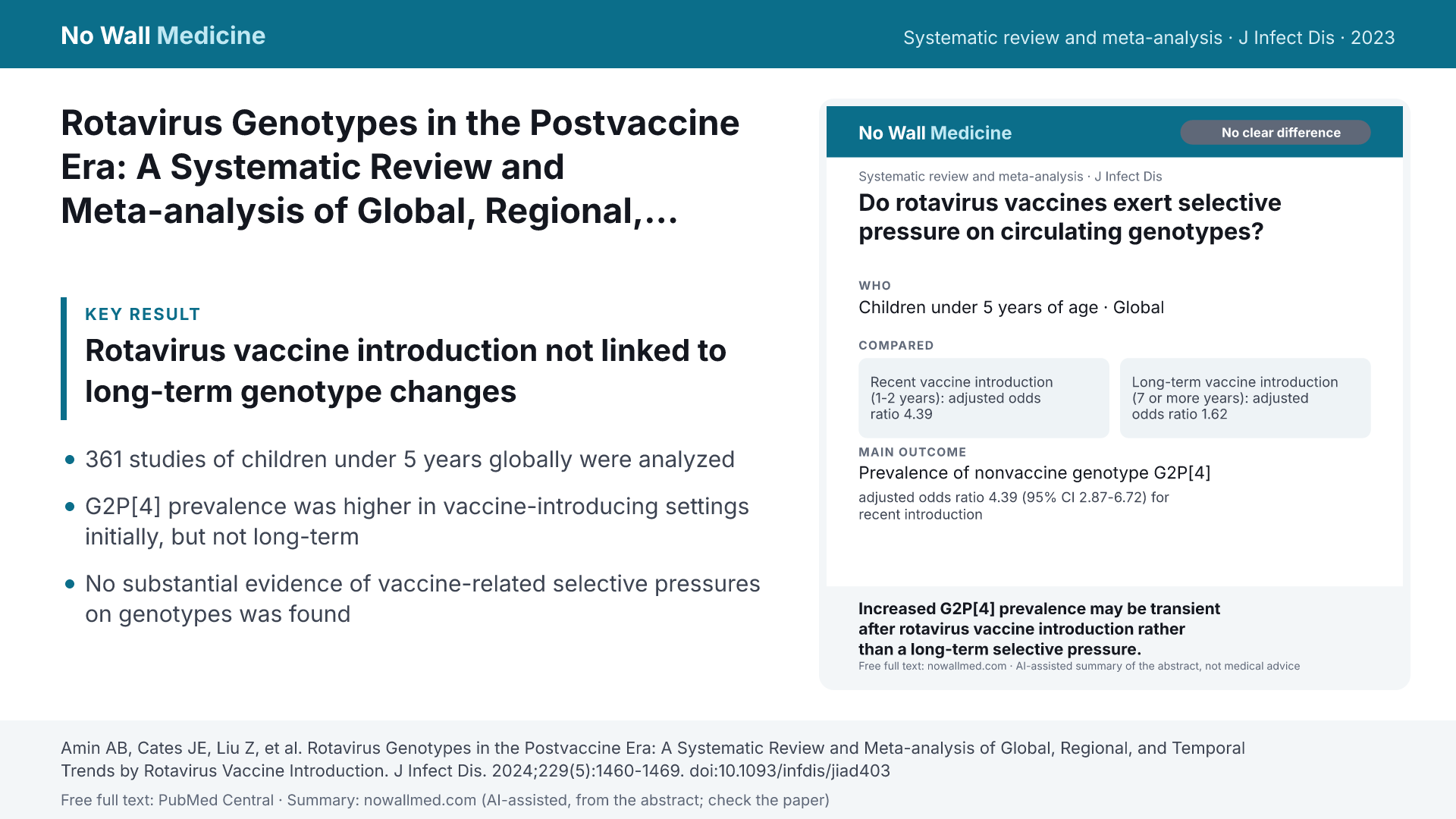
Rotavirus Genotypes in the Postvaccine Era: A Systematic Review and Meta-analysis of Global, Regional, and Temporal Trends by Rotavirus Vaccine Introduction
Key result: Rotavirus vaccine introduction not linked to long-term genotype changes
Systematic review and meta-analysisNo clear difference
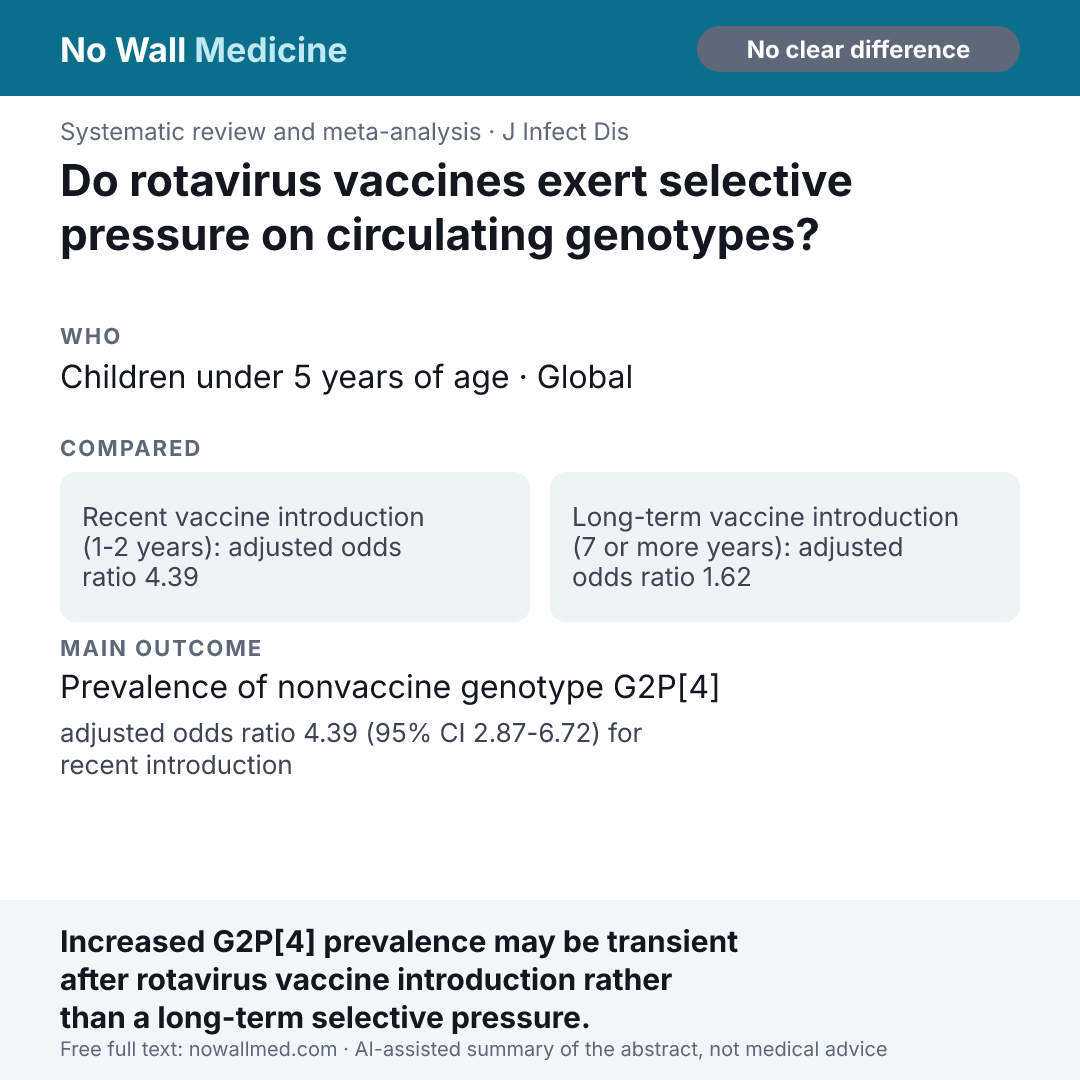
Do rotavirus vaccines exert selective pressure on circulating genotypes?
Who
Children under 5 years of age · Global
Compared
Recent vaccine introduction (1-2 years): adjusted odds ratio 4.39
Long-term vaccine introduction (7 or more years): adjusted odds ratio 1.62
Main outcome
Prevalence of nonvaccine genotype G2P[4]
Result: adjusted odds ratio 4.39 (95% CI 2.87-6.72) for recent introduction
Bottom line: Increased G2P[4] prevalence may be transient after rotavirus vaccine introduction rather than a long-term selective pressure.
J Infect Dis · 2023-09-22 · Save PNG
Key points
- 361 studies of children under 5 years globally were analyzed.
- G2P[4] prevalence was higher in vaccine-introducing settings initially, but not long-term.
- No substantial evidence of vaccine-related selective pressures on genotypes was found.
Discussion prompts
- Would these patients look like yours? Who was left out?
- Is the main outcome one that matters to patients?
- Is the difference large enough to change what you do?
Cite: Amin AB, Cates JE, Liu Z, et al. Rotavirus Genotypes in the Postvaccine Era: A Systematic Review and Meta-analysis of Global, Regional, and Temporal Trends by Rotavirus Vaccine Introduction. J Infect Dis. 2024;229(5):1460-1469. doi:10.1093/infdis/jiad403
Free full text: PubMed Central · Summary and visual abstract: nowallmed.com/a/rotavirus-genotypes-in-the-postvaccine-era-a-systematic-review-and-5fphyj/ (AI-assisted from the abstract; check the paper before relying on it).