Invasive management of NSTEMI in elderly patients did not reduce mortality or cardiac death
Routine Invasive vs Conservative Management of NSTEMI in Elderly Patients: Updated Meta-Analysis of Randomized Trials
Meta-analysis of 8 randomized controlled trialsMixed results
Is routine invasive strategy superior to conservative management of NSTEMI in elderly patients?
Who
3275
Patients aged 70 years or more with non-ST-segment elevation myocardial infarction
Compared
Routine invasive strategy
Conservative management
Main outcome
All-cause mortality and cardiac-related death
Result: OR: 1.07 (95% CI: 0.90-1.26)
Bottom line: Routine invasive strategy does not improve mortality but reduces myocardial reinfarction and urgent revascularization in elderly patients.
JACC Adv · 2025-10-29Download image
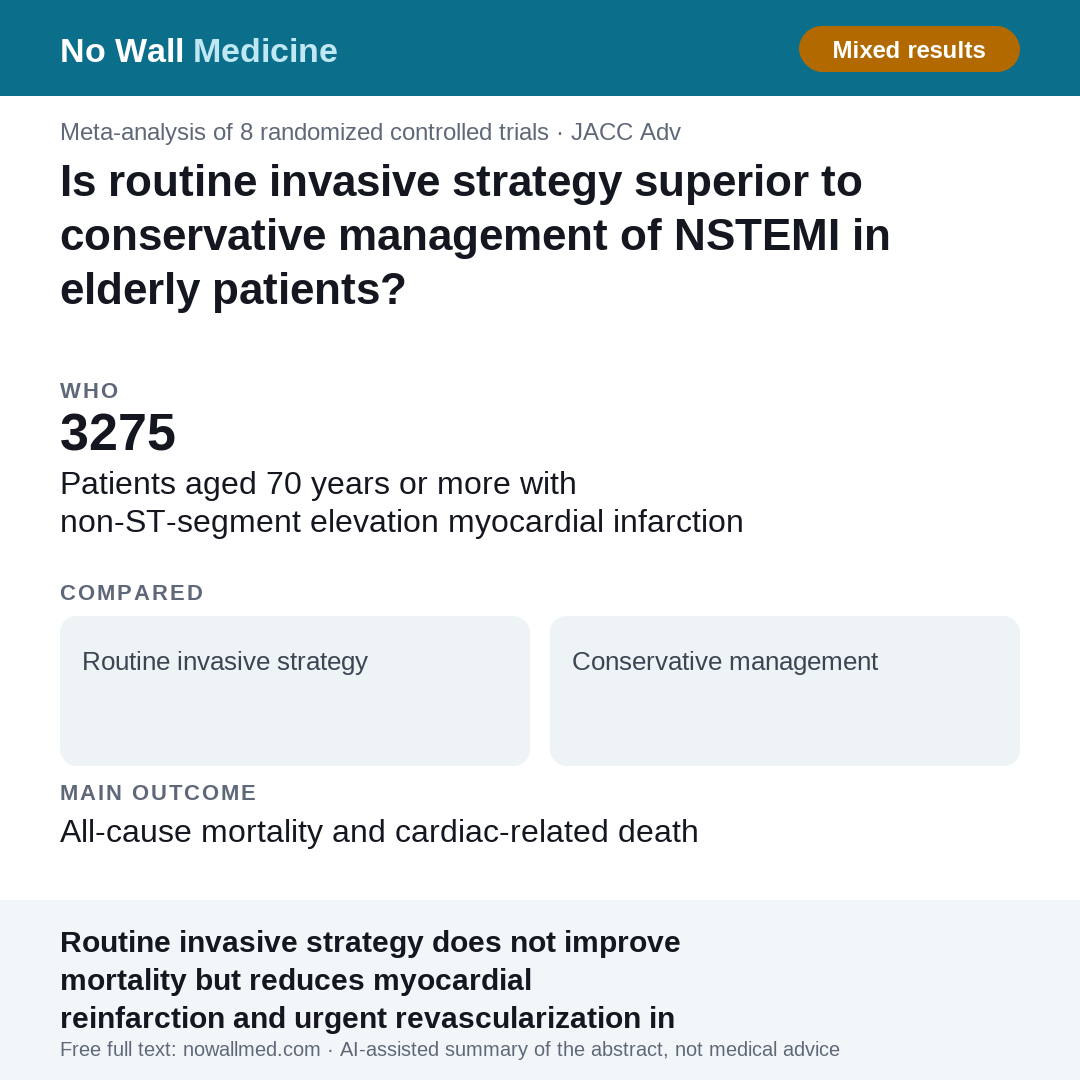
Clinical question: Is routine invasive strategy superior to conservative management of NSTEMI in elderly patients?
Why it matters: Clinical decision-making is debated because elderly patients are often under-represented in clinical trials regarding invasive versus conservative management for NSTEMI.
Key points
- Researchers analyzed 8 randomized controlled trials involving 3,275 patients aged 70 years or more with non-ST-segment elevation myocardial infarction.
- Routine invasive management was not superior to conservative management for all-cause mortality (OR: 1.07; 95% CI: 0.90-1.26; P = 0.44) or cardiac-related death (OR: 1.05; 95% CI: 0.86-1.29; P = 0.64).
- The invasive strategy was associated with a lower risk of myocardial reinfarction (OR: 0.71; 95% CI: 0.58-0.86; P = 0.0005) and urgent revascularization (OR: 0.31; 95% CI: 0.23-0.42; P < 0.00001).
Headline and key points written with AI from the paper’s abstract, with every number checked against it. Read the paper before relying on them.
Was this summary helpful?
Cite this article
Idowu A, Adebolu O, Evbayekha E, Lo KB, Akintoye E, Otabor E. Routine Invasive vs Conservative Management of NSTEMI in Elderly Patients: Updated Meta-Analysis of Randomized Trials. JACC Adv. 2025. doi:10.1016/j.jacadv.2025.102275
Spotted a mistake? Suggest a correction
Top studies every Monday
The week’s key trials and guidelines in your specialties, plus any topics you follow. By email, free.
Get the weekly digest