Standardized postoperative anesthesia visits did not change 30-day mortality in elective surgery patients
Routine Postsurgical Anesthesia Visit to Improve 30-day Morbidity and Mortality: A Multicenter, Stepped-wedge Cluster Randomized Interventional Study (The TRACE Study)
Stepped-wedge cluster randomized interventional studyNo clear difference
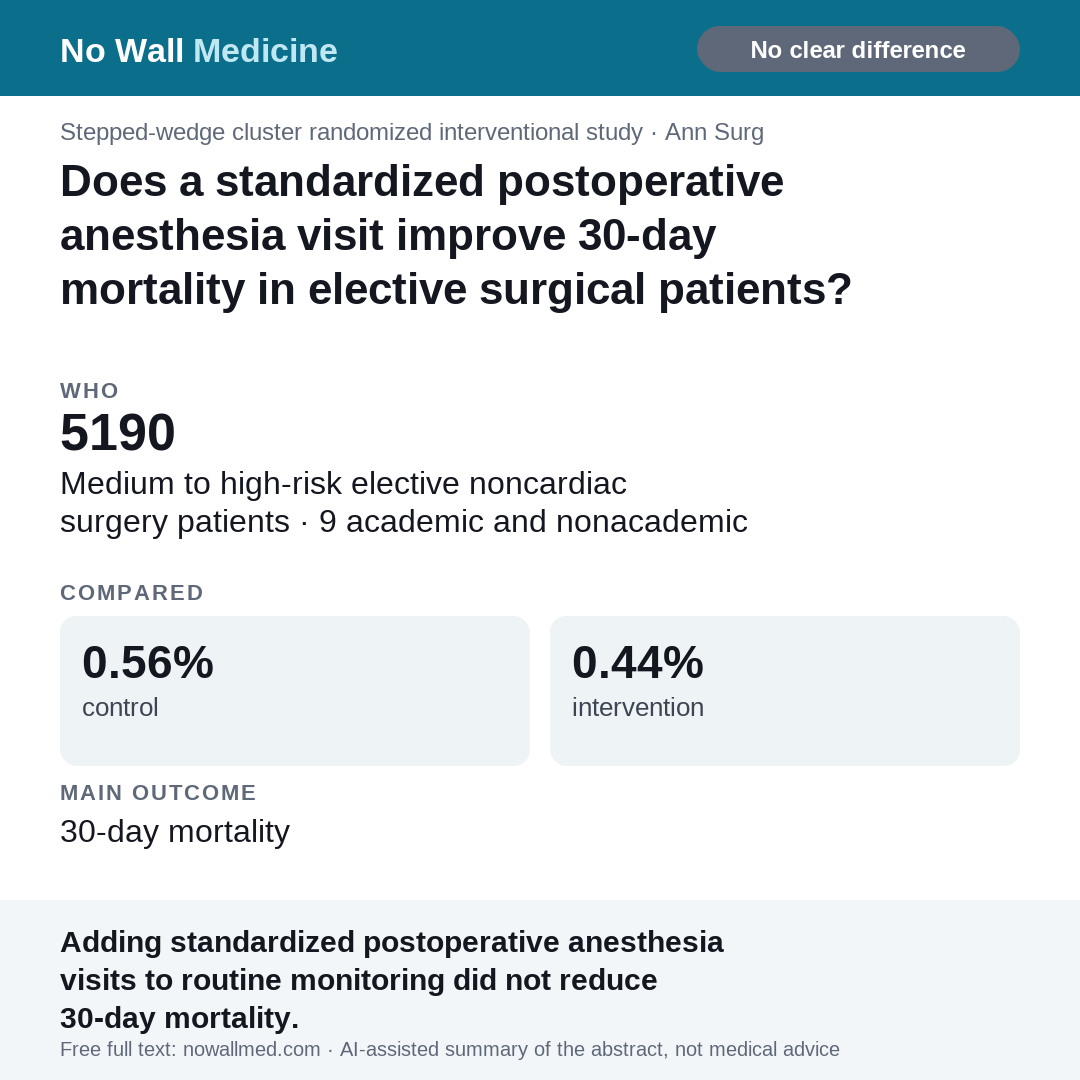
Does a standardized postoperative anesthesia visit improve 30-day mortality in elective surgical patients?
Who
5190
Medium to high-risk elective noncardiac surgery patients · 9 academic and nonacademic hospitals in the Netherlands
Compared
0.56%control (n = 14)
0.44%intervention (n = 12)
Main outcome
30-day mortality
Result: odds ratio 0.74, 95% Confidence interval 0.34-1.62
Bottom line: Adding standardized postoperative anesthesia visits to routine monitoring did not reduce 30-day mortality.
Ann Surg · 2021-05-24Download image
Clinical question: Does a standardized postoperative anesthesia visit improve 30-day mortality in elective surgical patients?
Why it matters: It is unknown if adding anesthesia expertise to routine vital sign monitoring systems can better identify early patient deterioration and improve outcomes.
Key points
- Researchers studied 5190 patients undergoing elective noncardiac surgery across 9 hospitals to see if adding anesthesia visits to routine vital sign monitoring changed outcomes.
- The 30-day mortality rate was 0.56% (n = 14) in the control group and 0.44% (n = 12) in the intervention group, which was not a statistically significant difference.
- Renal complications were higher in the control group at 1.7% (n = 41) compared to 1.0% (n = 27) in the intervention group.
Headline and key points written with AI from the paper’s abstract, with every number checked against it. Read the paper before relying on them.
Was this summary helpful?
Subject terms
Cite this article
TRACE Study Investigators. Routine Postsurgical Anesthesia Visit to Improve 30-day Morbidity and Mortality: A Multicenter, Stepped-wedge Cluster Randomized Interventional Study (The TRACE Study). Ann Surg. 2021. doi:10.1097/SLA.0000000000004954
Spotted a mistake? Suggest a correction
Top studies every Monday
The week’s key trials and guidelines in your specialties, plus any topics you follow. By email, free.
Get the weekly digest