Routine protamine administration increases hemostasis success and reduces complications after aortic valve implantation
Routine Protamine Administration for Bleeding in Transcatheter Aortic Valve Implantation: The ACE-PROTAVI Randomized Clinical Trial
Double-blind, placebo-controlled randomized clinical trialBenefit found
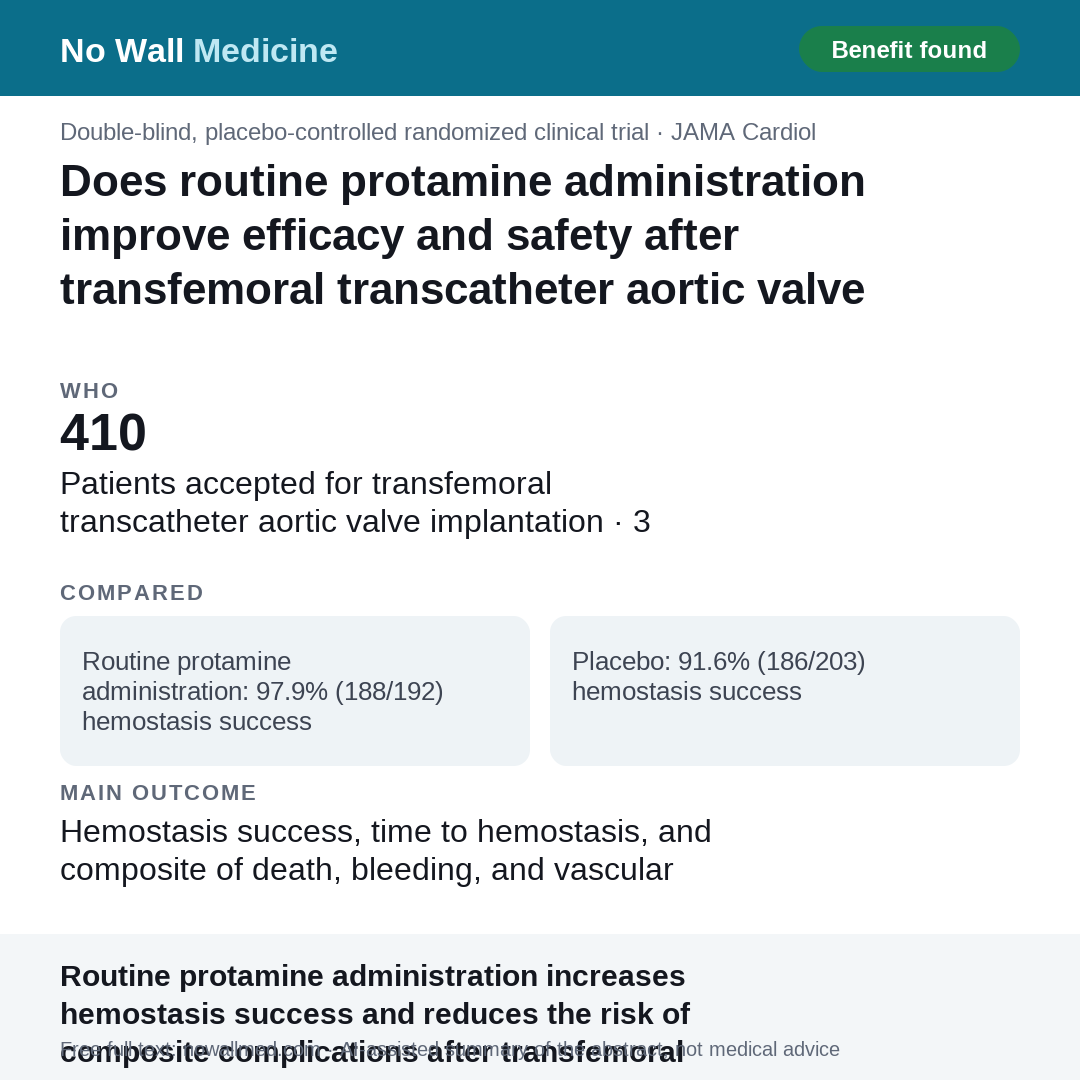
Does routine protamine administration improve efficacy and safety after transfemoral transcatheter aortic valve implantation?
Who
410
Patients accepted for transfemoral transcatheter aortic valve implantation · 3 Australian hospitals
Compared
Routine protamine administration: 97.9% (188/192) hemostasis success
Placebo: 91.6% (186/203) hemostasis success
Main outcome
Hemostasis success, time to hemostasis, and composite of death, bleeding, and vascular complications
Result: OR, 0.37 (95% CI, 0.1-0.8)
Bottom line: Routine protamine administration increases hemostasis success and reduces the risk of composite complications after transfemoral transcatheter aortic valve implantation.
JAMA Cardiol · 2024-08-14Download image
Clinical question: Does routine protamine administration improve efficacy and safety after transfemoral transcatheter aortic valve implantation?
Why it matters: It was unknown if routine reversal of anticoagulation with protamine after transfemoral transcatheter aortic valve implantation could reduce vascular complications.
Key points
- Researchers conducted a randomized trial with 410 patients receiving either routine protamine or a placebo after transfemoral transcatheter aortic valve implantation.
- Protamine administration resulted in a 97.9% hemostasis success rate compared to 91.6% for placebo and a shorter median time to hemostasis of 181 seconds versus 279 seconds.
- The composite outcome of death, bleeding, or vascular complications occurred in 5.2% of the protamine group compared to 12.8% in the placebo group.
Headline and key points written with AI from the paper’s abstract, with every number checked against it. Read the paper before relying on them.
Topics
Cite this article
Vriesendorp PA, Nanayakkara S, Heuts S, Ball J, Chandrasekar J, Dick R. Routine Protamine Administration for Bleeding in Transcatheter Aortic Valve Implantation: The ACE-PROTAVI Randomized Clinical Trial. JAMA Cardiol. 2024. doi:10.1001/jamacardio.2024.2454
Spotted a mistake? Suggest a correction
Top studies every Monday
The week’s key trials and guidelines in your specialties, plus any topics you follow. By email, free.
Get the weekly digest