Roxadustat did not significantly increase transfusion independence in patients with lower-risk myelodysplastic syndrome
Roxadustat versus placebo for patients with lower-risk myelodysplastic syndrome: MATTERHORN phase 3, double-blind, randomized controlled trial
Randomized, double-blind, phase 3 trialNo clear difference
Is roxadustat effective compared to placebo for transfusion-dependent lower-risk myelodysplastic syndromes?
Who
140
Transfusion-dependent, lower-risk myelodysplastic syndromes/neoplasms patients
Compared
roxadustat: 38/80 (47.5%)
placebo: 19/57 (33.3%)
Main outcome
transfusion independence for 56 days or more within 28 weeks
Bottom line: Roxadustat did not significantly improve transfusion independence compared to placebo in lower-risk myelodysplastic syndromes.
Limitation: The trial was terminated because interim analysis outcomes did not meet statistical significance.
Am J Hematol · 2024-06-17Download image
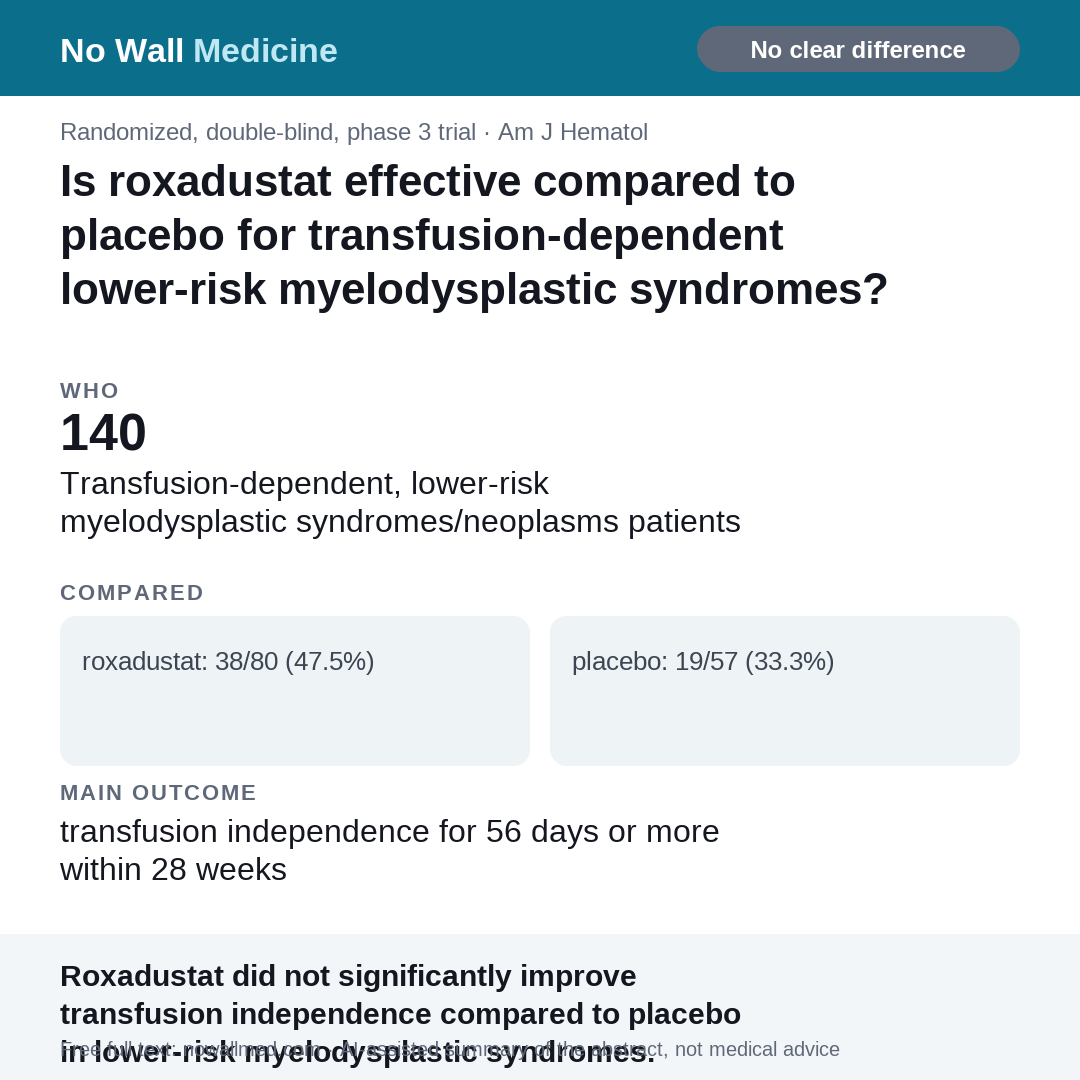
Clinical question: Is roxadustat effective compared to placebo for transfusion-dependent lower-risk myelodysplastic syndromes?
Why it matters: Response to first-line therapy for patients with lower-risk myelodysplastic syndromes is often limited and does not last long.
Key points
- The MATTERHORN phase 3 trial enrolled 140 patients with transfusion-dependent, lower-risk myelodysplastic syndrome (a group of blood cancers) and compared roxadustat to a placebo.
- Transfusion independence, meaning no need for red blood cell transfusions for at least 56 days, was achieved by 47.5% of the roxadustat group and 33.3% of the placebo group.
- The study was terminated because the primary result did not meet statistical significance, though a higher rate of transfusion independence was seen in patients requiring 2 or more red blood cell units every 4 weeks.
Limitation the authors note: The trial was terminated because interim analysis outcomes did not meet statistical significance.
Headline and key points written with AI from the paper’s abstract, with every number checked against it. Read the paper before relying on them.
Topics
Cite this article
Mittelman M, Henry DH, Glaspy JA, Tombak A, Harrup R, Kim I. Roxadustat versus placebo for patients with lower-risk myelodysplastic syndrome: MATTERHORN phase 3, double-blind, randomized controlled trial. Am J Hematol. 2024. doi:10.1002/ajh.27410
Spotted a mistake? Suggest a correction
Top studies every Monday
The week’s key trials and guidelines in your specialties, plus any topics you follow. By email, free.
Get the weekly digest