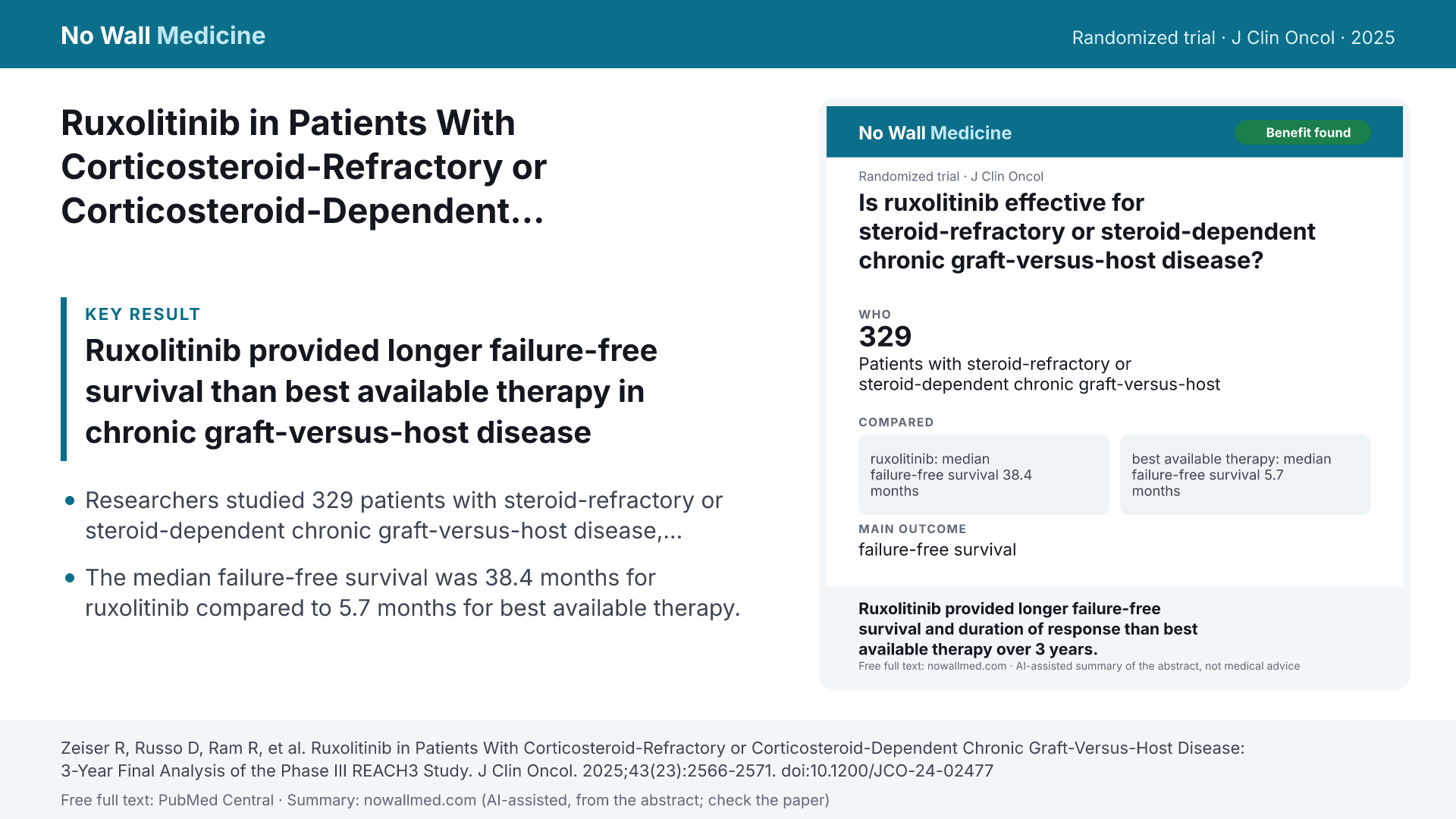
Ruxolitinib provided longer failure-free survival than best available therapy in chronic graft-versus-host disease
Ruxolitinib in Patients With Corticosteroid-Refractory or Corticosteroid-Dependent Chronic Graft-Versus-Host Disease: 3-Year Final Analysis of the Phase III REACH3 Study
Randomized trialBenefit found
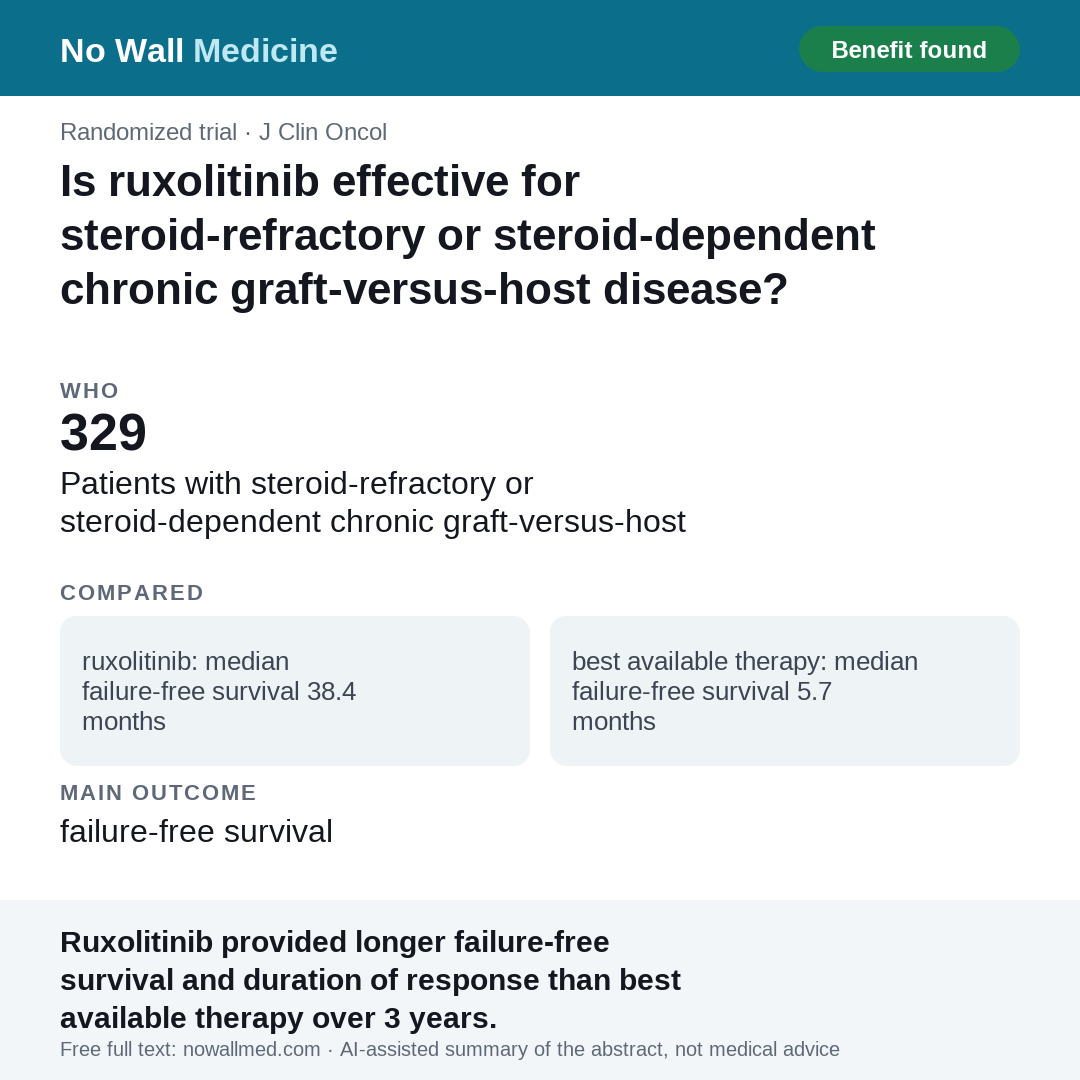
Is ruxolitinib effective for steroid-refractory or steroid-dependent chronic graft-versus-host disease?
Who
329
Patients with steroid-refractory or steroid-dependent chronic graft-versus-host disease
Compared
ruxolitinib: median failure-free survival 38.4 months
best available therapy: median failure-free survival 5.7 months
Main outcome
failure-free survival
Result: hazard ratio 0.36 (95% CI 0.27 to 0.49)
Bottom line: Ruxolitinib provided longer failure-free survival and duration of response than best available therapy over 3 years.
J Clin Oncol · 2025-06-25Download image
Clinical question: Is ruxolitinib effective for steroid-refractory or steroid-dependent chronic graft-versus-host disease?
Why it matters: Clinicians need to know the long-term efficacy and safety of ruxolitinib for patients with chronic graft-versus-host disease who do not respond well to corticosteroids.
Key points
- Researchers studied 329 patients with steroid-refractory or steroid-dependent chronic graft-versus-host disease, comparing ruxolitinib to best available therapy.
- The median failure-free survival was 38.4 months for ruxolitinib compared to 5.7 months for best available therapy.
- At 36 months, the probability of failure-free survival was 56.5% for ruxolitinib and 18.2% for best available therapy.
Headline and key points written with AI from the paper’s abstract, with every number checked against it. Read the paper before relying on them.
Was this summary helpful?
Subject terms
Cite this article
Zeiser R, Russo D, Ram R, et al. Ruxolitinib in Patients With Corticosteroid-Refractory or Corticosteroid-Dependent Chronic Graft-Versus-Host Disease: 3-Year Final Analysis of the Phase III REACH3 Study. J Clin Oncol. 2025. doi:10.1200/JCO-24-02477
Spotted a mistake? Suggest a correction