Text message video interventions did not significantly change primary safe sleep practices among low-income families
Safe Sleep Video Intervention via Text Messaging to Low-Income Families: The SMARTER Randomized Clinical Trial
Unblinded 4-group randomized clinical trialNo clear difference
Does text-delivered video intervention improve safe sleep practices among low-income families?
Who
1790
Pregnant mothers participating in Special Supplemental Nutrition Program for Women, Infants, and Children · WIC and Federally Qualified Health Centers in 18 states
Compared
Prenatal and postnatal intervention
Prenatal intervention alone
Postnatal intervention alone
Control
Main outcome
Maternal report of four infant sleep practices
Bottom line: Text-delivered video interventions did not significantly improve primary safe sleep practice outcomes among low-income families.
JAMA · 2026-07-23Download image
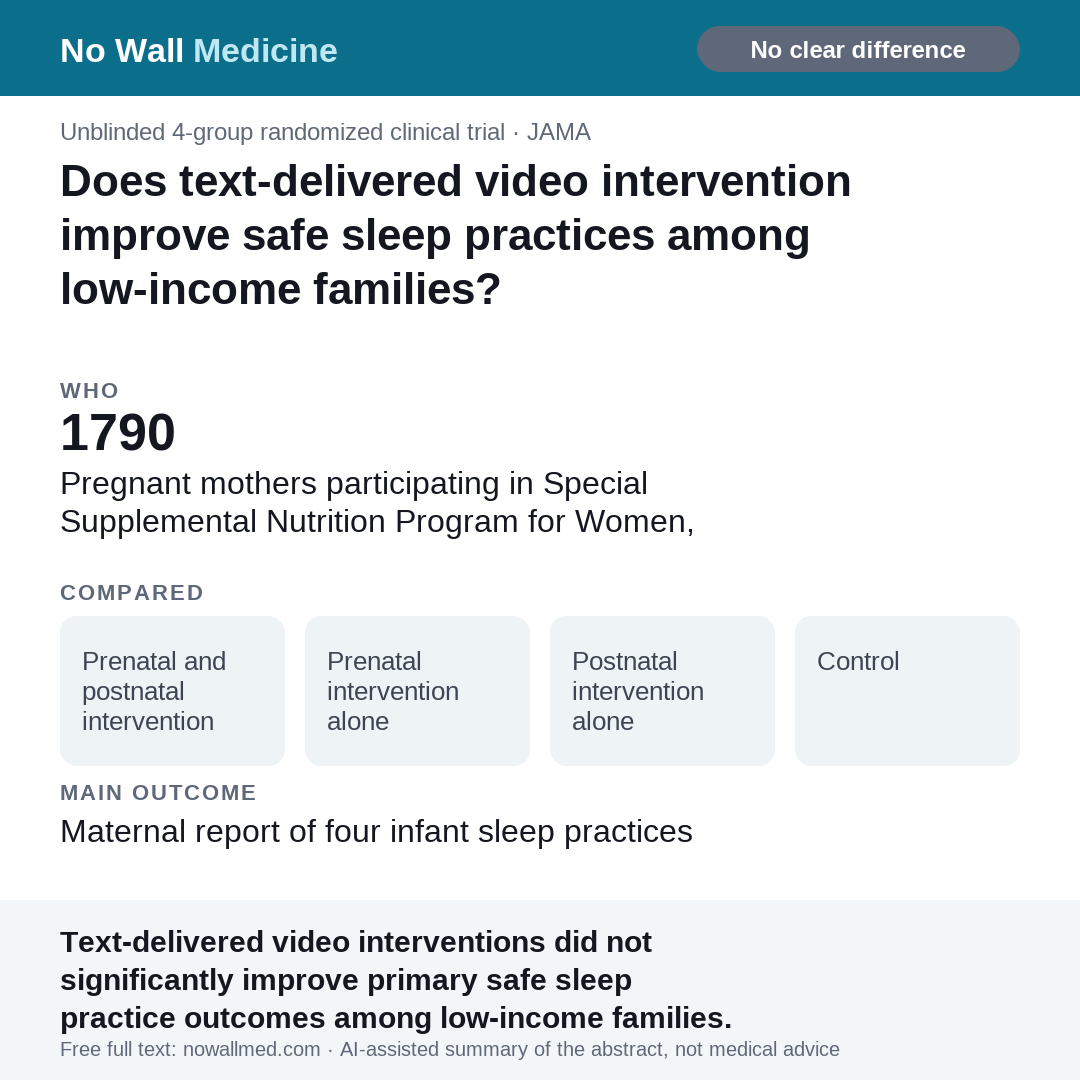
Clinical question: Does text-delivered video intervention improve safe sleep practices among low-income families?
Why it matters: Adherence to safe sleep practices remains low in the United States, particularly among low-income families.
Key points
- Researchers studied 1,790 participants receiving WIC benefits to compare text-delivered safe sleep videos against breastfeeding videos.
- There were no significant differences among the four groups for the primary outcomes of infant sleep position, room sharing, bedding use, or pacifier use.
- Among secondary outcomes, exclusive supine sleep position at 60 days was higher in the prenatal intervention group compared to controls (70.6% vs 60.9%).
Headline and key points written with AI from the paper’s abstract, with every number checked against it. Read the paper before relying on them.
Topics
Cite this article
Moon RY, Colson ER, Hauck FR, Kellams AL, Parker MG, Kerr SM. Safe Sleep Video Intervention via Text Messaging to Low-Income Families: The SMARTER Randomized Clinical Trial. JAMA. 2026. doi:10.1001/jama.2026.9119
Spotted a mistake? Suggest a correction